Have you ever heard someone say “thumb in” or “thumb out” and felt unsure what they meant? These phrases might seem simple, but their meaning changes depending on context if it’s driving, sports, hitchhiking, or even hand positioning.
In this easy guide, we’ll break down thumb in vs thumb out, explain what each means in different situations, give clear examples, and help you use them correctly with confidence.
Quick Answer
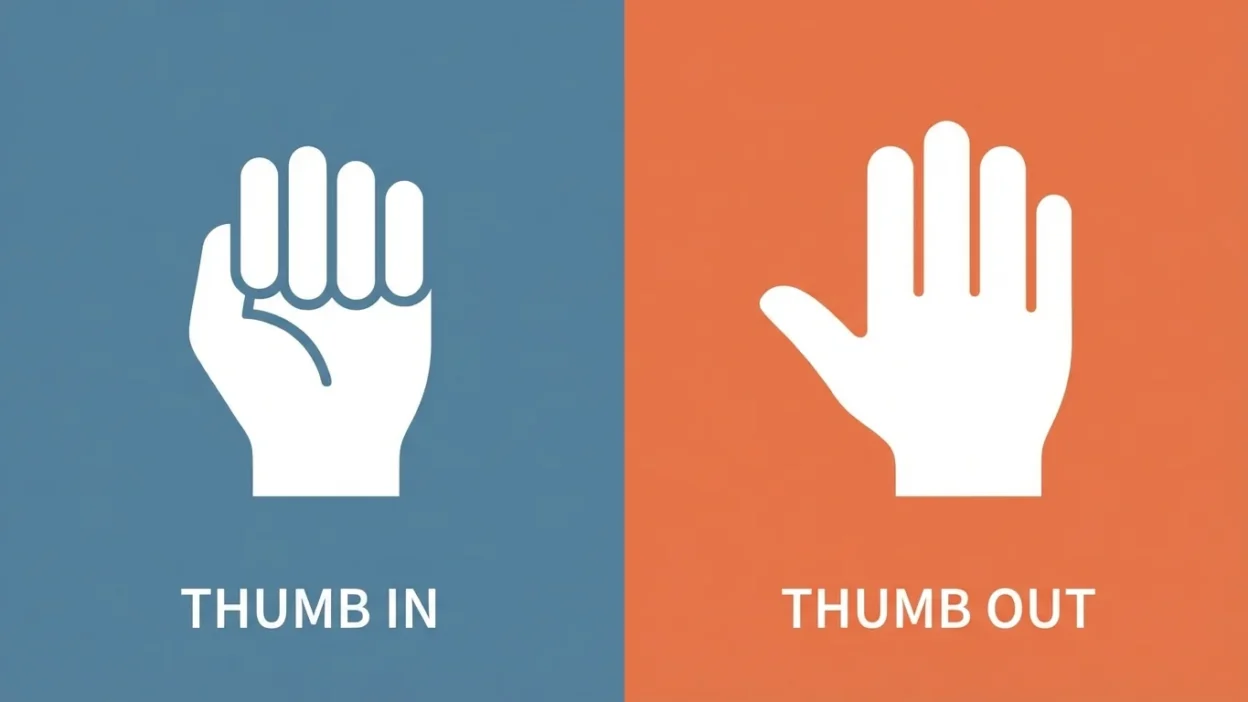
- ✅ Thumb in = thumb positioned inward (toward the palm or body)
- ✅ Thumb out = thumb positioned outward (away from the hand or body)
👉 Simple rule:
- Facing inward → thumb in
- Facing outward → thumb out
What Does “Thumb In” Mean?
Thumb in refers to positioning your thumb inward either tucked into your hand or pointing toward your body.
Common Meanings of “Thumb In”
- Thumb tucked into a fist
- Thumb pointing inward toward the body
- A more controlled or closed hand position
Example Situations
- In boxing: keeping the thumb in for safety
- While making a fist: thumb placed inside or alongside fingers
- In certain exercises: thumb in grip for stability
Example Sentences
- Keep your thumb in when making a fist.
- He held his hand with the thumb in for better control.
👉 Tone: Instructional, physical positioning
What Does “Thumb Out” Mean?
Thumb out refers to positioning your thumb outward away from your palm or body.
Common Meanings of “Thumb Out”
- Thumb extended away from the hand
- Used for signaling or gestures
- Open or relaxed hand position
Example Situations
- Hitchhiking: thumb out to signal for a ride
- Gestures: thumbs-up sign
- Sports or activities requiring grip flexibility
Example Sentences
- She stood by the road with her thumb out.
- Keep your thumb out for better balance in this move.
👉 Tone: Visual, gesture based, open positioning
Thumb In vs Thumb Out: Key Differences
The main difference is direction and purpose.
Comparison Table: Thumb In vs Thumb Out
| Feature | Thumb In | Thumb Out |
|---|---|---|
| Direction | Inward toward palm/body | Outward away from hand/body |
| Hand Position | Closed or controlled | Open or extended |
| Common Contexts | Fist, safety, grip | Gestures, hitchhiking, signals |
| Example | Thumb inside fist | Thumb extended outward |
When Should You Use “Thumb In”?
Use thumb in when describing a closed or inward hand position.
Best Situations for “Thumb In”
- Making a fist
- Safety instructions (sports, boxing)
- Controlled grip techniques
Examples
- “Keep your thumb in while punching.”
- “Hold the object with your thumb in for stability.”
👉 Think of thumb in as safe and controlled.
When Should You Use “Thumb Out”?
Use thumb out when describing an outward or extended thumb position.
Best Situations for “Thumb Out”
- Gestures (like thumbs-up)
- Hitchhiking
- Open-hand positions
Examples
- “He waited by the road with his thumb out.”
- “Extend your thumb out during the exercise.”
👉 Think of thumb out as open and visible.
Common Mistakes to Avoid
1. Confusing Direction
❌ Saying “thumb out” when the thumb is tucked in
✔ Match the direction correctly
2. Ignoring Context
These phrases depend heavily on situation:
- Sports → safety matters
- Gestures → communication matters
3. Using Them Without Clarity
Always make sure the reader understands the position being described.
Helpful Tip to Remember
👉 Thumb in = inward, closed
👉 Thumb out = outward, open
Memory trick:
- In = inside
- Out = outside
Real Life Examples
Thumb In
- “The coach reminded players to keep their thumb in.”
- “She held her hand tightly with the thumb in.”
Thumb Out
- “He signaled for help with his thumb out.”
- “The gesture requires your thumb out.”
Synonyms and Related Phrases
For Thumb In
- Tucked thumb
- Closed grip
- Inward position
For Thumb Out
- Extended thumb
- Open grip
- Outward position
👉 These can help add clarity in descriptive writing.
Thumb In vs Thumb Out in American and British English
- Both phrases are used similarly in American and British English
- No spelling differences
- Meaning depends entirely on context, not region
FAQs
1. Are thumb in and thumb out opposites?
Yes, they describe opposite thumb positions one inward and one outward.
2. Which is safer when making a fist?
Generally, keeping your thumb in (properly placed) is safer to avoid injury.
3. What does thumb out mean in hitchhiking?
It means extending your thumb outward to signal for a ride.
4. Are these phrases formal or informal?
They are neutral and used in both instructional and casual contexts.
5. Can they be used figuratively?
Mostly they are used literally to describe physical positioning.
6. Do they have different meanings in different countries?
No, the meaning is consistent worldwide.
7. Which is more common?
It depends on context both are equally common in their respective uses.
Summary
Understanding thumb in vs thumb out is all about direction and context. Thumb in refers to an inward or tucked position, often used for control and safety, while thumb out describes an outward or extended position, commonly used for gestures or signals.
Even though the difference is simple, using the correct phrase helps your instructions and descriptions become clearer and more accurate.
Actionable Takeaway
Next time you describe hand position, remember:
👉 Thumb in = inward, controlled
👉 Thumb out = outward, open
A quick visual check of direction will help you choose the right phrase every time.