If you’ve been researching Alphabet stock, you’ve probably noticed two nearly identical ticker symbols: GOOG and GOOGL. This often creates confusion among new and experienced investors alike. After all, both represent shares of the same parent company, yet they trade separately on the stock market.
Understanding the difference between GOOG vs GOOGL is important before investing because the two share classes come with different voting rights. While their price performance is usually very similar, the distinction can matter depending on your investment goals. In this guide, you’ll learn what GOOG and GOOGL are, their key differences, historical background, voting rights, performance comparisons, and which one may be the better choice for your portfolio.
Quick Answer
- GOOG = Alphabet Class C shares with no voting rights.
- GOOGL = Alphabet Class A shares with voting rights.
For most retail investors:
- Performance is usually very similar.
- GOOGL provides voting rights.
- GOOG sometimes trades at a slightly different price.
What Are GOOG and GOOGL?
Both GOOG and GOOGL are shares of Alphabet Inc., the parent company of Google.
Alphabet owns businesses including:
- Google Search
- YouTube
- Android
- Google Cloud
- Waymo
- DeepMind
Although both tickers represent ownership in Alphabet, they belong to different share classes.
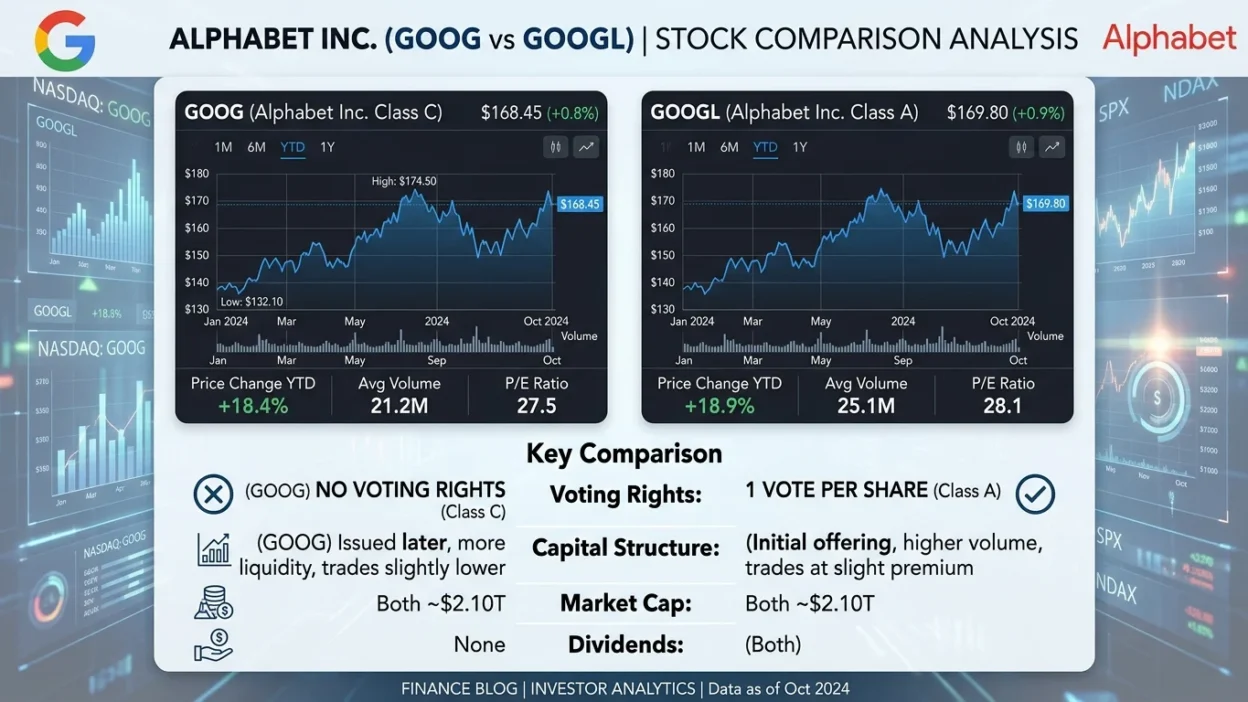
GOOG vs GOOGL Comparison Table
| Feature | GOOG | GOOGL |
|---|---|---|
| Share Class | Class C | Class A |
| Voting Rights | None | Yes |
| Ownership in Alphabet | Yes | Yes |
| Dividend | None | None |
| Stock Performance | Similar | Similar |
| Retail Investor Popularity | High | High |
Why Does Alphabet Have Two Stock Tickers?
In 2014, Alphabet created a new share structure.
The goal was to allow the company’s founders and insiders to maintain long term control while still raising capital through public markets.
Today, Alphabet primarily has:
Class A Shares (GOOGL)
These shares include voting rights.
Investors can vote on certain corporate matters such as:
- Board elections
- Shareholder proposals
- Corporate governance issues
Class C Shares (GOOG)
These shares have no voting rights.
Investors still participate in the economic performance of Alphabet but cannot vote on company matters.
What Are Voting Rights?
Voting rights allow shareholders to influence certain company decisions.
For example, shareholders may vote on:
- Board members
- Executive compensation proposals
- Corporate governance changes
However, Alphabet’s founders maintain significant control through special voting structures, meaning individual retail investors generally have limited influence regardless of whether they own GOOG or GOOGL.
Which Stock Performs Better?
Historically, GOOG and GOOGL tend to move almost identically because both represent ownership in the same business.
Why Prices Sometimes Differ
Price differences may occur because:
- Investor demand varies
- Institutional buying patterns differ
- Voting rights carry perceived value
Most of the time, the gap between the two share classes remains relatively small.
Advantages of GOOG
Potentially Slightly Lower Price
GOOG occasionally trades at a small discount compared to GOOGL.
Same Economic Exposure
Investors still benefit from Alphabet’s growth, profits, and market performance.
Simpler Choice for Passive Investors
If voting rights are not important to you, GOOG may be sufficient.
Advantages of GOOGL
Voting Rights
Investors receive shareholder voting privileges.
Preferred by Some Institutions
Certain institutional investors prefer shares with voting rights.
Additional Shareholder Participation
Although influence may be limited, investors still retain formal voting ability.
GOOG vs GOOGL for Long Term Investors
For many long term investors, the difference is relatively minor.
Questions to consider:
Do You Care About Voting Rights?
- Yes → Consider GOOGL.
- No → GOOG may work just as well.
Are You Focused on Alphabet’s Growth?
Both share classes generally provide similar exposure to:
- Search advertising
- YouTube revenue
- Artificial intelligence initiatives
- Cloud computing growth
Alphabet’s Business Strength
Many investors choose Alphabet because of its strong position in:
Digital Advertising
Google remains one of the world’s largest advertising platforms.
Cloud Computing
Google Cloud continues expanding in the enterprise technology market.
Artificial Intelligence
Alphabet invests heavily in AI through initiatives such as:
- Gemini
- DeepMind
- Search AI features
YouTube
YouTube remains one of the largest online video platforms globally.
Common Mistakes Investors Make
Mistake 1: Assuming GOOG and GOOGL Are Different Companies
Both represent the same company: Alphabet.
Mistake 2: Ignoring Voting Rights
Many investors purchase shares without understanding the distinction.
Mistake 3: Overestimating the Importance of Voting Power
Retail investors rarely influence major corporate decisions due to Alphabet’s ownership structure.
Mistake 4: Focusing Only on Ticker Symbols
The underlying business fundamentals often matter far more than the ticker choice.
GOOG vs GOOGL: Which Should You Buy?
Choose GOOG If
- You do not care about voting rights.
- It trades at a lower price.
- You want exposure to Alphabet’s business performance.
Choose GOOGL If
- Voting rights matter to you.
- You prefer owning the voting share class.
- The price difference is minimal.
For many investors, either choice provides nearly identical exposure to Alphabet’s long term growth.
FAQs
1. What is the difference between GOOG and GOOGL?
GOOG shares have no voting rights, while GOOGL shares include voting rights.
2. Are GOOG and GOOGL the same company?
Yes. Both represent ownership in Alphabet Inc.
3. Which stock is cheaper?
The price difference varies and may change daily.
4. Does GOOG pay dividends?
No. Alphabet currently does not pay regular dividends on these share classes.
5. Is GOOGL better than GOOG?
Not necessarily. The main advantage is voting rights.
6. Do both stocks move together?
Generally, yes. Their performance is usually very similar.
7. Why did Alphabet create two share classes?
To maintain founder control while continuing to access public markets.
8. Which stock do most retail investors choose?
Both are popular, and many investors choose based on pricing and voting preferences.
Final Summary
The debate around GOOG vs GOOGL comes down primarily to voting rights. GOOGL shares provide voting power, while GOOG shares do not. Beyond that distinction, both share classes offer investors exposure to the same underlying company, Alphabet Inc., and their long term performance is typically very similar.
For most investors, the decision is straightforward. If voting rights matter, GOOGL may be the preferred option. If you simply want exposure to Alphabet’s business and growth potential, GOOG can be an equally effective choice. Understanding this difference helps ensure you buy the share class that aligns with your investment goals.
Actionable Takeaway
Before purchasing Alphabet stock, ask yourself:
- Do I want shareholder voting rights? → Choose GOOGL.
- Do I only care about investment performance? → Compare prices and consider GOOG.
Either way, focus on Alphabet’s business fundamentals, long term growth prospects, and overall fit within your investment strategy.