
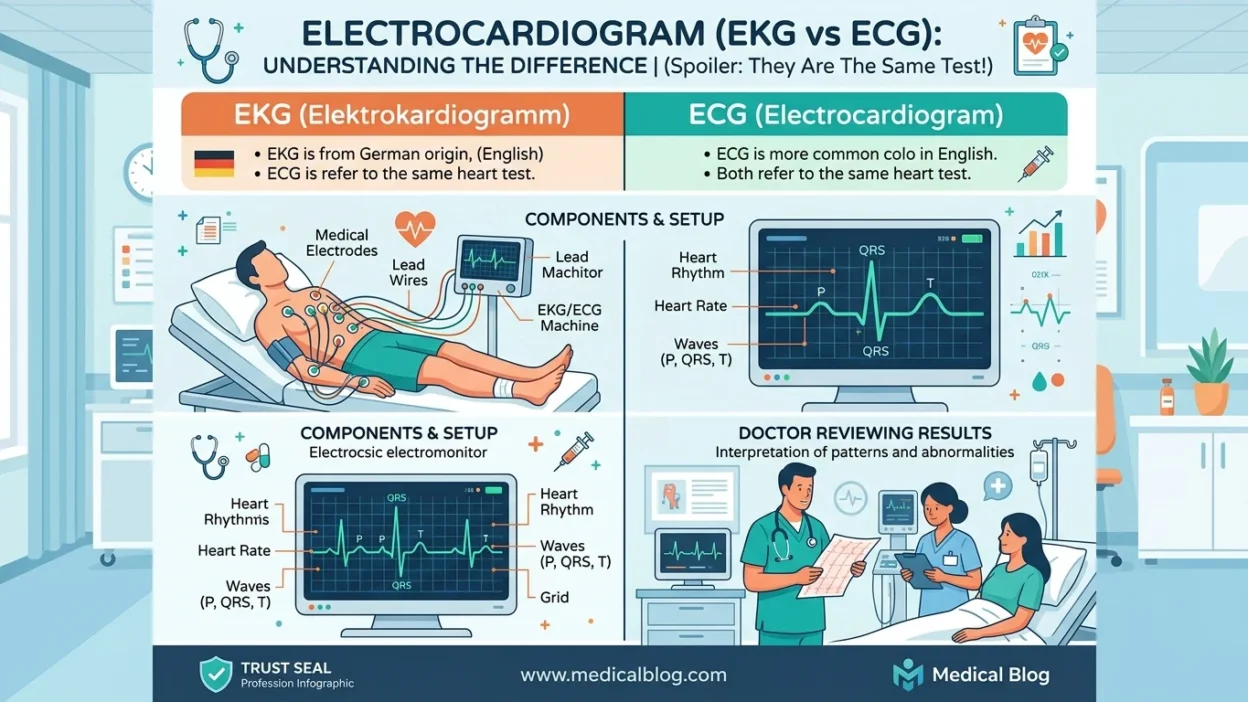
If you’ve ever had a heart test performed, you may have heard the terms EKG and ECG used interchangeably. This often leads to confusion, especially for patients who wonder whether they are different procedures or measure different aspects of heart health.
The good news is that EKG and ECG are the same test. The difference is simply in the abbreviation. Both terms refer to a test that records the electrical activity of the heart and helps healthcare professionals detect various heart conditions. In this guide, you’ll learn the meaning of EKG and ECG, why two names exist, how the test works, what it detects, and common misconceptions.
Quick Answer
- EKG and ECG are the same medical test.
- Both stand for electrocardiogram.
- ECG comes from the English spelling.
- EKG comes from the German spelling Elektrokardiogramm.
In practice, there is no difference in the test itself.
What Is an ECG?
An electrocardiogram (ECG) is a medical test that records the electrical signals produced by the heart.
It helps healthcare providers evaluate:
- Heart rhythm
- Heart rate
- Electrical conduction
- Signs of heart disease
- Evidence of previous heart damage
How an ECG Works
Small adhesive electrodes are placed on the skin.
These sensors detect electrical impulses generated by the heart and create a graph showing heart activity.
What Is an EKG?
EKG refers to exactly the same test.
The abbreviation comes from the German word:
Elektrokardiogramm
Because the German spelling starts with “K,” the abbreviation became EKG.
Many hospitals, clinics, and healthcare professionals continue to use EKG, especially in the United States.
EKG vs ECG Comparison Table
| Feature | EKG | ECG |
|---|---|---|
| Test Type | Electrocardiogram | Electrocardiogram |
| Purpose | Heart electrical activity | Heart electrical activity |
| Procedure | Same | Same |
| Equipment | Same | Same |
| Results | Same | Same |
| Medical Meaning | Same | Same |
Why Are There Two Names?
The history of the electrocardiogram explains the two abbreviations.
The technology was heavily influenced by European medical research, including work by Willem Einthoven, who played a major role in developing modern electrocardiography.
Over time:
- English speaking countries adopted ECG
- Many healthcare settings continued using EKG
Today, both terms remain accepted.
What Does an EKG or ECG Measure?
The test measures the heart’s electrical activity.
Each heartbeat is triggered by electrical signals that coordinate the heart muscle.
An ECG records:
- Heart rate
- Heart rhythm
- Timing of electrical signals
- Strength of electrical impulses
Conditions an ECG Can Help Detect
An electrocardiogram may help identify:
Irregular Heart Rhythms
Also called arrhythmias.
Examples include:
- Fast heart rhythms
- Slow heart rhythms
- Irregular rhythms
Heart Attack
An ECG can help identify signs of:
- Current heart attacks
- Previous heart attacks
Electrical Conduction Problems
The test can reveal abnormalities in how electrical signals travel through the heart.
Enlarged Heart Chambers
Certain ECG patterns may suggest enlargement of parts of the heart.
What Happens During the Test?
The procedure is quick and painless.
Step 1
Electrodes are attached to the chest, arms, and legs.
Step 2
You remain still while the machine records heart activity.
Step 3
The machine produces a tracing showing electrical patterns.
Most standard ECGs take only a few minutes.
Is an ECG Painful?
No.
The test is completely noninvasive.
You may feel:
- Mild coolness from the electrode pads
- Slight discomfort when adhesive pads are removed
The test itself causes no pain.
Types of ECG Tests
Resting ECG
Performed while lying still.
Stress ECG
Conducted during exercise or physical activity.
Holter Monitor
A portable ECG device worn for extended monitoring.
Event Monitor
Records heart activity when symptoms occur.
Understanding ECG Waves
A standard electrocardiogram produces several wave patterns.
P Wave
Represents activity in the upper chambers of the heart.
QRS Complex
Represents electrical activity in the lower chambers.
T Wave
Represents recovery of the heart muscle after contraction.
Healthcare professionals analyze these patterns to evaluate heart function.
Common Mistakes People Make
Mistake 1: Thinking EKG and ECG Are Different Tests
They are exactly the same test.
Mistake 2: Assuming a Normal ECG Guarantees Perfect Heart Health
An ECG is valuable but cannot detect every possible heart condition.
Mistake 3: Confusing ECG With Echocardiogram
An ECG measures electrical activity.
An Echocardiogram uses ultrasound to create images of the heart.
Mistake 4: Worrying About Pain
The test is generally painless and very safe.
EKG vs ECG in American and British English
United States
Many hospitals and clinics commonly use:
- EKG
United Kingdom and Many Other Countries
Healthcare professionals more commonly use:
- ECG
Despite the naming difference, the procedure remains identical.
Who Might Need an ECG?
A healthcare provider may recommend an ECG if you experience:
- Chest pain
- Heart palpitations
- Shortness of breath
- Dizziness
- Fainting episodes
It may also be used during routine medical evaluations.
FAQs
1. What is the difference between EKG and ECG?
There is no medical difference. Both terms refer to the same electrocardiogram test.
2. Why do doctors say EKG instead of ECG?
EKG comes from the German word Elektrokardiogramm and remains widely used in some healthcare settings.
3. Is an EKG painful?
No. The procedure is painless and noninvasive.
4. How long does an ECG take?
A standard ECG usually takes only a few minutes.
5. Can an ECG detect a heart attack?
Yes. It can help identify signs of current or previous heart attacks.
6. What does an ECG measure?
It records the electrical activity of the heart.
7. Is EKG more accurate than ECG?
No. They are exactly the same test.
8. Who should get an ECG?
People with certain symptoms or risk factors may be advised by a healthcare professional to have one.
Final Summary
The debate over EKG vs ECG is actually much simpler than many people expect. Both terms describe the same electrocardiogram test used to measure the heart’s electrical activity. The only real difference is the abbreviation itself. ECG comes from English terminology, while EKG comes from the German spelling that influenced early medical practice.
Whether your healthcare provider says EKG or ECG, the procedure, equipment, purpose, and results are the same. Understanding this distinction can help reduce confusion and make medical conversations easier to follow.
Actionable Takeaway
If you hear either term during a medical appointment:
- ECG = Electrocardiogram
- EKG = Electrocardiogram
They are the same heart test. Focus on understanding your results and discussing any concerns with your healthcare provider rather than worrying about the name used.