
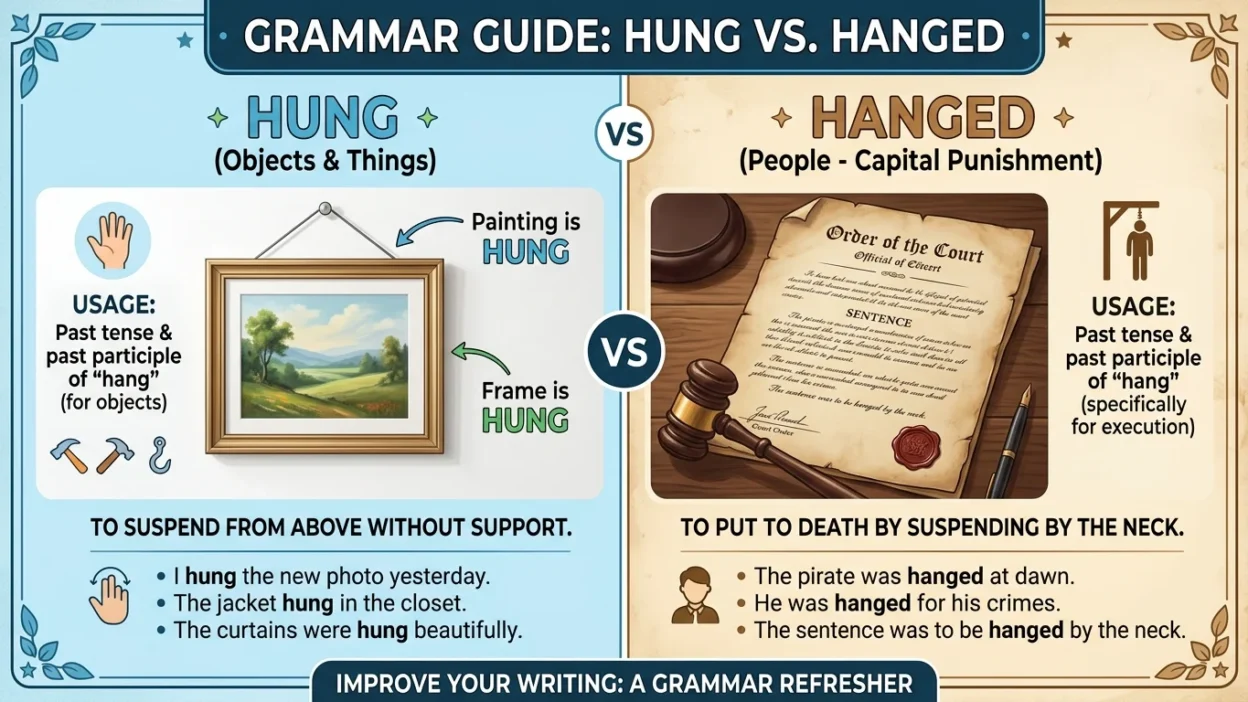
The confusion between hung vs hanged is one of the most common grammar mistakes in English. Since both words come from the verb hang, many people assume they can be used interchangeably. However, traditional English grammar treats them differently depending on the context.
If you’ve ever wondered whether a picture was “hung” on a wall or “hanged” on a wall, you’re not alone. Understanding the distinction can make your writing more accurate and professional. In this guide, you’ll learn the meanings of hung and hanged, when to use each one, examples, common mistakes, and easy memory tricks.
Quick Answer
- Hung is used for most meanings of hang, such as suspending objects.
- Hanged is traditionally used only when referring to execution by hanging.
Examples:
- “She hung the painting on the wall.” ✅
- “The criminal was hanged.” ✅
What Does Hung Mean?
Hung is the standard past tense and past participle of hang in most situations.
It refers to placing, suspending, or attaching something so that it hangs from above.
Common Uses of Hung
- Hanging pictures
- Hanging clothes
- Hanging decorations
- Hanging lights
- Hanging curtains
Examples of Hung in Sentences
- “They hung a mirror in the hallway.”
- “She hung her coat by the door.”
- “Christmas lights were hung across the street.”
- “The artist hung his paintings in the gallery.”
What Does Hanged Mean?
Hanged is traditionally reserved for the act of execution by hanging.
It refers to a person being put to death using a rope around the neck.
Examples of Hanged in Sentences
- “The prisoner was hanged for treason.”
- “Several people were hanged during that period of history.”
- “The convicted criminal was hanged.”
In modern writing, this special usage remains the standard grammatical rule.
Hung vs Hanged Comparison Table
| Feature | Hung | Hanged |
|---|---|---|
| Main Meaning | Suspended or attached | Executed by hanging |
| Common Usage | Everyday situations | Legal or historical executions |
| Frequency | Very common | Rare |
| Example | Hung a picture | Hanged a criminal |
Why Are There Two Forms?
Historically, English developed separate past tense forms for different meanings of hang.
Over time:
- Hung became the standard form for ordinary uses.
- Hanged remained associated with judicial executions.
This distinction has survived into modern English.
When to Use Hung
Use hung whenever you’re talking about objects or non execution situations.
Examples
- “He hung the banner outside.”
- “The dress was hung in the closet.”
- “They hung lanterns around the garden.”
- “A clock hung on the wall.”
Easy Rule
If no execution is involved, use hung.
When to Use Hanged
Use hanged only when referring to a person being executed by hanging.
Examples
- “The outlaw was hanged.”
- “The accused man was hanged after the trial.”
- “Historically, some prisoners were hanged for serious crimes.”
Easy Rule
If the meaning is execution, use hanged.
Common Mistakes People Make
Mistake 1: Using Hanged for Objects
❌ “The picture was hanged on the wall.”
✅ “The picture was hung on the wall.”
Mistake 2: Using Hung for Executions
❌ “The prisoner was hung.”
✅ “The prisoner was hanged.”
Traditional grammar prefers hanged in this context.
Mistake 3: Assuming Both Are Always Interchangeable
Although they come from the same verb, standard English treats them differently.
Side by Side Examples
Hung
- “She hung a painting.”
- “The jacket was hung neatly.”
- “They hung decorations for the party.”
Hanged
- “The criminal was hanged.”
- “The prisoner was hanged after conviction.”
- “The historical record states he was hanged.”
Memory Trick
A simple way to remember the difference:
Hung = Things
Think:
- Hung pictures
- Hung clothes
- Hung decorations
Hanged = Humans Executed
Think:
- Hanged criminals
- Hanged prisoners
This memory trick works in most situations.
Historical Use of Hanged
In older English, hanged appeared more frequently.
Today, it is mainly seen in:
- History books
- Legal discussions
- Historical fiction
- Academic writing
Outside these contexts, hung is far more common.
American vs British English
The distinction between hung and hanged is generally the same in both American and British English.
American English
- Hung for objects
- Hanged for executions
British English
- Hung for objects
- Hanged for executions
There is little difference between the two varieties of English on this rule.
Examples in Literature and History
Historical texts frequently use hanged because they often discuss punishments and legal systems.
Modern fiction and everyday writing use hung much more often because it applies to ordinary situations.
FAQs
1. What is the difference between hung and hanged?
Hung refers to suspending objects, while hanged refers to execution by hanging.
2. Is “the picture was hanged” correct?
No. A picture is hung, not hanged.
3. Is “the prisoner was hung” correct?
Traditional grammar says the prisoner was hanged.
4. Why does English have two forms?
Historical usage preserved a separate form for executions.
5. Which word is more common?
Hung is much more common in everyday English.
6. Is hanged still used today?
Yes, mainly in historical, legal, and academic contexts.
7. Do American and British English follow the same rule?
Yes. Both generally use hung for objects and hanged for executions.
8. Can I use hung for people?
Yes, if you simply mean suspended or positioned, not executed.
Example:
- “He hung upside down from the tree.”
Final Summary
Understanding hung vs hanged is easier once you know the key rule. Hung is the standard past tense and past participle for almost every meaning of hang, including pictures, clothes, decorations, and objects. Hanged is a special form traditionally reserved for executions by hanging.
While the distinction may seem small, using the correct word improves clarity and demonstrates strong grammar skills. Fortunately, the rule is simple and easy to remember once you practice it.
Actionable Takeaway
Before choosing between hung and hanged, ask yourself:
- Is an object being suspended? → Use hung.
- Is a person being executed by hanging? → Use hanged.
Following this simple guideline will help you use both words correctly every time.