
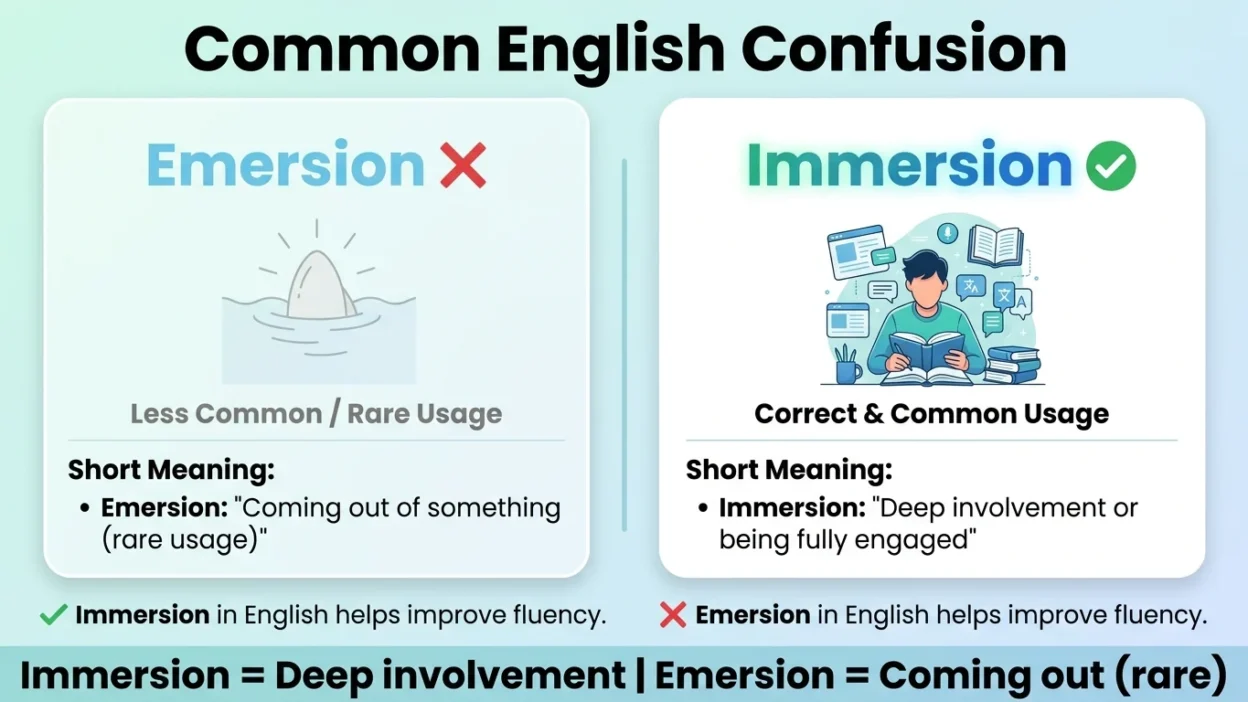
Many people are confused about emersion vs immersion because these words look similar and are valid in English with different meanings.
This understanding helps people use sentences correctly in communication whether in daily speaking or writing.
Even when talking about liquid ideas or real-life context learners often mix both terms but clear practice removes confusion.
Immersion usually means sinking plunging into water liquid or an activity or situation while emersion means coming out or rising back from something
The difference refers to direction of movement and helps you avoid mistakes by knowing when something goes out or goes in It also shows how means difficulties and a situation change depending on usage especially when we describe movement like diving or returning to surface.
A simple guide explains these simple terms with examples and tips to learn better In subjects like astronomy language learning and even baptism we see both ideas in daily life.
This helps learners improve writing speaking and communication by making ideas clearly and confidently understood instead of leading to confusion.
Quick Answer:
Immersion means being fully submerged or deeply involved in something (like water, learning, or experience).
Emersion means coming out of something, especially emerging from water or darkness.
In short:
- Immersion = going in / being inside / deeply involved
- Emersion = coming out / emerging / surfacing
What Does Immersion Mean?
Immersion is the more commonly used word in modern English. It has both literal and figurative meanings.
Literal meaning (physical)
Immersion refers to going completely under a liquid, usually water.
Example:
- The scientist studied fish behavior after full immersion in water.
- The baptism ceremony involves immersion in a river.
Figurative meaning (experience or learning)
Immersion also describes deep involvement in an activity, language, or environment.
Examples:
- She learned English through full immersion in an English-speaking country.
- Gaming provides total immersion in a virtual world.
- Students improve faster with immersion-based learning.
Related phrases:
- Language immersion
- Cultural immersion
- Immersive experience
- Total immersion learning
What Does Emersion Mean?
Emersion is less common in everyday speech but still important, especially in scientific, religious, and formal contexts.
Literal meaning (coming out of water or covering)
Emersion refers to the act of coming out of water, darkness, or something that was covering or hiding.
Examples:
- The diver’s emersion from the ocean was slow due to strong waves.
- The turtle’s emersion from the pond amazed the children.
Scientific meaning (astronomy)
In astronomy, emersion is used when a celestial body comes out of eclipse or shadow.
Example:
- The emersion of the moon from Earth’s shadow marked the end of the eclipse.
Related phrases:
- Partial emersion
- Full emersion
- Lunar emersion (astronomy context)
Key Difference Between Emersion vs Immersion
The easiest way to understand the difference is movement direction:
- Immersion = going into something (submerging or deep involvement)
- Emersion = coming out of something (emerging or resurfacing)
Both words are connected to movement, but in opposite directions.
Comparison Table: Emersion vs Immersion
| Feature | Immersion | Emersion |
| Basic meaning | Going into or being inside something | Coming out of something |
| Usage | Common in daily English | Rare, formal, scientific |
| Context | Water, learning, experience | Water, astronomy, emergence |
| Verb form idea | To immerse (to put in) | To emerge (to come out) |
| Frequency | Very high | Low |
| Example | Immersion in water or culture | Emersion from water or shadow |
Common Mistakes with Emersion vs Immersion
Many learners confuse these words because they sound similar. Here are the most common mistakes:
1. Using “emersion” instead of “immersion” in learning contexts
❌ Wrong: He improved English through emersion in Canada.
✔ Correct: He improved English through immersion in Canada.
2. Confusing physical movement direction
❌ Wrong: The fish was in emersion in the tank.
✔ Correct: The fish was in immersion in the tank.
3. Using both interchangeably
These words are NOT interchangeable. One means going in, the other means coming out.
4. Ignoring context in science writing
In astronomy or biology, using the wrong term can change the meaning completely.
American vs British English Usage
There is no major difference between American and British English in the spelling or meaning of emersion and immersion. Both dialects use:
- Immersion in the same way (very common in education and daily speech)
- Emersion in formal, scientific, or technical writing
However, one subtle difference is usage frequency:
- American English: “immersion learning” is extremely common in education systems
- British English: also uses “immersion,” especially in academic contexts, but may use slightly more formal phrasing in writing
Why Immersion Is More Common Than Emersion
In modern English, immersion dominates usage because it applies to many real-life situations:
- Language learning methods
- Technology (virtual reality immersion)
- Religious ceremonies
- Medical procedures (immersion therapy)
- Gaming and entertainment experiences
Meanwhile, emersion is niche, mostly limited to:
- Astronomy
- Biology
- Formal scientific descriptions
Simple Memory Trick to Remember
If you keep mixing them up, use this easy trick:
- Im = In → Immersion = going in
- E = Exit → Emersion = coming out
This mental shortcut works well for quick recall.
Real Life Examples to Understand Better
Here are practical sentences that make the difference clearer:
- The scuba diver experienced full immersion in the coral reef.
- After minutes underwater, the diver’s emersion was carefully monitored.
- Language immersion helps students think directly in English.
- The emersion of the sun after the eclipse was visible to astronomers.
- VR technology creates total immersion in digital environments.
FAQs
1. What is the main difference between emersion and immersion?
Immersion means going into something deeply, while emersion means coming out of something.
2. Is emersion a common English word?
No, emersion is rare and mostly used in scientific or formal contexts.
3. Can I use immersion for learning English?
Yes, “immersion learning” is one of the most effective language learning methods.
4. Is emersion the opposite of immersion?
Yes, emersion is generally considered the opposite of immersion in physical contexts.
5. Which word is more useful in daily English?
Immersion is far more useful and commonly used in everyday English.
6. Is immersion only related to water?
No, it can also describe deep involvement in activities, culture, or experiences.
7. What is immersion therapy?
It is a medical or psychological method where a person is exposed deeply to controlled environments for treatment or learning.
8. Why do people confuse emersion and immersion?
Because they look and sound similar, but their meanings are directionally opposite.
Summary
The difference between emersion vs immersion is simple once you understand the direction of action. Immersion means going into or being deeply involved in something, while emersion refers to coming out or emerging from it. Although both words are correct, immersion is far more commonly used in modern English.
If you remember one thing, let it be this: immersion pulls you in, emersion brings you out. This simple logic helps you avoid confusion in writing, exams, and everyday communication. With practice, you’ll naturally choose the right word without hesitation.