Have you ever wondered when to use “whether or not” and when simply “whether” is enough? This phrase appears frequently in everyday conversation, academic writing, and professional communication, but many writers are unsure when the extra words are necessary.
The good news is that the rule is fairly simple once you understand how the phrase works in a sentence.
In this guide, we’ll explain whether or not, show correct usage, provide examples, highlight common mistakes, and help you write more naturally and clearly.
Quick Answer
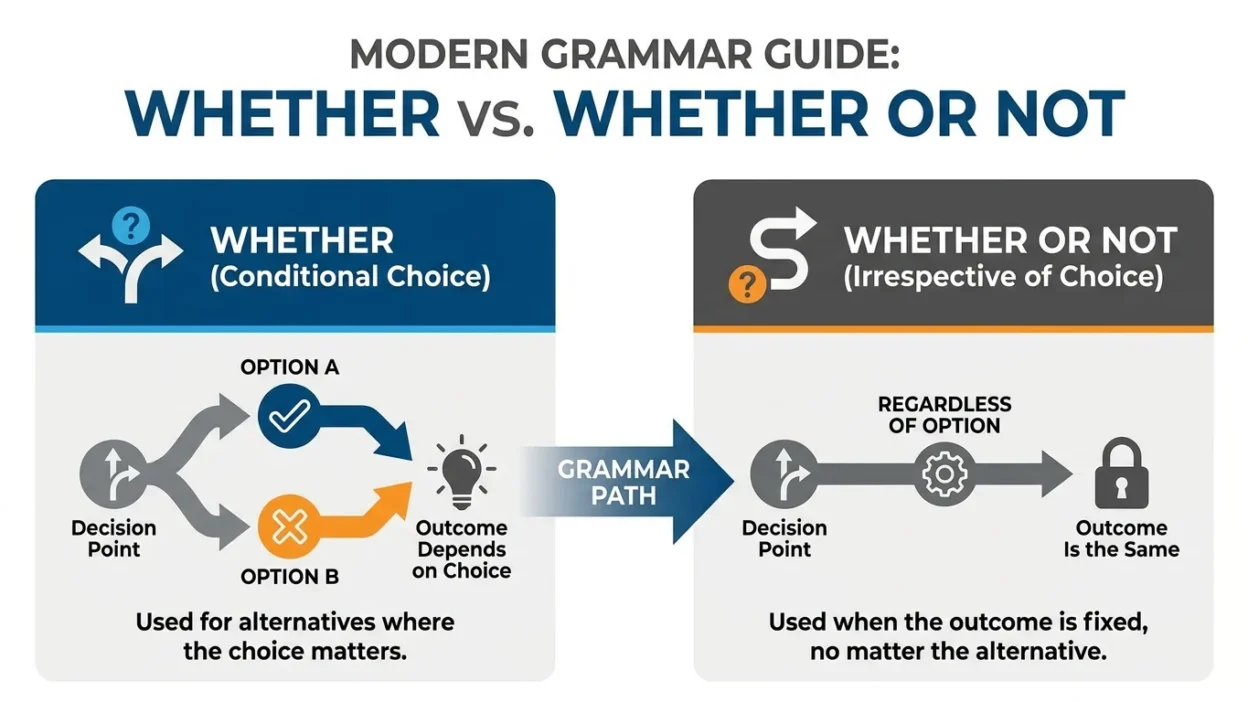
✅ Whether or not means “regardless of if” or “no matter if”
👉 Simple rule:
- Use whether or not when emphasizing both possibilities
- Sometimes whether alone is enough
What Does “Whether or Not” Mean?
The phrase whether or not introduces alternatives or uncertainty.
It usually means:
- Regardless of the outcome
- No matter which option is true
- If something happens or does not happen
Example Sentences
- I don’t know whether or not she will come.
- We must decide whether or not to continue.
- The event will happen whether or not it rains.
👉 The phrase often highlights two possible outcomes.
What Does “Whether” Mean by Itself?
Whether alone can often express the same idea.
Examples
- I don’t know whether she will come.
- She asked whether we were ready.
- They debated whether to leave early.
👉 In many sentences, “or not” is optional.
Whether vs Whether or Not: Key Differences
Comparison Table: Whether vs Whether or Not
| Feature | Whether | Whether or Not |
|---|---|---|
| Correct grammar | ✔ Yes | ✔ Yes |
| Shorter and cleaner | ✔ Yes | ✖ Longer |
| Emphasizes both outcomes | Sometimes | ✔ Strongly |
| Common in formal writing | ✔ Yes | ✔ Yes |
| Meaning | Similar | Similar |
When Should You Use “Whether or Not”?
Use whether or not when:
- You want extra emphasis
- Both possibilities matter equally
- The sentence means “regardless of outcome”
Examples
- We are going whether or not you join us.
- The results matter whether or not they are published.
- He must decide whether or not to apologize.
👉 Here, the phrase stresses both possibilities clearly.
When Is “Whether” Enough?
In many cases, the sentence works perfectly without “or not.”
Examples
- I wonder whether she called.
- They discussed whether to move.
- We haven’t decided whether it’s necessary.
👉 Shorter phrasing often sounds cleaner and more natural.
“Whether or Not” vs “If”
This is another common confusion.
Use Whether
When there are:
- Alternatives
- Choices
- Uncertainty between options
Use If
When expressing:
- Conditions
- Possibilities
Examples
✔ I don’t know whether he agrees.
✔ I’ll go if he agrees.
👉 Whether is usually better for alternatives or decisions.
Common Sentence Patterns
1. Whether or Not + Clause
- She asked whether or not we were ready.
- We will continue whether or not they approve.
2. Whether + Infinitive
- He couldn’t decide whether to stay.
- They debated whether to invest.
3. Whether or Not + Infinitive
- She must choose whether or not to participate.
Common Mistakes to Avoid
1. Using “If” Instead of “Whether”
❌ I don’t know if or not she’s coming
✔ I don’t know whether or not she’s coming
2. Adding “Or Not” Unnecessarily
Sometimes shorter writing sounds better.
❌ We discussed whether or not to possibly maybe leave
✔ We discussed whether to leave
3. Confusing “Whether” with “Weather”
- whether = choice or uncertainty
- weather = climate conditions
Helpful Tip to Remember
👉 Whether = choice or uncertainty
👉 Whether or not = emphasis on both possibilities
Memory trick:
- “Whether or not” often means “regardless”
More Examples in Context
Whether
- She wondered whether he was serious.
- We discussed whether to expand the business.
- I’m unsure whether that’s true.
Whether or Not
- The meeting will happen whether or not everyone attends.
- You should study whether or not the exam is difficult.
- He asked whether or not she accepted the offer.
Formal vs Informal Usage
Formal Writing
Both whether and whether or not are acceptable.
However:
- Concise writing often prefers whether alone
Informal Conversation
People frequently use whether or not for emphasis.
👉 Style and clarity matter more than strict rules.
Synonyms and Related Expressions
Depending on context, you can also use:
- Regardless of whether
- No matter if
- Irrespective of whether
- Either way
👉 These alternatives can vary the tone of your writing.
FAQs
1. Is “whether or not” grammatically correct?
Yes, it is completely correct.
2. Can I use just “whether” instead?
Often yes. Many sentences work without “or not.”
3. What does “whether or not” mean?
It means regardless of the outcome or possibility.
4. Is “whether or not” formal?
Yes, it works in both formal and informal writing.
5. Should I use “if” or “whether”?
Use whether for choices or uncertainty between alternatives.
6. Is “or not” always necessary?
No, sometimes it is optional and can be omitted for conciseness.
7. What is the difference between whether and weather?
Whether relates to choices or uncertainty, while weather refers to climate conditions.
Summary
Understanding whether or not becomes easier once you recognize its role in expressing alternatives or uncertainty. Whether alone is often enough, but adding “or not” emphasizes both possible outcomes more strongly.
Both forms are grammatically correct, and the best choice depends on clarity, tone, and sentence style. In many situations, shorter phrasing sounds cleaner, while “whether or not” adds emphasis and completeness.
Actionable Takeaway
Next time you write the phrase, remember:
👉 Whether = usually enough
👉 Whether or not = stronger emphasis on both possibilities
Choose the version that sounds clearest and most natural in your sentence.