Have you ever wondered whether you need a resume or a CV when applying for a job? Many people use the terms interchangeably, but they are not always the same thing.
The difference depends on:
- Country
- Industry
- Career level
- Purpose of the document
In some places, the terms mean almost identical things, while in others they refer to completely different job application documents.
In this guide, we’ll explain resume vs CV, show the key differences, provide examples, and help you understand which one you should use.
Quick Answer
In the United States and Canada
- Resume = short job application summary
- CV = detailed academic or professional document
In the UK, Europe, and many other countries
- CV often means the standard job application document
👉 Simple rule:
In the U.S., resumes and CVs are different.
In many other countries, “CV” is the general term for a resume.
What Is a Resume?
A resume is a concise document used for most job applications.
Main Features
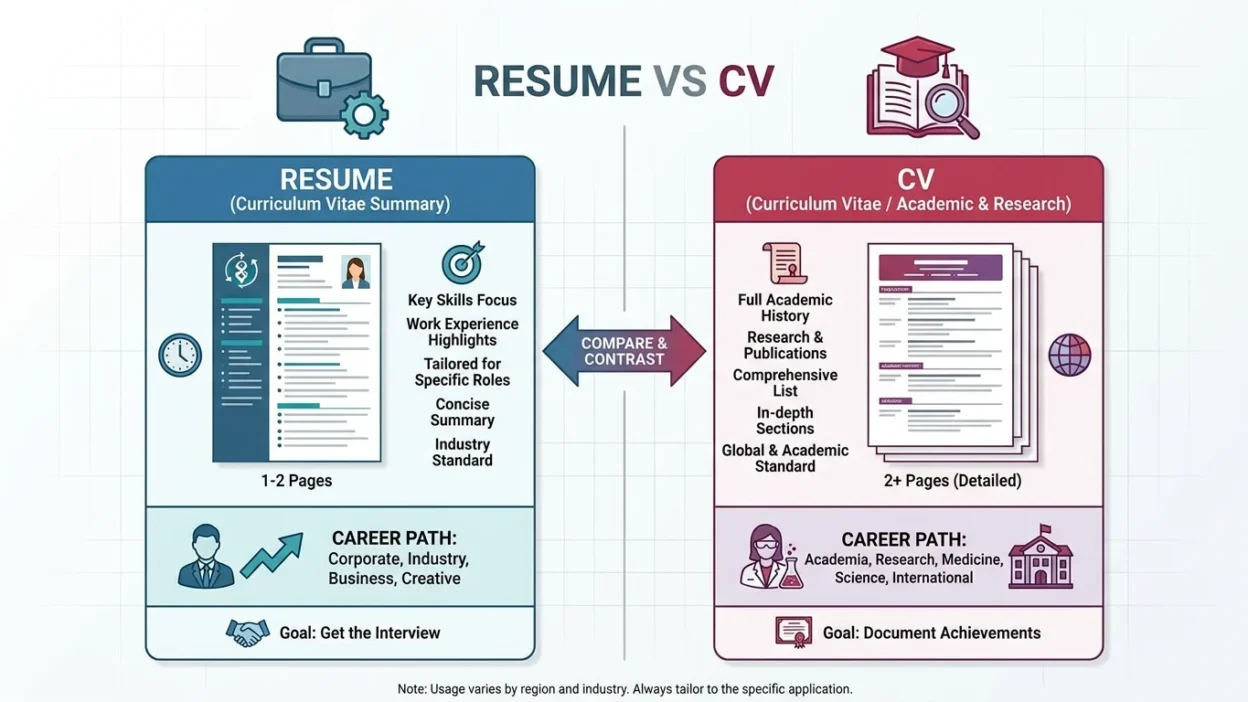
- Usually 1–2 pages
- Focused on skills and work experience
- Customized for each job
- Common in business and corporate hiring
Typical Resume Sections
- Contact information
- Professional summary
- Work experience
- Skills
- Education
Example
A marketing professional applying for a company job would usually submit a resume.
What Is a CV?
CV stands for:
- Curriculum Vitae
This is a Latin phrase meaning:
- “Course of life”
In the U.S.
A CV is:
- Longer
- More detailed
- Used mainly in academic, medical, or research fields
Typical CV Sections
- Education
- Research
- Publications
- Teaching experience
- Awards
- Certifications
- Conferences
- Academic achievements
Example
A university professor applying for a research position would typically use a CV.
Resume vs CV: Key Differences
Comparison Table: Resume vs CV
| Feature | Resume | CV |
|---|---|---|
| Length | 1–2 pages | Multiple pages |
| Detail level | Concise | Comprehensive |
| Main purpose | Most jobs | Academic/research careers |
| Customization | Tailored for each role | Often static and detailed |
| Common in U.S. business hiring | ✔ Yes | ✖ Usually no |
| Academic focus | Limited | Strong |
Resume vs CV by Country
United States and Canada
- Resume = standard job application
- CV = academic/research document
United Kingdom and Europe
- CV often means the regular job application document
- Resume is used less frequently
Australia, New Zealand, South Asia
- CV is commonly used for most jobs
👉 Regional differences are extremely important.
When Should You Use a Resume?
Use a resume when:
- Applying for corporate jobs
- Applying in business fields
- Applying in technology, sales, marketing, or management
- The employer specifically requests a resume
Examples
- Software engineer applications
- Retail positions
- Office jobs
- Business careers
When Should You Use a CV?
Use a CV when:
- Applying for academic jobs
- Applying for research positions
- Applying in medicine or science
- Seeking grants or fellowships
- The employer specifically requests a CV
Examples
- University lecturer applications
- Research scientist positions
- Medical residency applications
Common Mistakes to Avoid
1. Sending the Wrong Document Type
Always check whether the employer asks for:
- Resume
- CV
2. Making a Resume Too Long
Resumes should usually stay concise.
3. Leaving Important Academic Details Out of a CV
CVs are expected to be detailed and comprehensive.
4. Ignoring Regional Expectations
The meaning of CV changes depending on country.
Helpful Tip to Remember
👉 Resume = brief summary
👉 CV = complete career history
Memory trick:
- Resume sounds like “summary”
- CV is usually more comprehensive
More Examples in Context
Resume
- She submitted her resume for the marketing role.
- The recruiter reviewed hundreds of resumes.
- His resume highlighted leadership experience.
CV
- The professor updated her CV.
- Academic publications were listed on the CV.
- The university requested a detailed CV.
Resume vs CV in Academic Careers
Resume
Usually too short for:
- Research careers
- Academia
- Scientific positions
CV
Expected for:
- Professorships
- Fellowships
- Research grants
- Graduate academic work
👉 Academic employers often expect detailed credentials.
Resume vs CV Formatting Style
Resume Style
- Concise
- Achievement focused
- Tailored to job description
CV Style
- Comprehensive
- Chronological
- Documentation focused
👉 The structure and purpose are different.
FAQs
1. What is the difference between a resume and a CV?
A resume is shorter and job focused, while a CV is longer and more detailed.
2. Which is used in the United States?
Most jobs use resumes. CVs are mainly for academia and research.
3. Is a CV longer than a resume?
Yes, usually much longer.
4. Can a resume be two pages?
Yes, especially for experienced professionals.
5. What does CV stand for?
Curriculum Vitae.
6. Which is better for academic jobs?
A CV is usually required.
7. Are resume and CV the same in every country?
No, the meanings vary by region.
Summary
Understanding resume vs CV is simple once you know the regional and professional differences. A resume is typically a short, customized document used for most professional jobs, especially in the United States. A CV is usually a longer, more detailed document focused on academic, research, or specialized professional achievements.
In many countries outside the U.S., however, the term CV may simply refer to the standard job application document. Knowing your audience and industry is the key to choosing the correct format.
Actionable Takeaway
Next time you apply for a job, remember:
👉 Resume = short professional summary
👉 CV = detailed academic or career history
Always check the employer’s requirements and regional expectations before submitting your application.