
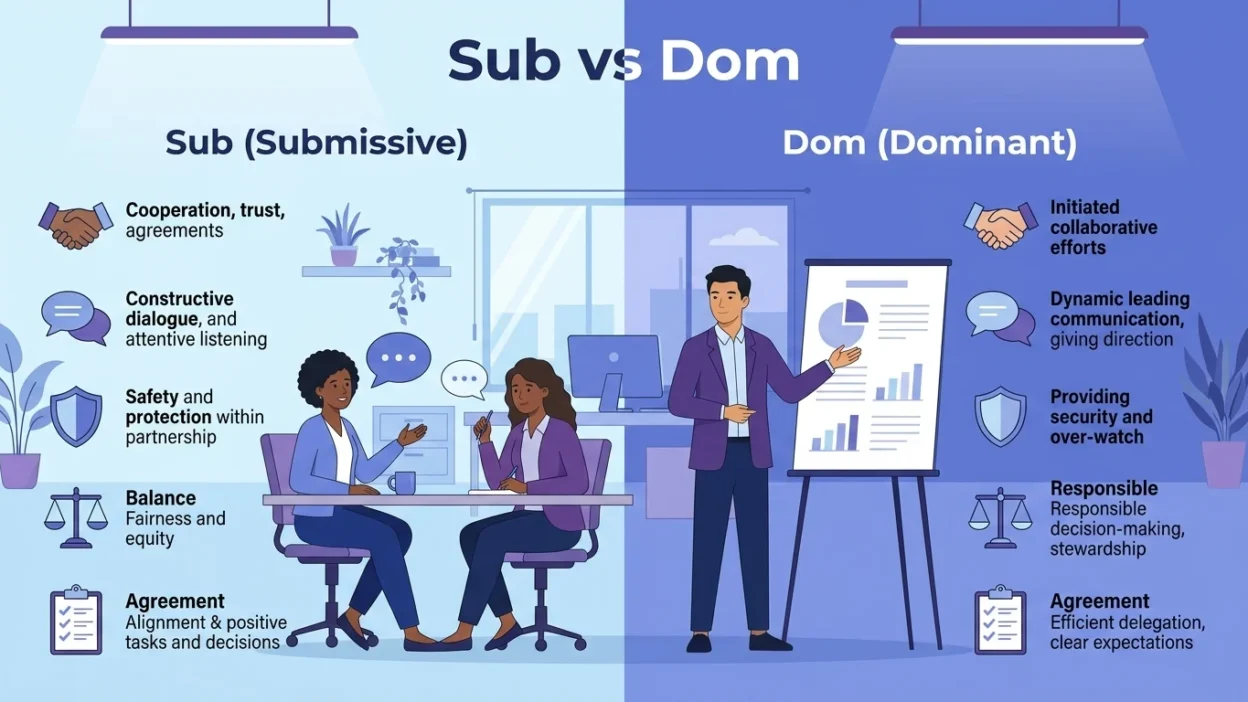
The terms sub and dom are commonly used in BDSM and power-exchange relationships. While they are often portrayed in popular culture, their actual meanings are based on consensual roles involving authority, control, trust, and communication between adults. Understanding sub vs dom can help clarify these roles and dispel common misconceptions.
A submissive (sub) and a dominant (dom) may participate in a relationship, scene, or activity where one person voluntarily gives up a degree of control while the other takes on leadership or authority. These roles vary widely from person to person, and there is no single “correct” way to be a sub or a dom.
Quick Answer
- Sub (Submissive): A person who consensually gives up some control, follows agreed-upon rules, or takes a more yielding role.
- Dom (Dominant): A person who consensually takes charge, leads, directs, or exercises authority within agreed boundaries.
The key element is mutual consent and communication.
What Does “Sub” Mean?
A submissive, often shortened to sub, is someone who enjoys taking a more yielding, obedient, or responsive role in a power-exchange dynamic.
Being a sub does not mean being weak or lacking independence. Many submissives are highly confident individuals who enjoy voluntarily giving control within specific situations or relationships.
Common Traits of a Sub
- Enjoys following agreed instructions
- Values trust and guidance
- Appreciates structure or rules
- Finds satisfaction in pleasing a partner
- Communicates personal limits and boundaries
Example
A sub may agree to let their partner choose activities during a planned BDSM scene, while still maintaining the right to stop at any time.
What Does “Dom” Mean?
A dominant, often shortened to dom, is someone who enjoys taking a leadership or authority role within a consensual dynamic.
A dom is responsible for respecting boundaries, communicating clearly, and ensuring the well-being of everyone involved.
Common Traits of a Dom
- Enjoys leading or directing
- Takes responsibility seriously
- Values communication and trust
- Sets expectations within agreed limits
- Focuses on mutual enjoyment and safety
Example
A dom may plan a scene, establish rules, and guide activities while respecting the sub’s agreed boundaries.
Sub vs Dom: Key Differences
| Feature | Sub | Dom |
|---|---|---|
| Role | Follows or yields | Leads or directs |
| Authority | Gives up some control | Takes on some control |
| Responsibility | Communicates limits and consent | Ensures safety and respects limits |
| Focus | Following agreed dynamics | Guiding agreed dynamics |
| Decision-Making | Often follows established rules | Often establishes or enforces rules |
| Power Exchange | Receives direction | Provides direction |
Neither role is inherently superior to the other. Both contribute equally to the dynamic.
The Importance of Consent
Consent is the foundation of any healthy BDSM relationship or activity.
Key principles include:
- Clear communication
- Mutual agreement
- Respect for boundaries
- Ability to withdraw consent
- Ongoing discussion and feedback
A sub and dom should discuss expectations before participating in any activity.
Common Types of Dominants
Traditional Dom
Takes a leadership role during scenes or specific activities.
Soft Dom
Uses guidance, encouragement, and gentle authority.
Strict Dom
Prefers structured rules and higher levels of discipline within agreed boundaries.
Service Dom
Focuses on leading in ways that benefit both partners.
Common Types of Submissives
Service Sub
Enjoys helping or serving a partner.
Brat
May playfully challenge a dominant within agreed dynamics.
Bottom
Receives actions during a scene but may not necessarily participate in a power-exchange relationship.
Passive Sub
Prefers following direction without actively challenging authority.
Common Misconceptions
Dominants Have All the Power
In reality, submissives often hold significant power because they establish boundaries and consent to the dynamic.
Submissives Are Weak
Submissives are not inherently weak. Submission is a voluntary choice, not a personality flaw.
Every BDSM Relationship Is the Same
Every dynamic is unique. Some are casual, while others involve long-term agreements.
Being a Dom Means Being Controlling Everywhere
Many dominants only take that role in specific contexts and have entirely different personalities in daily life.
How to Know Which Role Fits You
Consider questions such as:
- Do you enjoy leading or following?
- Are you more comfortable giving direction or receiving it?
- Do you prefer structure or creating structure?
- What aspects of power exchange appeal to you?
Many people discover their preferences through communication, education, and experience.
Switches: When You’re Both
Not everyone identifies exclusively as a sub or a dom.
A switch is someone who enjoys both dominant and submissive roles depending on the situation, partner, or mood.
Switches may:
- Dominate one partner
- Submit to another partner
- Alternate roles with the same partner
American vs British English
The terms sub and dom are widely used in both American and British English BDSM communities.
There are no major spelling or meaning differences between the two varieties of English.
Frequently Asked Questions
Can someone be both a sub and a dom?
Yes. A person who enjoys both roles is commonly called a switch.
Is a sub the same as a bottom?
Not always. A bottom receives actions during a scene, while a sub participates in a power-exchange dynamic. Sometimes a person can be both.
Is a dom always in control?
A dom exercises agreed authority within established boundaries. Consent and communication remain essential.
Do submissives make decisions?
Yes. Submissives decide what activities, limits, and dynamics they are comfortable with.
Are sub and dom relationships always sexual?
No. Some dynamics are romantic, emotional, lifestyle-based, or focused on power exchange rather than sexual activity.
What is the most important part of a sub/dom relationship?
Trust, communication, consent, and mutual respect.
Can roles change over time?
Yes. People’s preferences and comfort levels may evolve.
Is one role better than the other?
No. Neither role is inherently better. Both are equally important to a healthy dynamic.
Summary
Understanding sub vs dom begins with recognizing that both roles are based on mutual consent, trust, communication, and respect. A sub voluntarily takes a more yielding role, while a dom voluntarily takes a leadership role within agreed boundaries. The dynamic works best when both individuals communicate openly and prioritize each other’s well-being.
There is no universal way to be a sub or a dom. Some people strongly identify with one role, while others enjoy both as switches. The healthiest dynamics are built on honesty, clear expectations, and ongoing consent rather than stereotypes or assumptions.
Actionable Takeaway
If you’re exploring sub/dom dynamics, focus first on learning about consent, communication, boundaries, and trust. Understanding these foundations is far more important than fitting into any specific label.