Have you ever seen the words payer and payor in contracts, insurance documents, healthcare forms, or financial agreements and wondered whether they mean the same thing? You’re not alone. The comparison of payer vs payor often causes confusion because both terms refer to the party responsible for making a payment.
The good news is that the difference is mostly about spelling and industry preference rather than meaning. In most situations, both words can be used to describe a person, business, insurer, or organization that pays money to another party. This guide explains the meaning of each term, when to use them, common mistakes to avoid, and which spelling is generally preferred.
Quick Answer
Payer and payor have the same meaning: the person or entity that makes a payment.
- Payer is the more common spelling in everyday English.
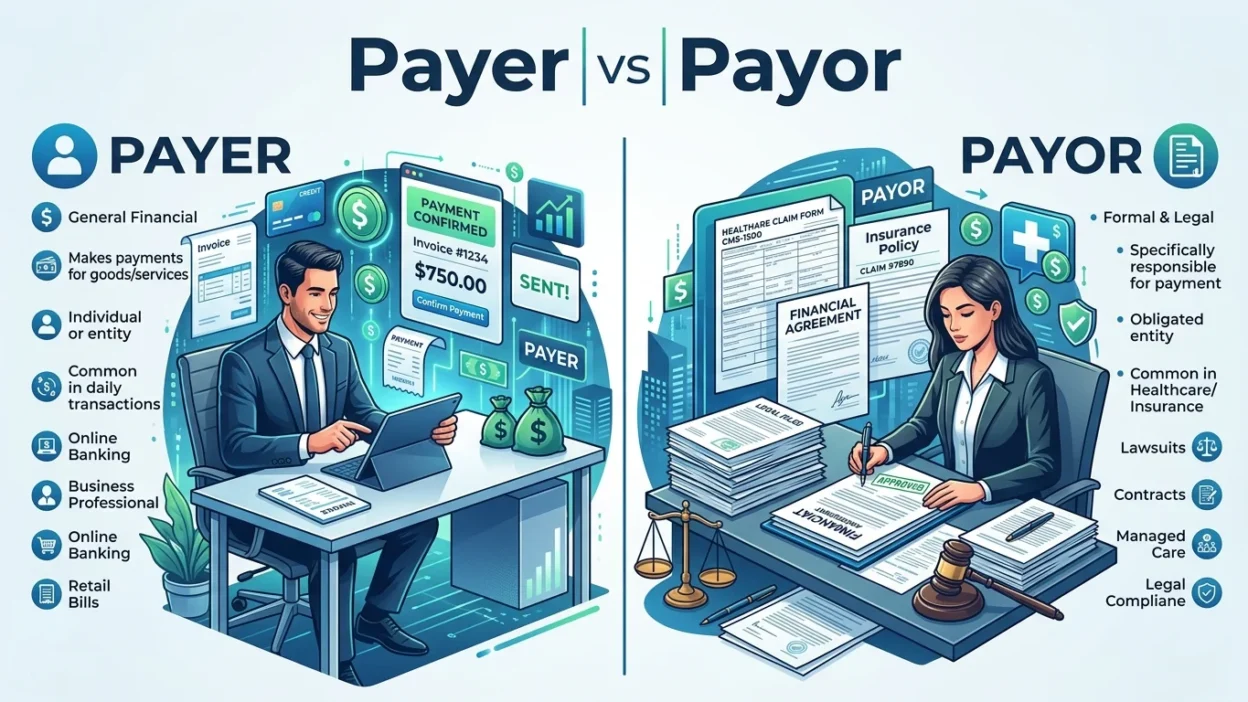
- Payor is often used in legal, healthcare, insurance, and financial documents.
- For most general writing, payer is the preferred choice.
What Does Payer Mean?
A payer is a person, company, government agency, or organization that sends money to another party in exchange for goods, services, obligations, or benefits.
The term follows standard English spelling conventions and is widely used in business, banking, accounting, and everyday communication.
Examples of Payer
- A customer paying for a product.
- A tenant paying monthly rent.
- An employer paying employee salaries.
- A business paying an invoice.
- A client paying for professional services.
Example Sentences
- The payer must complete the transaction before the due date.
- The bank verified the payer’s identity.
- The payer received a payment confirmation email.
What Does Payor Mean?
A payor is also a person or organization responsible for making a payment. The definition is essentially identical to payer.
The spelling payor is commonly found in specialized industries, especially where legal and contractual language is involved.
Examples of Payor
- An insurance company paying medical claims.
- A government agency distributing benefits.
- A corporation making contractual payments.
- A healthcare insurer covering treatment costs.
Example Sentences
- The payor approved the reimbursement request.
- The agreement requires the payor to make monthly payments.
- The healthcare payor processed the claim successfully.
Payer vs Payor: Key Differences
| Feature | Payer | Payor |
|---|---|---|
| Meaning | Person or entity making payment | Person or entity making payment |
| Everyday Usage | Very common | Less common |
| Business Writing | Preferred | Occasionally used |
| Legal Documents | Sometimes used | Frequently used |
| Healthcare Industry | Common | Very common |
| Insurance Industry | Common | Industry standard in many cases |
| Reader Familiarity | Higher | Lower |
The most important point is that the meaning does not change. The difference lies primarily in industry convention and style preferences.
Why Are There Two Spellings?
The existence of both spellings comes from historical language development and legal terminology.
Many legal and contractual terms use the suffix -or, such as:
- Grantor
- Mortgagor
- Obligor
- Assignor
Because of this tradition, legal professionals often adopted payor to maintain consistency with similar legal terms.
Meanwhile, payer evolved as the standard spelling used in everyday English and general business communication.
Which Spelling Is More Common?
Today, payer is considerably more common in general usage.
You’ll frequently encounter payer in:
- Blogs
- Business correspondence
- Educational materials
- Financial articles
- Banking resources
- Consumer-facing content
By contrast, payor is more common in:
- Insurance policies
- Healthcare billing systems
- Legal agreements
- Government payment programs
- Regulatory documentation
Payer vs Payor in Healthcare
Healthcare is one of the industries where payor remains especially common.
A healthcare payor is typically the organization responsible for covering medical expenses.
Examples include:
- Private health insurance companies
- Government healthcare programs
- Employer-sponsored health plans
Healthcare Example
A patient receives treatment from a hospital.
- The hospital is the provider.
- The insurance company is the payor.
- The patient may be responsible for a copayment or deductible.
Because healthcare systems frequently use industry-specific terminology, payor is often preferred in this field.
Payer vs Payor in Insurance
Insurance companies often use the term payor because it aligns with established legal and contractual language.
For example:
- Auto insurance payor
- Health insurance payor
- Life insurance payor
However, some insurers use payer in customer-facing communications to improve readability.
Payer vs Payor in Legal Documents
Legal contracts frequently use payor because it fits traditional legal drafting conventions.
Many attorneys and legal departments prefer payor to maintain consistency with other legal terms ending in -or.
Payer vs Payor in Everyday Business Writing
For most business situations, payer is the recommended choice.
Examples include:
- Marketing materials
- Website content
- Emails
- Financial guides
- Customer support documents
Payer is generally easier for readers to recognize and understand.
Common Mistakes People Make
Assuming the Words Have Different Meanings
One of the most common misconceptions is that payer and payor refer to different parties. In reality, they usually mean exactly the same thing.
Mixing Both Spellings
Choose one spelling and use it consistently throughout a document.
Using Payor in Casual Content
While not incorrect, payor may sound overly technical in blogs, newsletters, and everyday communications.
Ignoring Industry Standards
Certain industries, particularly healthcare and insurance, may expect the term payor.
When Should You Use Payer?
Use payer when writing:
- Blog posts
- Website articles
- Business emails
- Educational content
- Financial guides
- Customer communications
It is the most reader-friendly option.
When Should You Use Payor?
Use payor when writing:
- Legal contracts
- Insurance documents
- Healthcare billing materials
- Regulatory filings
- Formal financial agreements
Following industry conventions can improve professionalism and consistency.
American vs British English
Unlike many spelling differences between American and British English, payer and payor are not primarily regional variations.
In both American and British English:
- Payer is the more common general-purpose spelling.
- Payor is largely reserved for legal, insurance, and healthcare contexts.
Therefore, the distinction is based more on industry usage than geographic location.
Easy Memory Tip
- Payer/Payor = Pays the money
- Payee = Receives the money
Frequently Asked Questions
Is payer the same as payor?
Yes. Both terms refer to the person or organization responsible for making a payment.
Which spelling is correct: payer or payor?
Both spellings are correct. Payer is more common in general English, while payor is often preferred in legal and healthcare settings.
Is payor an outdated term?
No. Payor remains widely used in insurance, healthcare, legal, and financial industries.
Which term should I use in a blog article?
Payer is usually the better choice because it is more familiar to most readers.
Why do healthcare companies use payor?
Healthcare organizations often follow industry terminology where payor has become a standard term.
Can payer and payor be used interchangeably?
In most cases, yes. However, it’s wise to follow the terminology commonly used within your industry.
Is payor more formal than payer?
Generally, yes. Payor often appears more formal because of its strong connection to legal and contractual language.
What is the opposite of payer or payor?
The opposite is payee, which refers to the person or organization receiving the payment.
Summary
The comparison of payer vs payor is largely about spelling preference and professional context rather than meaning. Both terms describe the party responsible for making a payment, whether that party is an individual, company, insurer, or government agency. For most everyday writing, payer is the more common and reader-friendly choice.
However, payor remains widely accepted and is frequently used in healthcare, insurance, legal, and regulatory documents. Understanding your audience and industry standards will help you choose the most appropriate spelling and maintain consistency throughout your writing.
Actionable Takeaway
Use payer for blogs, websites, business communications, and general content. Use payor when creating legal, healthcare, insurance, or industry-specific documents where that terminology is commonly expected.