Many writers searching for how are you faring vs fairing get confused because both phrases look similar, yet only one fits everyday English correctly.
I have noticed that even native speakers end up getting tripped up and pause while typing these words. They are both legitimate words, but they serve different purposes. Among many confusing word pairs in the English language, this pair creates unnecessary confusion, especially when asking someone about their wellbeing. Knowing the right choice helps you communicate more naturally.
From my experience helping learners, I have found that improving English grammar and grammar skills starts with remembering the correct phrase. When you write about someone’s progress or condition, how are you faring is the correct expression. Focusing on correct spelling, spelling, and careful everyday writing also improves your English capabilities.
Once you understand the difference, this small language puzzle becomes much easier, and this comprehensive guide makes the distinction clear so you can avoid common mistakes with confidence in both conversation and writing.
Quick Answer
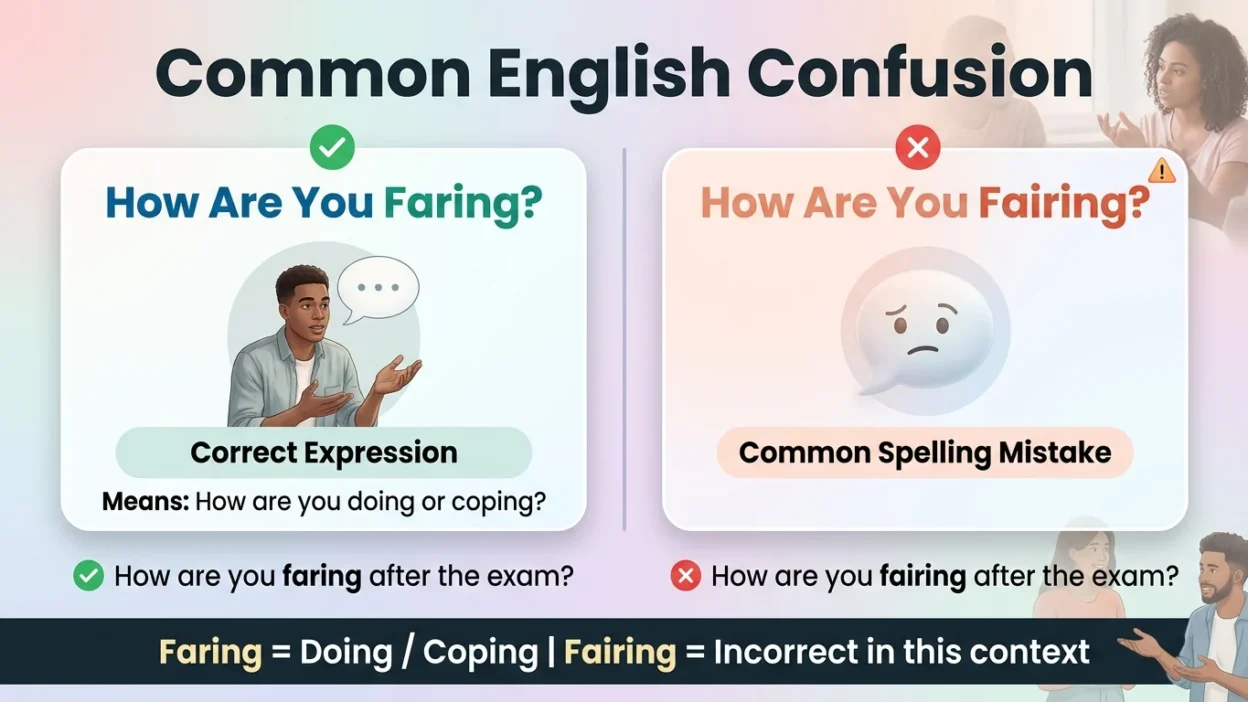
The correct phrase is “How are you faring?”
- ✅ How are you faring? = Asking how someone is doing, managing, or coping.
- ❌ How are you fairing? = Incorrect in this context because fairing refers to a structure on vehicles, aircraft, or boats.
If you’re checking on someone’s well-being or asking how they’re handling a situation, always use faring.
What Does “Faring” Mean?
The word faring comes from the verb fare, which means:
- To get along
- To perform
- To manage
- To cope with a situation
- To experience success or difficulty
When you ask, “How are you faring?”, you’re simply asking:
- How are you doing?
- How are things going?
- How are you managing?
- How are you coping?
Examples
- How are you faring after your surgery?
- She’s faring much better since changing jobs.
- The students are faring well in their final exams.
- We wanted to know how the business was faring this year.
- How are you faring with your new responsibilities?
In every example, faring refers to someone’s progress, condition, or performance.
What Does “Fairing” Mean?
Fairing is a completely different word. It is mainly used in engineering, aviation, boating, cycling, and motorcycling.
A fairing is a smooth covering added to reduce air or water resistance and improve performance.
Examples
- The motorcycle has a new front fairing.
- The aircraft’s wing fairing reduces drag.
- The racing bicycle includes an aerodynamic fairing.
- Engineers redesigned the boat’s fairing for better speed.
Notice that none of these examples have anything to do with asking how someone is doing.
How Are You Faring vs Fairing: The Key Difference
| Faring | Fairing |
| Comes from the verb fare | A noun used in engineering |
| Means doing, managing, or coping | Means an aerodynamic covering |
| Used in everyday conversations | Used in technical fields |
| Correct in “How are you faring?” | Incorrect in that sentence |
The easiest way to remember this difference is that faring relates to a person’s progress, while fairing relates to machines and vehicles.
Why Do People Confuse “Faring” and “Fairing”?
These words are homophones, meaning they sound exactly the same but have different spellings and meanings.
People often write fairing because:
- They rely on pronunciation instead of spelling.
- Spell-check doesn’t always catch correctly spelled but incorrect words.
- They are unfamiliar with the verb fare.
- They have seen fairing used in technical articles.
Understanding the meaning behind each word makes choosing the correct spelling much easier.
Memory Trick to Remember the Correct Word
Here’s a simple trick:
Faring = Fare = How you’re doing.
Think of the phrase:
Fare through life.
If you’re talking about someone’s progress, health, work, or life, use faring.
If you’re talking about motorcycles, airplanes, boats, or race cars, use fairing.
Common Mistakes
Many writers accidentally use the wrong spelling.
Incorrect
- ❌ How are you fairing today?
- ❌ I hope you’re fairing well.
- ❌ She has been fairing much better recently.
Correct
- ✅ How are you faring today?
- ✅ I hope you’re faring well.
- ✅ She has been faring much better recently.
Whenever you’re asking about someone’s condition or progress, faring is always the right choice.
Everyday Examples of “Faring”
Here are more natural examples you may hear in daily conversations:
- How are your parents faring these days?
- The company is faring better than expected.
- Our team is faring well this season.
- She’s faring much better after taking a short break.
- The local economy is faring surprisingly well.
- How are you faring with your new routine?
- We checked how everyone was faring after the storm.
- He’s faring better than last year.
These examples all describe progress, performance, or well-being.
Examples of “Fairing” in Technical Contexts
To see the difference more clearly, here are correct uses of fairing:
- The motorcycle’s front fairing protects the rider from wind.
- The airplane’s landing gear fairing improves aerodynamics.
- Engineers installed a lightweight carbon fiber fairing.
- The racing boat uses a streamlined fairing to reduce drag.
Unless you’re discussing engineering or transportation, you probably won’t need this word.
American vs British English
There is no difference between American and British English for these words.
In both varieties of English:
- How are you faring? is the correct expression.
- Fairing still refers to an aerodynamic covering on vehicles or aircraft.
The spelling and meanings remain the same worldwide.
Related Words and Similar Expressions
If you’re looking for alternatives to How are you faring?, you can also say:
- How are you doing?
- How are things going?
- How have you been?
- How are you getting along?
- How are you managing?
- How are you coping?
- How’s everything?
- How’s life treating you?
These phrases express the same general idea in everyday conversation.
When Should You Use “Faring”?
Use faring whenever you’re talking about:
- Someone’s health
- Emotional well-being
- School performance
- Career progress
- Business success
- Recovery
- Daily life
- Managing challenges
For example:
- The patients are faring much better.
- Our project is faring well despite delays.
- She asked how I was faring after moving abroad.
FAQs
Is “How are you fairing?” ever correct?
No. When asking someone how they are doing, fairing is incorrect. The correct phrase is “How are you faring?”
Why do people spell it as “fairing”?
Because faring and fairing sound identical. Since they’re homophones, many people accidentally choose the wrong spelling.
What does “faring well” mean?
It means someone is doing well, succeeding, coping effectively, or making good progress.
Is “fairing” a real English word?
Yes. Fairing is a legitimate noun used in engineering to describe an aerodynamic covering on vehicles, aircraft, boats, or bicycles.
Can “fare” mean “do”?
Yes. As a verb, fare means to get along, succeed, or manage in a particular situation.
Is “How are you faring?” formal?
It’s suitable for both formal and informal English. It’s especially common in thoughtful conversations when asking how someone is coping.
Are “faring” and “doing” interchangeable?
Often, yes. In many situations, How are you faring? and How are you doing? have nearly the same meaning.
Summary
Understanding how are you faring vs fairing is actually quite simple once you know what each word means. Faring comes from the verb fare, meaning to manage, cope, or do in a particular situation. That’s why the correct question is always “How are you faring?” when checking on someone’s well-being or progress.
On the other hand, fairing is a technical noun describing an aerodynamic covering found on motorcycles, airplanes, boats, and similar vehicles. Although both words sound identical, they belong in completely different contexts. Remember this simple rule: if you’re talking about a person’s condition or progress, choose faring. If you’re discussing vehicle design or engineering, choose fairing.
Actionable Takeaway
Before writing “How are you faring?”, ask yourself one question: Am I talking about a person or a vehicle? If it’s about someone’s well-being, progress, or success, use faring. If it’s about an aircraft, motorcycle, boat, or other machine, use fairing. Keeping this simple distinction in mind will help you avoid one of the most common English spelling mistakes.