
When working with mixing equipment in industries such as manufacturing, chemical processing, food production, pharmaceuticals, or wastewater treatment, you’ll often encounter the terms agitator and impeller. While many people use these terms interchangeably, they are not the same thing. Understanding the difference between agitator vs impeller is essential for selecting the right mixing system and achieving the desired results.
The confusion usually arises because both agitators and impellers play a role in mixing liquids, suspensions, and other materials. However, an agitator refers to the overall mixing mechanism, while an impeller is one specific component within that system. This guide explains their meanings, differences, examples, applications, and common misconceptions.
Quick Answer
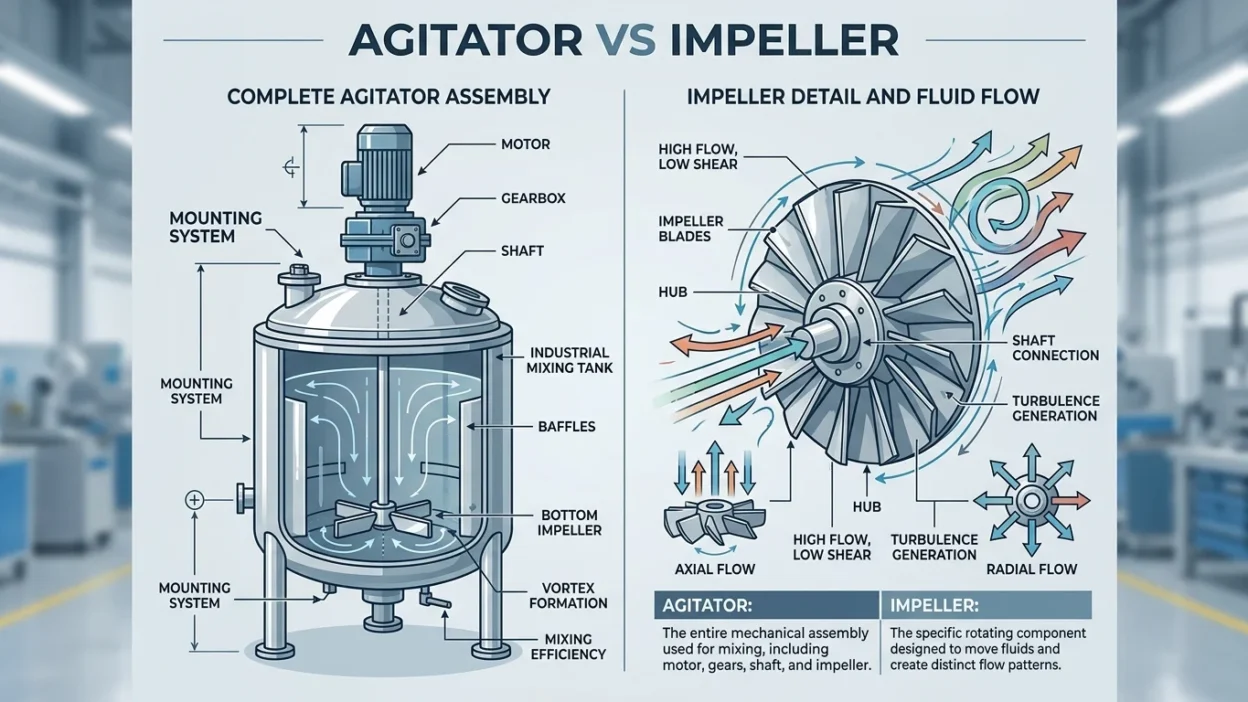
An agitator is the complete mixing device used to stir, blend, or maintain uniformity in a tank or vessel.
An impeller is the rotating blade or rotor attached to the agitator shaft that actually creates fluid movement.
In simple terms:
- Agitator = Entire mixing system
- Impeller = Rotating part that performs the mixing action
What Is an Agitator?
An agitator is a mechanical device designed to mix, stir, suspend, blend, or circulate materials within a container or tank.
A typical agitator system may include:
- Motor
- Gearbox
- Shaft
- Impeller(s)
- Mounting assembly
- Control system
The agitator provides the power and structure necessary for mixing operations.
Common Uses of Agitators
- Chemical blending
- Pharmaceutical manufacturing
- Food processing
- Paint production
- Water treatment
- Fermentation processes
Example
In a chemical mixing tank, the motor, shaft, and blades together form the agitator system.
What Is an Impeller?
An impeller is the rotating component attached to the agitator shaft that moves fluid through the tank.
As the impeller rotates, it generates flow patterns that help:
- Mix liquids
- Suspend solids
- Disperse gases
- Transfer heat
- Prevent settling
The impeller is the part directly responsible for creating fluid movement.
Common Impeller Types
- Propeller impeller
- Turbine impeller
- Paddle impeller
- Hydrofoil impeller
- Rushton turbine impeller
- Anchor impeller
Each design produces different flow characteristics.
Example
Inside a mixing vessel, the blades spinning at the end of the shaft are the impeller.
Agitator vs Impeller: Key Differences
| Feature | Agitator | Impeller |
|---|---|---|
| Definition | Complete mixing system | Rotating mixing element |
| Function | Powers and controls mixing | Generates fluid movement |
| Components | Motor, shaft, impeller, gearbox, supports | Blades or vanes only |
| Size | Larger assembly | Single component |
| Purpose | Overall mixing operation | Creates flow and turbulence |
| Replacement | Entire unit | Individual part |
| Installation | Mounted on vessel | Attached to shaft |
The simplest way to remember the difference is that an impeller is usually one part of an agitator.
How Agitators and Impellers Work Together
Agitators and impellers are not competing technologies. Instead, they work together.
The process typically works like this:
- The motor powers the agitator.
- The agitator shaft rotates.
- The impeller spins with the shaft.
- Fluid movement is generated.
- Mixing occurs throughout the vessel.
Without an impeller, most agitators cannot effectively move fluid. Without the agitator system, the impeller cannot operate.
Types of Agitators
Different applications require different agitator designs.
Top-Mounted Agitator
Installed at the top of the vessel.
Common for:
- Chemical processing
- Water treatment
- Storage tanks
Side-Entry Agitator
Mounted on the side wall.
Common for:
- Large storage tanks
- Petroleum applications
Bottom Mounted Agitator
Installed beneath the vessel.
Common for:
- Pharmaceutical production
- Hygienic processing
Portable Agitator
Designed for temporary mixing operations.
Common for:
- Small batches
- Laboratory work
Types of Impellers
The choice of impeller significantly affects mixing performance.
Propeller Impeller
Produces strong axial flow.
Best for:
- Low-viscosity liquids
- High circulation requirements
Turbine Impeller
Creates both radial and axial flow.
Best for:
- General-purpose mixing
- Gas dispersion
Paddle Impeller
Suitable for moderate mixing duties.
Best for:
- Medium viscosity fluids
Hydrofoil Impeller
Offers high efficiency with lower power consumption.
Best for:
- Energy efficient mixing
Anchor Impeller
Designed for high viscosity materials.
Best for:
- Syrups
- Creams
- Polymers
Applications of Agitators and Impellers
Chemical Industry
Used to:
- Blend chemicals
- Maintain uniform concentrations
- Improve reaction rates
Food and Beverage Industry
Used for:
- Mixing ingredients
- Preparing sauces
- Dairy processing
Pharmaceutical Industry
Used to:
- Produce medicines
- Ensure product consistency
- Maintain sterile conditions
Wastewater Treatment
Used for:
- Sludge mixing
- Aeration processes
- Chemical dosing
Oil and Gas Industry
Used for:
- Tank mixing
- Additive blending
- Storage applications
Advantages of Agitators
Agitators provide several benefits:
- Efficient mixing
- Better product consistency
- Reduced settling
- Improved heat transfer
- Enhanced chemical reactions
- Automation capabilities
Advantages of Impellers
Impellers contribute to mixing performance by:
- Creating circulation
- Improving flow patterns
- Increasing mixing efficiency
- Supporting gas dispersion
- Reducing dead zones in tanks
Common Mistakes People Make
Assuming Agitator and Impeller Mean the Same Thing
This is the most common mistake.
An agitator is the entire system, while an impeller is one component within it.
Choosing the Wrong Impeller
Different impellers are designed for different viscosities and mixing goals.
Ignoring Tank Design
Even the best agitator may perform poorly if the vessel design is unsuitable.
Overlooking Power Requirements
The motor and agitator must match the mixing load.
Focusing Only on Speed
Mixing effectiveness depends on impeller design, not just rotational speed.
When Is an Agitator More Important?
The agitator becomes the primary concern when evaluating:
- Motor size
- Gearbox selection
- Mounting configuration
- Overall mixing capacity
- System reliability
When Is an Impeller More Important?
The impeller becomes critical when evaluating:
- Flow patterns
- Mixing quality
- Energy efficiency
- Shear sensitivity
- Product characteristics
American vs British English
The terms agitator and impeller have the same meanings in both American and British English.
Industrial engineers and manufacturers in both regions use these terms similarly, and there are no major spelling or usage differences.
Frequently Asked Questions
Is an agitator the same as an impeller?
No. An agitator is the complete mixing system, while an impeller is the rotating component that moves the fluid.
Can an agitator have multiple impellers?
Yes. Large industrial agitators often use multiple impellers on a single shaft to improve mixing performance.
Which is more important, the agitator or the impeller?
Both are important. The agitator provides power and structure, while the impeller determines how the fluid moves and mixes.
What is the main purpose of an impeller?
The primary purpose of an impeller is to generate fluid flow and mixing within a vessel.
What industries use agitators and impellers?
Chemical, pharmaceutical, food processing, wastewater treatment, oil and gas, mining, and manufacturing industries all use them extensively.
Can I replace only the impeller?
Yes. In many cases, the impeller can be replaced without replacing the entire agitator system.
Which impeller is best for thick liquids?
Anchor impellers are commonly used for high-viscosity materials such as creams, syrups, and polymers.
How do I choose the right impeller?
Consider fluid viscosity, tank size, mixing objectives, power requirements, and desired flow patterns.
Summary
Understanding agitator vs impeller is essential for anyone involved in industrial mixing processes. Although the terms are often confused, they refer to different parts of the mixing system. An agitator is the complete assembly responsible for powering and controlling the mixing operation, while an impeller is the rotating element that creates fluid movement within the tank.
Choosing the right combination of agitator and impeller can improve efficiency, product quality, energy consumption, and overall process performance. By understanding their distinct roles, engineers and operators can make better equipment decisions and achieve more effective mixing results.
Actionable Takeaway
Remember this simple rule: the agitator is the entire mixing machine, and the impeller is the blade that does the actual mixing. When selecting equipment, evaluate both the agitator system and the impeller design to ensure optimal performance for your specific application.