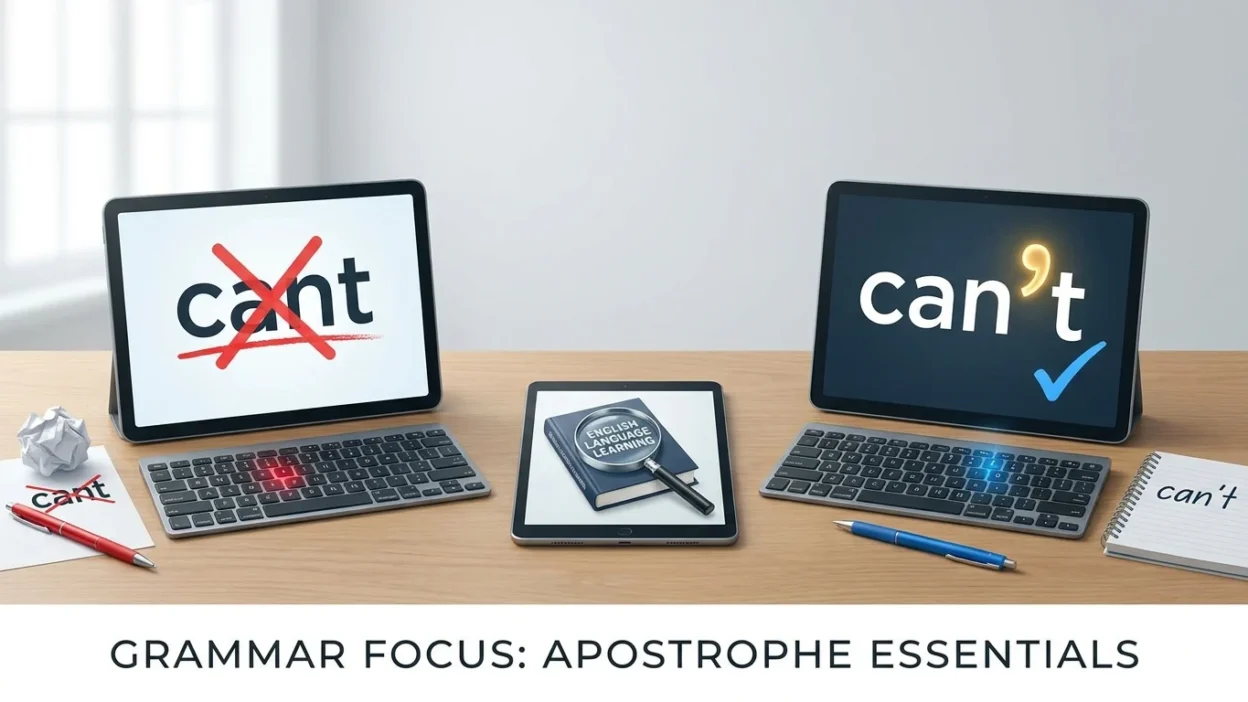
At first glance, “cant” and “can’t” look almost identical. In fact, many people assume one is simply a typo of the other. But that tiny apostrophe changes everything.
One word is an extremely common contraction used in everyday English. The other is a completely different word with its own meanings that most people rarely use.
This confusion happens more often than you might think, especially when typing quickly, texting, writing essays, or using autocorrect. Missing a single apostrophe can accidentally change the meaning of a sentence or make writing look grammatically incorrect.
For students, writers, bloggers, professionals, and English learners, understanding the difference between cant vs can’t is important because these words are not interchangeable.
The good news is the explanation is very simple once you see how each word works in real sentences.
This guide explains the meaning, grammar, pronunciation, examples, common mistakes, and correct usage of cant and can’t in easy everyday English.
Quick Answer: Cant vs Can’t
“Can’t” is the contraction of “cannot” and means something is impossible or not allowed. “Cant” without an apostrophe is a separate word that usually refers to specialized language, insincere talk, or a tilted angle.
Most of the time, people actually mean “can’t” with the apostrophe.
What Does “Can’t” Mean?
“Can’t” is one of the most commonly used contractions in English.
It combines:
- Can
- Not
So:
- Can’t = Cannot
Examples of “Can’t”
- I can’t swim.
- She can’t come today.
- We can’t afford that right now.
- He can’t drive yet.
In all these examples, “can’t” expresses:
- Inability
- Impossibility
- Restriction
What Does “Cant” Mean?
“Cant” without an apostrophe is a real word, but it is much less common.
It has several meanings depending on context.
Common Meanings of “Cant”
Specialized Language or Jargon
A type of vocabulary used by a specific group.
Example:
- Thieves’ cant
- Political cant
Hypocritical or Insincere Speech
Speech that sounds fake, moralizing, or overly rehearsed.
Example:
- People grew tired of the politician’s cant.
A Tilt or Slant
Used in architecture, engineering, or design.
Example:
- The road has a slight cant.
Cant vs Can’t: Main Difference
| Word | Meaning | Common Usage |
|---|---|---|
| Can’t | Cannot | Extremely common |
| Cant | Jargon, hypocrisy, or tilt | Rare |
The apostrophe completely changes the word.
Why “Can’t” Is So Common
“Can’t” appears constantly in:
- Conversations
- Text messages
- Emails
- Movies
- Social media
- Songs
- Everyday speech
English speakers use contractions naturally because they sound smoother and more conversational.
Formal vs Informal
Formal Writing
- Cannot
Casual Writing
- Can’t
Both are grammatically correct.
Why People Accidentally Write “Cant”
Most mistakes happen because of:
- Fast typing
- Autocorrect errors
- Missing apostrophes
- Keyboard shortcuts
Common Mistake
Incorrect:
- I cant believe it.
Correct:
- I can’t believe it.
Without the apostrophe, the sentence becomes grammatically incorrect in standard English.
How Apostrophes Change Meaning
English apostrophes often show:
- Missing letters
- Possession
In “can’t,” the apostrophe replaces:
- The “no” in “cannot”
Other examples:
- Don’t = Do not
- Won’t = Will not
- Isn’t = Is not
Pronunciation Difference Between Cant and Can’t
In everyday speech, “cant” and “can’t” may sound similar depending on accent.
Can’t
Usually pronounced clearly with emphasis because it expresses negation.
Cant
Less commonly spoken outside specialized contexts.
Most people hearing “cant” in conversation assume you mean “can’t.”
Examples of “Can’t” in Sentences
Ability
- I can’t lift this box.
Permission
- You can’t park here.
Impossibility
- That can’t be true.
Refusal
- She can’t attend the meeting.
Examples of “Cant” in Sentences
Specialized Language
- The group developed its own cant.
Insincere Talk
- Voters ignored the leader’s political cant.
Slanted Angle
- Engineers measured the cant of the bridge.
Is “Cant” Ever Correct in Everyday Writing?
Rarely.
Most people almost never need the word “cant” unless discussing:
- Literature
- Linguistics
- Engineering
- Politics
- Architecture
In normal communication, “can’t” is usually the intended word.
Common Grammar Mistakes With Can’t
Missing Apostrophe
Incorrect:
- She cant help us.
Correct:
- She can’t help us.
Confusing Cannot and Can Not
Usually:
- Cannot
is preferred over:
- Can not
except for specific emphasis situations.
Can You Use “Cannot” Instead of “Can’t”?
Yes.
Cannot
Feels:
- More formal
- More serious
- More professional
Can’t
Feels:
- More natural
- More conversational
- More relaxed
Both are correct.
Cant vs Can’t in Academic Writing
Academic writing usually avoids contractions.
Preferred Academic Style
- Cannot
instead of:
- Can’t
However, contractions may still appear in:
- Creative writing
- Dialogue
- Informal essays
- Blog posts
Why This Tiny Apostrophe Matters
A missing apostrophe may seem small, but it can:
- Change meaning
- Affect professionalism
- Create confusion
- Make writing look careless
That is why proofreading matters.
Common Search Questions About Cant vs Can’t
Many people search this topic because:
- Spellcheck sometimes misses it
- Apostrophe mistakes are common
- English learners get confused
- Typing habits remove punctuation
It is one of the easiest grammar mistakes to make quickly.
Expert Writing Tips
Use “Can’t” for Natural Tone
Especially in:
- Blogs
- Texts
- Casual communication
Use “Cannot” for Formal Tone
Especially in:
- Academic papers
- Legal writing
- Business documents
Avoid “Cant” Unless You Truly Mean It
Because most readers will assume it is a typo.
Final Verdict
The difference between cant vs can’t comes down to one tiny apostrophe but that small mark changes the entire meaning of the word.
“Can’t” is the common contraction for “cannot” and appears constantly in everyday English.
“Cant” without the apostrophe is a completely different word related to jargon, insincere speech, or slanted angles.
In most situations:
- You probably mean “can’t”
- The apostrophe matters
- Missing it changes the sentence
So if you are writing about inability, impossibility, or something not allowed, always use:
- Can’t
with the apostrophe.
FAQs
What is the difference between cant and can’t?
“Can’t” means “cannot,” while “cant” is a separate word related to jargon, insincere speech, or slanted angles.
Is “cant” a real English word?
Yes, “cant” is a real word, but it is much less commonly used than “can’t.”
Why is the apostrophe important in can’t?
The apostrophe shows missing letters in the contraction of “cannot.”
Is “I cant do it” grammatically correct?
No. The correct sentence is “I can’t do it.”
Can I use cannot instead of can’t?
Yes, both are correct. “Cannot” is more formal, while “can’t” sounds more conversational.
What does cant mean in literature?
In literature, “cant” can refer to specialized language, slang, or insincere moral speech.
How do you pronounce can’t?
“Can’t” is usually pronounced like “kant” depending on accent and region.
Is cant used in everyday English?
Rarely. Most people use “can’t” far more often.
Why do people accidentally write cant?
Usually because of fast typing, missing punctuation, or autocorrect issues.
Which is more formal: can’t or cannot?
“Cannot” is considered more formal than “can’t.”