Many English learners get confused by play vs draw because both words are common, simple, and used in everyday conversations. Yet they have completely different meanings depending on the situation. If you have ever wondered whether someone should “play a picture” or “draw a game,” you are not alone. These two words often appear in beginner English lessons, sports discussions, art classes, and even grammar exercises.
Understanding the difference between play and draw can improve your speaking, writing, and confidence in English. In this guide, you will learn the meaning of each word, how to use them correctly, common mistakes to avoid, practical examples, and even British vs American English differences. By the end, you will clearly know when to use “play” and when to use “draw.”
Quick Answer
Play usually means taking part in a game, sport, activity, or performance.
Draw usually means creating a picture with a pen or pencil, pulling something, or ending a game with equal scores.
Examples:
- “The children love to play football.”
- “She can draw beautiful flowers.”
- “The match ended in a draw.”
So, play is connected with activities and entertainment, while draw is commonly related to art, pulling, or tied games.
What Does “Play” Mean?
The word play has several meanings in English, but the most common one is to participate in an activity for fun, entertainment, or competition.
Common Uses of Play
1. Taking Part in Games or Sports
This is the most popular meaning.
Examples:
- “They play cricket every weekend.”
- “My brother plays chess online.”
- “Do you play basketball?”
2. Performing Music or Acting
“Play” can also mean performing music or acting in a role.
Examples:
- “She plays the piano beautifully.”
- “He played the role of a king in the movie.”
3. Having Fun
Children often use play to describe fun activities.
Examples:
- “The kids are playing in the park.”
- “Let’s play together after school.”
Verb Forms of Play
| Form | Word |
|---|---|
| Base Verb | Play |
| Past Tense | Played |
| Past Participle | Played |
| Present Participle | Playing |
What Does “Draw” Mean?
The word draw also has multiple meanings. Most people first learn it as creating pictures, but it has other uses too.
Common Uses of Draw
1. Making a Picture
This is the most common meaning.
Examples:
- “She likes to draw cartoons.”
- “Can you draw a cat?”
- “He drew a mountain scene.”
2. Pulling Something
“Draw” can mean pulling or moving something.
Examples:
- “Please draw the curtains.”
- “The horse drew the cart.”
3. A Tie in Sports or Games
In sports, a draw means both teams have the same score.
Examples:
- “The football match ended in a draw.”
- “It was a 2-2 draw.”
Verb Forms of Draw
| Form | Word |
| Base Verb | Draw |
| Past Tense | Drew |
| Past Participle | Drawn |
| Present Participle | Drawing |
Play vs Draw: Main Difference
Here is the easiest way to remember the difference between play vs draw:
| Word | Main Meaning | Example |
| Play | Participate in games, fun, music, or sports | “We play tennis every Friday.” |
| Draw | Create pictures, pull something, or tie a game | “She can draw animals very well.” |
A simple memory trick:
- Play = activity or action
- Draw = picture, pull, or tie
Examples of Play and Draw in Sentences
Learning through examples makes English easier. Here are practical sentence examples using both words.
Examples Using Play
- “I play video games at night.”
- “They played football yesterday.”
- “Can you play the guitar?”
- “The children are playing outside.”
- “She loves to play with her dog.”
Examples Using Draw
- “My sister can draw realistic faces.”
- “He drew a map for us.”
- “The game ended in a draw.”
- “Please draw your chair closer.”
- “She has drawn many beautiful sketches.”
Common Mistakes with Play vs Draw
Many English learners mix up these words because they may translate differently in their native language.
Mistake 1: Using Draw Instead of Play
❌ “I draw football every weekend.”
✅ “I play football every weekend.”
Why? Because football is a sport you participate in, not a picture you create.
Mistake 2: Using Play Instead of Draw
❌ “She plays a picture of a bird.”
✅ “She draws a picture of a bird.”
Why? Because creating pictures requires the verb “draw.”
Mistake 3: Confusing “Draw” in Sports
Some learners think “draw” only means sketching.
Example:
- “The teams drew 1-1.”
- “The match was a draw.”
In sports vocabulary, a draw means no team won.
Play vs Draw in Sports
Sports discussions often create confusion because both words can appear together.
Examples:
- “Brazil will play Argentina tomorrow.”
- “The last game ended in a draw.”
Here:
- Play = participate in the match
- Draw = final tied result
Sports Examples
| Sentence | Meaning |
| “They play cricket.” | They participate in cricket. |
| “The game was a draw.” | Nobody won the game. |
| “We played yesterday.” | We took part in a game. |
| “The teams drew 0-0.” | The match ended equally. |
British vs American English Differences
There are small differences between British and American English when using draw in sports.
British English
British English commonly uses “draw” as both a noun and verb.
Examples:
- “Manchester United drew with Chelsea.”
- “The match ended in a draw.”
American English
American English often uses “tie” more commonly in sports.
Examples:
- “The game ended in a tie.”
- “The teams tied 3-3.”
However, Americans still understand the word “draw,” especially in soccer and international sports.
Synonyms and Related Words
Using related vocabulary helps improve fluency and SEO relevance.
Synonyms for Play
- Participate
- Compete
- Perform
- Entertain
- Act
Synonyms for Draw
- Sketch
- Illustrate
- Pull
- Attract
- Tie
Related LSI Keywords
- difference between play and draw
- play meaning in English
- draw meaning in English
- play vs draw grammar
- play and draw examples
- draw in football meaning
- play in sports meaning
- English vocabulary differences
When to Use Play and Draw
A quick guideline can help you choose the right word instantly.
Use “Play” When Talking About:
- Sports
- Games
- Music
- Acting
- Fun activities
Examples:
- “They play volleyball.”
- “She plays the violin.”
Use “Draw” When Talking About:
- Sketching or art
- Pulling objects
- Tied games
Examples:
- “He likes to draw comics.”
- “The game ended in a draw.”
Easy Memory Tips
Here are simple tricks to remember the difference forever.
Remember This:
- You play a game.
- You draw a picture.
- A game can end in a draw.
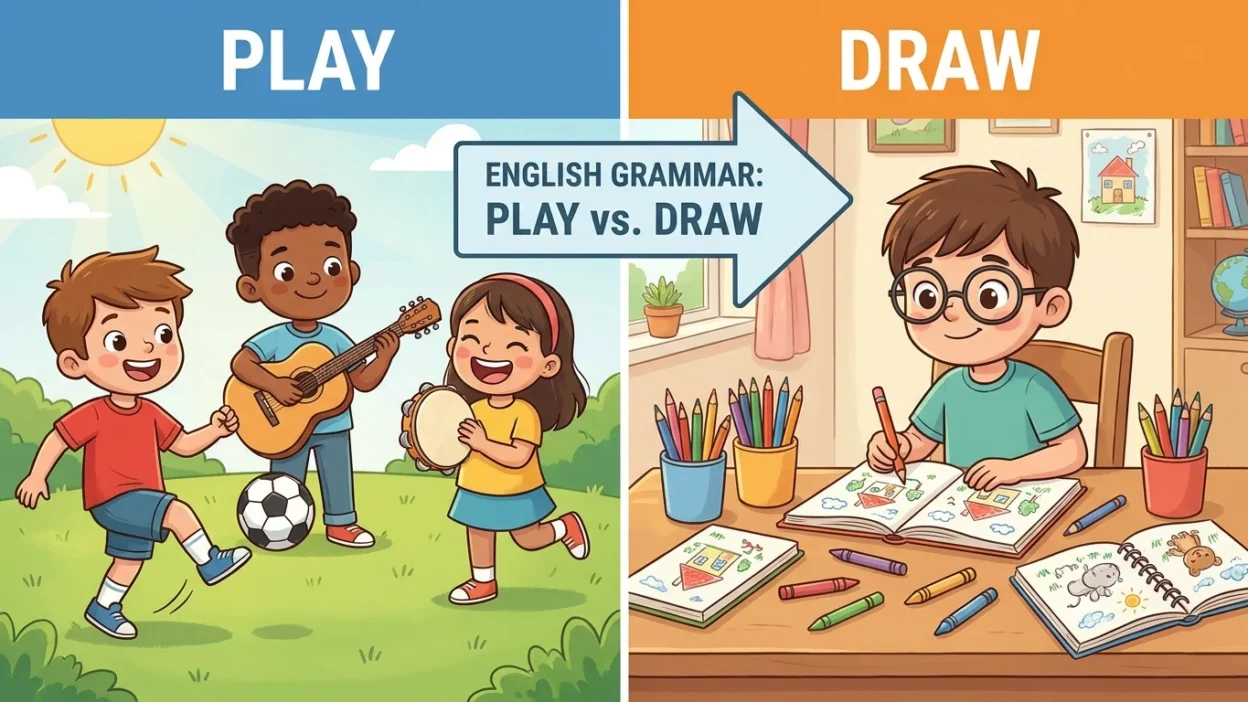
Visual Memory Trick
Think about this:
- A child with a football = play
- A child with crayons = draw
This simple image helps many learners remember the correct usage.
FAQs
1. What is the main difference between play and draw?
Play means participating in activities, games, or performances, while draw usually means sketching, pulling something, or ending a game equally.
2. Can draw mean a tied game?
Yes. In sports, a draw means both teams finished with the same score.
3. Is draw used differently in American English?
Yes. Americans often say “tie” instead of “draw,” especially in sports like basketball or baseball.
4. Can you say “draw football”?
No. The correct phrase is “play football.”
5. What is the past tense of draw?
The past tense of draw is “drew.”
Example:
- “She drew a beautiful flower.”
6. What is the past tense of play?
The past tense of play is “played.”
Example:
- “We played tennis yesterday.”
7. Is drawing considered a type of play for children?
Sometimes, yes. Children may draw as part of playful learning activities, but grammatically the action is still “draw.”
8. Can both words be used in the same sentence?
Absolutely.
Example:
- “The children played games and drew pictures after school.”
Final Summary
Understanding play vs draw is important for speaking and writing correct English naturally. The word play is mainly connected with games, sports, fun activities, music, and acting. Meanwhile, draw usually refers to sketching pictures, pulling objects, or describing a tied result in sports. Although both words are common, their meanings are very different.
The best way to master these vocabulary words is through practice and real-life examples. When you talk about sports or activities, use “play.” When you talk about art or tied scores, use “draw.” Over time, these differences will become automatic in everyday English conversations.
Actionable Takeaway
Next time you speak or write in English, pause for one second and ask yourself:
- Am I talking about an activity or game? → Use play.
- Am I talking about art, pulling, or a tied result? → Use draw.
Practice by creating five sentences using each word. This small exercise can quickly improve your vocabulary, grammar confidence, and spoken English fluency.