When you see an unexpected bill, credit card transaction, invoice, fee, or charge, you may face an important decision: pay vs dispute. Should you simply pay the amount owed, or should you challenge the charge because you believe it is incorrect, unauthorized, or unfair?
Understanding the difference between paying and disputing a charge can help you avoid unnecessary costs, protect your rights, and make better financial decisions. In this guide, you’ll learn what “pay” and “dispute” mean, when each option makes sense, common scenarios, key differences, and mistakes to avoid.
Quick Answer
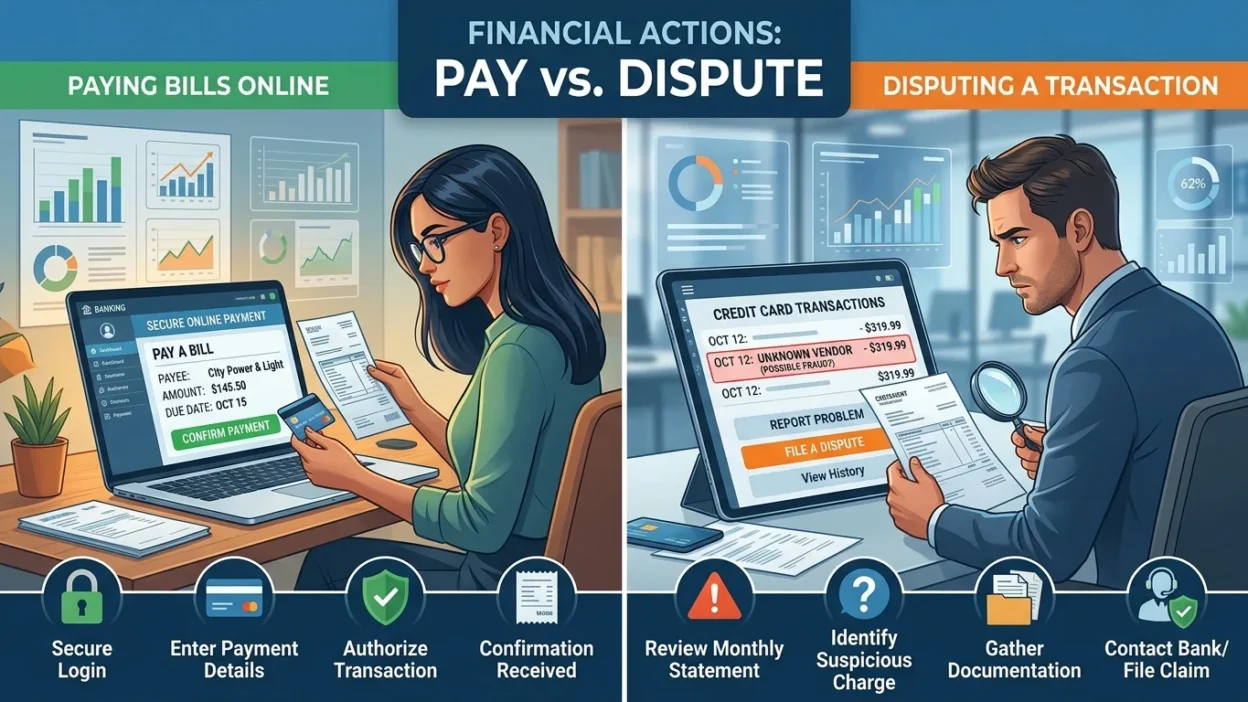
- Pay means accepting the charge and submitting payment.
- Dispute means formally challenging a charge because you believe there is a problem with it.
Generally:
- Pay if the charge is accurate and legitimate.
- Dispute if the charge is incorrect, fraudulent, duplicated, or unauthorized.
What Does Pay Mean?
To pay means to provide money to satisfy a debt, bill, fee, invoice, or financial obligation.
Common Examples of Paying
- Paying a credit card bill
- Paying a utility bill
- Paying rent
- Paying a subscription fee
- Paying a store purchase
Example
You purchase a laptop and receive the correct invoice.
In this case, paying is usually the appropriate action.
What Does Dispute Mean?
To dispute means to formally challenge a charge, transaction, claim, or bill because you believe it is incorrect or invalid.
A dispute may be filed with:
- A bank
- A credit card company
- A merchant
- An insurance company
- A service provider
Example
You notice a charge on your credit card from a business you never used.
Instead of paying, you may dispute the charge.
Pay vs Dispute Comparison Table
| Feature | Pay | Dispute |
|---|---|---|
| Purpose | Settle the amount owed | Challenge the charge |
| Accepts the Charge | Yes | No |
| Requires Investigation | No | Usually |
| Risk of Late Fees | Reduced | May depend on outcome |
| Common Reason | Valid charge | Incorrect charge |
When Should You Pay?
Paying is generally appropriate when:
The Charge Is Accurate
The amount matches what you agreed to pay.
The Product or Service Was Delivered
You received what you purchased.
There Is No Billing Error
The invoice is correct.
The Charge Is Authorized
You knowingly approved the transaction.
When Should You Dispute?
Disputing may be appropriate when:
Unauthorized Transactions
Someone used your card without permission.
Billing Errors
The amount charged is incorrect.
Duplicate Charges
You were charged multiple times for the same purchase.
Products Not Received
The seller failed to deliver the item.
Services Not Provided
You paid for a service that was never performed.
Common Credit Card Disputes
Many disputes involve credit card transactions.
Examples
- Fraudulent purchases
- Duplicate payments
- Incorrect charges
- Merchandise not received
- Subscription issues
Most card issuers provide procedures for investigating disputes.
Pay vs Dispute for Credit Cards
Pay
You may choose to pay when:
- The transaction is legitimate.
- The charge amount is correct.
- You received the promised goods or services.
Dispute
You may choose to dispute when:
- The charge appears fraudulent.
- The merchant refuses to resolve an issue.
- You were billed incorrectly.
Benefits of Paying
Avoids Late Fees
Paying on time may prevent additional charges.
Protects Credit History
Timely payments can help maintain a positive credit record.
Resolves the Matter Quickly
No investigation is required.
Benefits of Disputing
Protects Against Fraud
Disputes can help recover funds from unauthorized transactions.
Corrects Billing Mistakes
Errors can often be reversed.
Preserves Consumer Rights
Many laws and card networks provide dispute protections.
Risks of Paying
Difficult to Reverse Later
Once a bill is paid, recovering money may become more complicated.
You May Pay an Invalid Charge
Paying immediately could mean accepting a charge that was actually incorrect.
Risks of Disputing
Investigation Time
Disputes can take days or weeks to resolve.
Documentation Requirements
You may need receipts, emails, or supporting evidence.
Possible Denial
Not every dispute is successful.
Common Mistakes People Make
Mistake 1: Paying a Fraudulent Charge
Always review statements before paying.
Mistake 2: Disputing a Legitimate Charge
Disputing valid charges can complicate matters unnecessarily.
Mistake 3: Waiting Too Long
Many financial institutions have deadlines for disputes.
Mistake 4: Not Keeping Records
Receipts and communication records can be important evidence.
Questions to Ask Before Deciding
Before choosing pay or dispute, consider:
- Did I authorize this charge?
- Is the amount correct?
- Did I receive the product or service?
- Is there evidence of fraud?
- Can the merchant resolve the issue directly?
These questions often clarify the best course of action.
Pay vs Dispute in Business
Businesses also face pay versus dispute decisions.
Examples include:
- Vendor invoices
- Contract disagreements
- Service billing disputes
- Shipping discrepancies
Many businesses attempt negotiation before escalating disputes.
American vs British English Usage
The meanings of pay and dispute are essentially the same in American and British English.
American English
Common phrases include:
- Dispute a charge
- File a dispute
- Contest a charge
British English
Similar phrases include:
- Dispute a payment
- Challenge a charge
- Raise a billing dispute
FAQs
1. What is the difference between pay and dispute?
Paying accepts and settles a charge, while disputing challenges its validity.
2. Should I dispute a charge I don’t recognize?
If you genuinely do not recognize the charge, contacting the merchant or your financial institution may be appropriate.
3. Can I dispute a charge after paying it?
In some situations, yes, but rules vary depending on the payment method and institution.
4. What happens during a dispute?
The financial institution or merchant investigates the transaction and reviews evidence.
5. How long do disputes take?
Timeframes vary, but investigations often take several days or weeks.
6. Will disputing a charge hurt my credit score?
Generally, filing a legitimate dispute does not directly affect your credit score.
7. What evidence helps support a dispute?
Receipts, emails, screenshots, contracts, and communication records can be helpful.
8. Should I contact the merchant first?
In many cases, contacting the merchant directly may resolve the issue more quickly.
Final Summary
The decision between pay vs dispute depends on whether the charge is legitimate and accurate. Paying is usually the correct choice when you authorized the transaction, received the product or service, and the amount is correct. Disputing is generally appropriate when there is fraud, a billing error, duplicate charges, or a failure to deliver what was promised.
Making the right decision can protect your finances, save time, and help you exercise your consumer rights effectively. The key is to review the facts carefully before taking action.
Actionable Takeaway
Before choosing to pay or dispute a charge:
- Verify the transaction details.
- Review receipts and statements.
- Contact the merchant if appropriate.
- Gather supporting documentation.
- Act promptly if you suspect an error or unauthorized activity.
A few minutes of review can help you avoid paying charges you do not actually owe.