Have you ever paused while writing and wondered whether to use “either” or “neither”? These two words are closely related, but they carry opposite meanings and mixing them up can completely change what you’re trying to say.
In this guide, we’ll break down either vs neither in a clear, friendly way. You’ll learn their meanings, see practical examples, understand common mistakes, and pick the right word confidently every time.
Quick Answer
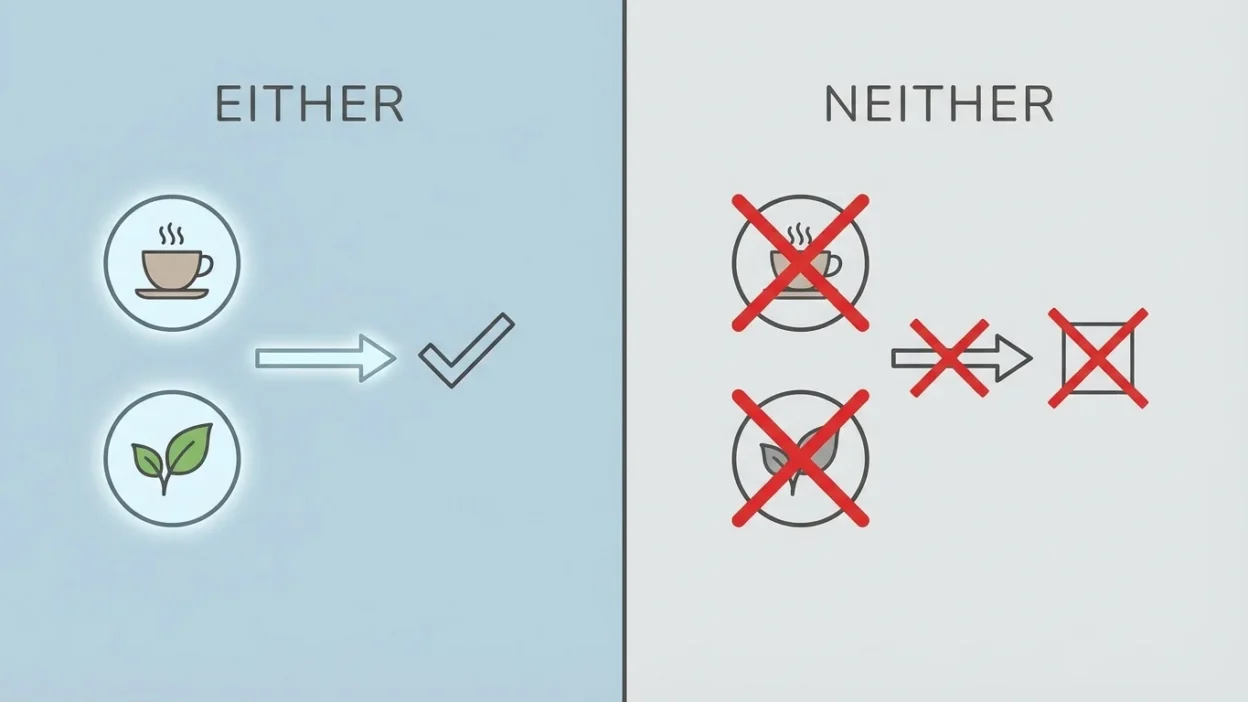
- ✅ Either = one or the other (positive/choice)
- ❌ Neither = not one and not the other (negative)
👉 Simple rule:
- Choice between two → either
- Rejecting both → neither
What Does “Either” Mean?
Either is used when referring to one of two options. It often shows a choice or possibility.
Common Uses of “Either”
- Offering options
- Showing flexibility
- Expressing agreement (in negative sentences)
Example Sentences
- You can choose either option.
- Either road will take you there.
- I don’t like coffee, and she doesn’t either.
👉 Tone: Neutral, flexible, choice-based
What Does “Neither” Mean?
Neither is used to indicate that none of the two options apply—it rejects both.
Common Uses of “Neither”
- Saying “not this and not that”
- Rejecting two choices
- Negative statements
Example Sentences
- Neither answer is correct.
- I like neither of the options.
- Neither of them showed up.
👉 Tone: Negative, definite
Either vs Neither: Key Differences
The main difference is meaning—positive choice vs negative rejection.
Comparison Table: Either vs Neither
| Feature | Either | Neither |
|---|---|---|
| Meaning | One or the other | Not one nor the other |
| Tone | Positive/neutral | Negative |
| Usage | Choice or option | Rejection of both |
| Example | Either option works | Neither option works |
How to Use “Either” Correctly
Use either when you’re talking about one of two possibilities.
Common Structures
1. Either…or
- Either you call, or I will.
- You can choose either tea or coffee.
2. In Negative Sentences (Agreement)
- I don’t like it, and he doesn’t either.
👉 Think of either as “one of two.”
How to Use “Neither” Correctly
Use neither when you’re rejecting both options.
Common Structures
1. Neither…nor
- Neither John nor Mike came.
- Neither option is good.
2. As a Standalone Negative
- “Which one do you want?”
“Neither.”
👉 Think of neither as “zero of two.”
Common Mistakes to Avoid
1. Using “Either” When You Mean “Neither”
❌ Either answer is correct (when both are wrong)
✔ Neither answer is correct
2. Double Negatives with “Neither”
❌ I don’t like neither option
✔ I like neither option
👉 “Neither” already includes a negative—no extra “don’t” needed.
3. Confusing “Either” in Negative Sentences
Correct usage:
- I don’t like it either ✔
(Not: I don’t like it neither ❌)
Helpful Tip to Remember
👉 Either = one of two
👉 Neither = none of two
Memory trick:
- Either → “E” for “one” option
- Neither → “N” for “none”
More Examples in Context
Either
- “You can sit on either side.”
- “Either plan will work.”
Neither
- “Neither solution is effective.”
- “I trust neither of them.”
Synonyms and Related Words
For Either
- One or the other
- Any one
- One option
For Neither
- None
- Not either
- Not one
👉 These help vary your writing naturally.
Either vs Neither in American and British English
- Both words are used the same way in American and British English
- No spelling differences
- Grammar rules are consistent worldwide
👉 The difference is about meaning, not region.
FAQs
1. Are either and neither opposites?
Yes, either offers a choice, while neither rejects both options.
2. Can I use “either” in negative sentences?
Yes, to show agreement (e.g., “I don’t like it either”).
3. Is “neither” always negative?
Yes, it already includes a negative meaning.
4. What comes after “neither”?
Usually “nor” (e.g., neither…nor).
5. Can I say “I don’t like neither”?
No, that’s a double negative. Say “I like neither.”
6. Which is more common?
Both are common, depending on context.
7. Can they be used for more than two items?
Traditionally for two, but sometimes used loosely for more in informal speech.
Summary
Understanding either vs neither is simple once you focus on meaning. Either is used when choosing between two options, while neither is used when rejecting both. Even though they look similar, they express opposite ideas.
Using them correctly improves clarity and prevents confusion in your writing. A small mistake here can completely change your message, so it’s worth getting right.
Actionable Takeaway
Next time you write, remember:
👉 Either = one of two (choice)
👉 Neither = none of two (negative)
Ask yourself: Am I choosing one or rejecting both?
That answer will guide you to the right word every time.