Have you ever paused while writing and wondered whether to use “lay” or “lie”? You’re definitely not alone. These two verbs are among the most commonly confused in English because their forms overlap and that can make even simple sentences tricky.
In this guide, we’ll break down lay vs lie in a clear, friendly way. You’ll learn the meanings, verb forms, examples, common mistakes, and a simple trick to remember the difference every time.
Quick Answer
- ✅ Lay = to put or place something (needs an object)
- ✅ Lie = to rest or recline (does NOT need an object)
👉 Simple rule:
- If you’re placing something → lay
- If you’re resting yourself → lie
What Does “Lay” Mean?
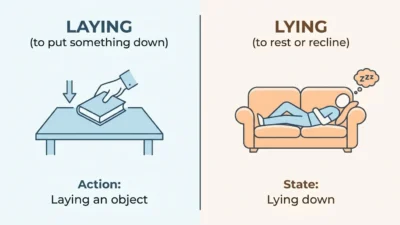
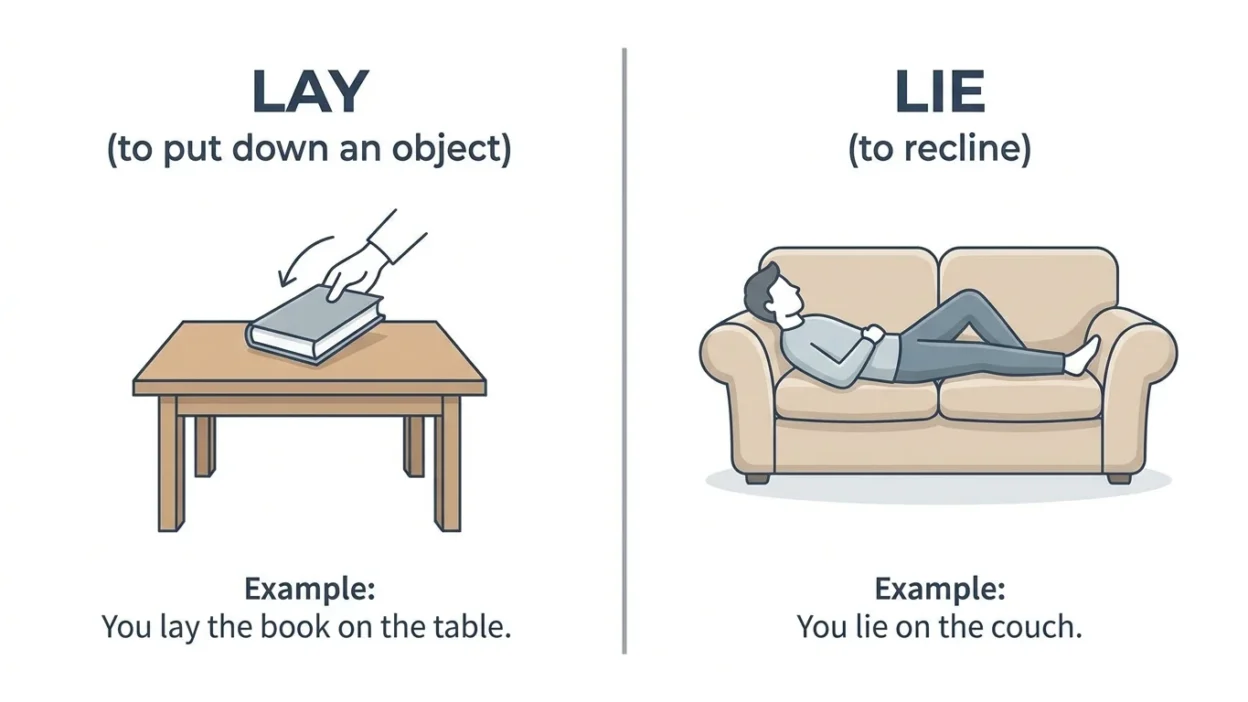
Lay is a verb that means to put or place something down. It always needs an object (something receiving the action).
Verb Forms of “Lay”
- Present: lay
- Past: laid
- Past participle: laid
Example Sentences
- Please lay the book on the table.
- She laid the baby in the crib.
- He has laid the keys on the desk.
👉 Key idea: You lay something
What Does “Lie” Mean?
Lie (not to be confused with “lie” meaning to tell a falsehood) means to rest, recline, or be in a flat position.
Verb Forms of “Lie”
- Present: lie
- Past: lay
- Past participle: lain
Example Sentences
- I want to lie down.
- Yesterday, I lay on the couch all day.
- She has lain there for hours.
👉 Key idea: You lie yourself down
Lay vs Lie: Key Differences
The difference comes down to whether there is an object.
Comparison Table: Lay vs Lie
| Feature | Lay | Lie |
|---|---|---|
| Meaning | Put/place something | Rest or recline |
| Needs object? | ✔ Yes | ✖ No |
| Present | Lay | Lie |
| Past | Laid | Lay |
| Example | Lay the book down | Lie down |
Why This Is So Confusing
The confusion comes from this overlap:
👉 The past tense of “lie” is “lay”
- Today: I lie down
- Yesterday: I lay down
That’s why mistakes are so common!
When Should You Use “Lay”?
Use lay when you’re putting something somewhere.
Examples
- “Please lay the phone here.”
- “She laid the blanket on the bed.”
👉 Ask yourself: Am I placing something?
When Should You Use “Lie”?
Use lie when you’re talking about resting or reclining.
Examples
- “I need to lie down.”
- “He lay on the grass yesterday.”
👉 Ask yourself: Am I resting myself?
Common Mistakes to Avoid
1. Using “Lay” Instead of “Lie”
❌ I’m going to lay down
✔ I’m going to lie down
👉 You’re not placing yourself—you’re resting.
2. Mixing Up Past Tense
❌ Yesterday, I laid on the couch
✔ Yesterday, I lay on the couch
👉 “Lay” is past tense of lie, not present.
3. Forgetting the Object Rule
- If there’s no object → use lie
- If there is an object → use lay
Helpful Tip to Remember
👉 Lay = place (needs object)
👉 Lie = recline (no object)
Memory trick:
- Lay → “pLay” (you place something)
- Lie → “recline” (both have “i”)
More Examples in Context
Lay
- “He laid the papers on the table.”
- “Please lay your bag here.”
Lie
- “She wants to lie down.”
- “He lay there quietly.”
Synonyms and Related Words
For Lay
- Place
- Put
- Set down
For Lie
- Rest
- Recline
- Stretch out
👉 These can help simplify your writing if needed.
Lay vs Lie in American and British English
- Both words follow the same rules in American and British English
- No spelling differences
- Confusion exists in both regions
👉 This is a universal English challenge!
FAQs
1. What is the main difference between lay and lie?
Lay needs an object; lie does not.
2. Why is this so confusing?
Because the past tense of lie is lay.
3. Is “lay down” ever correct?
Yes, if you’re placing something down (e.g., lay the book down).
4. Is “lie down” correct?
Yes, when you mean resting yourself.
5. What is the past tense of lie?
The past tense of lie is lay.
6. What is the past tense of lay?
The past tense of lay is laid.
7. Can I avoid confusion easily?
Yes just check if there’s an object.
Summary
Understanding lay vs lie comes down to one key idea: objects. Lay means to place something and always needs an object, while lie means to rest and does not need one. The confusion comes from overlapping verb forms, especially since the past tense of lie is lay.
Once you focus on whether something is being placed or someone is resting, the difference becomes much easier to remember and apply.
Actionable Takeaway
Next time you write, remember:
👉 Lay = put something down (needs object)
👉 Lie = rest yourself (no object)
Quick check: Is there something being placed?
If yes → lay
If no → lie