Have you ever paused while writing and wondered whether to use “mid day” or “midday”? It’s a small difference a space but it matters. One form is standard in modern English, while the other is usually considered incorrect.
In this guide, we’ll break down mid day vs midday, explain the correct usage, provide examples, highlight common mistakes, and help you use the right form with confidence.
Quick Answer
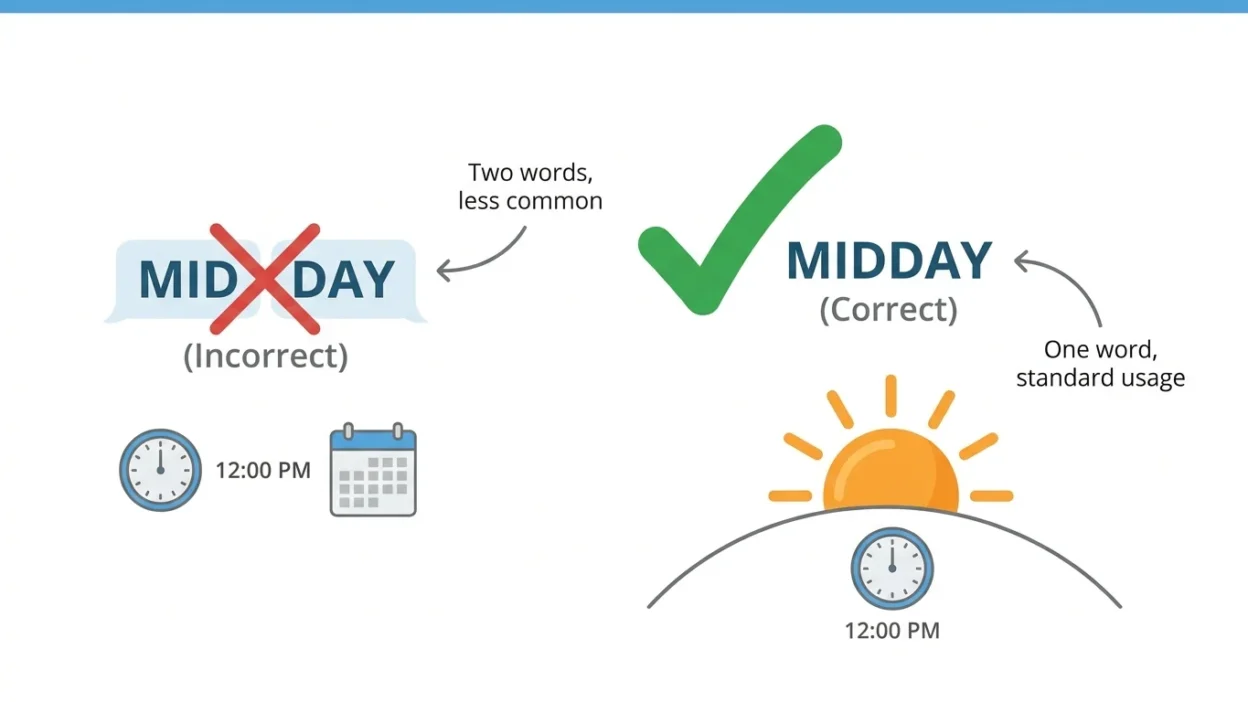
- ✅ Midday = correct standard spelling
- ❌ Mid day = incorrect in most modern usage
👉 Simple rule:
Always write midday as one word.
What Does “Midday” Mean?
Midday is a noun that refers to the middle of the day around 12:00 PM (noon) or the time when the sun is highest in the sky.
Common Meanings
- Noon or around noon
- The middle part of the day
- A general reference to early afternoon
Example Sentences
- Let’s meet at midday.
- The sun is strongest at midday.
- He usually takes a break around midday.
👉 Tone: Neutral, standard, widely accepted
Why “Mid Day” Is Incorrect
The form “mid day” (two words) is not considered standard in modern English.
Why the Confusion Happens
- Many English words combine over time (e.g., “anytime,” “today”)
- People assume “mid day” follows the same pattern
Correct Form
- Mid + day → midday ✔
- Mid day → ❌ incorrect in standard usage
👉 Most dictionaries and style guides prefer midday.
Mid Day vs Midday: Key Differences
Comparison Table: Mid Day vs Midday
| Feature | Midday | Mid Day |
|---|---|---|
| Correctness | ✔ Correct | ✖ Incorrect |
| Form | One word | Two words |
| Usage | Standard English | Nonstandard |
| Meaning | Middle of the day | Same idea (but incorrect form) |
When Should You Use “Midday”?
Use midday in all writing formal or informal when referring to the middle of the day.
Best Situations for “Midday”
- Scheduling events
- Describing time of day
- General writing
Examples
- “We’ll arrive by midday.”
- “Temperatures peak at midday.”
- “Lunch is served at midday.”
👉 Think of midday as the correct, modern form.
Common Mistakes to Avoid
1. Splitting the Word
❌ We’ll meet at mid day
✔ We’ll meet at midday
👉 Always combine it into one word.
2. Overthinking Compound Words
Some words stay separate, but midday is fully combined.
3. Mixing Forms
Don’t switch between “mid day” and “midday” stick with the correct one.
Helpful Tip to Remember
👉 Midday = one word, like “today”
Memory trick:
- If you write today, you should also write midday
More Examples in Context
- “The meeting is scheduled for midday.”
- “The heat is intense at midday.”
- “She usually rests around midday.”
Synonyms and Related Words
To vary your writing, you can also use:
- Noon
- Mid-afternoon
- Lunchtime
- Early afternoon
👉 These can help avoid repetition.
Midday in American and British English
- Midday is correct in both American and British English
- No spelling differences
- Widely accepted globally
👉 No regional variation just one correct form.
FAQs
1. Is “mid day” ever correct?
No, it is generally considered incorrect in modern standard English.
2. What is the correct spelling?
Midday (one word) is correct.
3. Does midday mean exactly 12 PM?
It can mean noon or the general middle of the day.
4. Can I use midday in formal writing?
Yes, it is perfectly acceptable in all contexts.
5. Why do people write “mid day”?
Because they assume it’s two separate words, but it has become a compound word.
6. Is midday the same as noon?
Often yes, though midday can be slightly broader.
7. Are there similar words?
Yes like “today,” “tonight,” and “anytime.”
Summary
When comparing mid day vs midday, the correct and standard form is always midday. It’s a single word used to describe the middle of the day, typically around noon. The version mid day is a common mistake and should be avoided in modern writing.
Using the correct form keeps your writing clear, polished, and aligned with standard English usage.
Actionable Takeaway
Next time you write, remember:
👉 Midday = correct (one word)
👉 Mid day = incorrect
Keep it simple combine the word and write midday every time.