Have you ever typed “passed” when you meant “past” or vice versa? You’re not alone. These two words sound identical, which makes them one of the most common spelling mix-ups in English.
In this guide, we’ll break down past vs passed in a simple, friendly way. You’ll learn their meanings, see clear examples, understand common mistakes, and get an easy trick to remember the difference every time.
Quick Answer
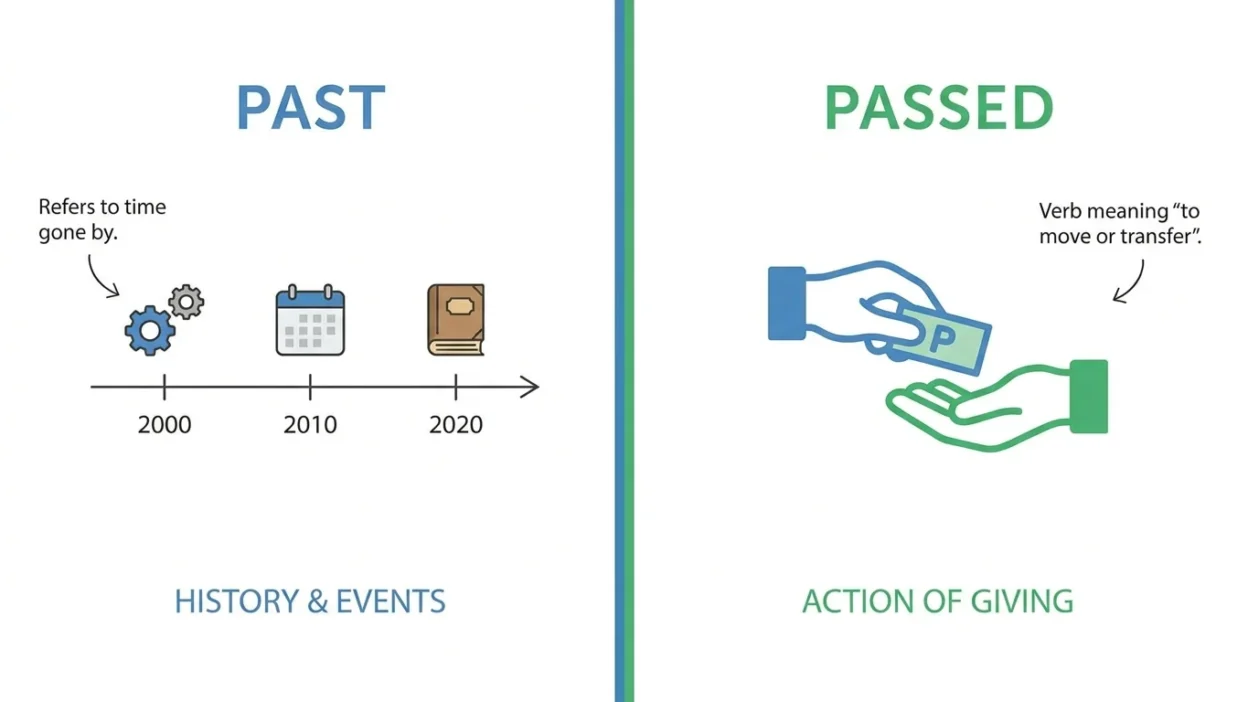
- ✅ Past = time before now OR a position (not a verb)
- ✅ Passed = past tense of “pass” (a verb/action)
👉 Simple rule:
- If it’s an action → passed
- If it’s about time or position → past
What Does “Past” Mean?
Past can be a noun, adjective, adverb, or preposition. It generally refers to time before now or movement beyond something.
Common Meanings of “Past”
- Time that has already happened
- Beyond a certain point
- Previous or former
Example Sentences
- That happened in the past.
- It’s past midnight.
- He walked past the store.
- In the past, things were different.
👉 Tone: Descriptive, not an action
What Does “Passed” Mean?
Passed is the past tense of the verb pass, which means to move, go by, give, or succeed.
Common Uses of “Passed”
- Moving by something
- Time going by
- Giving or transferring something
- Succeeding (e.g., exams)
Example Sentences
- She passed the exam.
- He passed me on the road.
- Time passed quickly.
- She passed the salt.
👉 Tone: Action-based (verb)
Past vs Passed: Key Differences
The main difference is grammar one is not a verb, and the other is.
Comparison Table: Past vs Passed
| Feature | Past | Passed |
|---|---|---|
| Part of Speech | Noun/adjective/adverb/preposition | Verb (past tense of “pass”) |
| Meaning | Time before now or beyond | Action of passing |
| Usage | Descriptive | Action-based |
| Example | Past experience | Passed the test |
When Should You Use “Past”?
Use past when referring to time, position, or something that has already happened.
Best Situations for “Past”
- Talking about history or time
- Describing position (beyond something)
- Referring to earlier events
Examples
- “We can’t change the past.”
- “It’s half past ten.”
- “He walked past me.”
👉 Think of past as time or place, not action.
When Should You Use “Passed”?
Use passed when describing an action related to “pass.”
Best Situations for “Passed”
- Moving by something
- Completing something
- Giving something
- Time moving
Examples
- “She passed the test.”
- “He passed the ball.”
- “The car passed us.”
👉 Think of passed as something happening.
Common Mistakes to Avoid
1. Using “Passed” for Time
❌ In the passed, we were happy
✔ In the past, we were happy
👉 Time → past
2. Using “Past” for Action
❌ He past me on the road
✔ He passed me on the road
👉 Action → passed
3. Confusing Similar Sentences
- He walked past me (correct: position)
- He passed me (correct: action)
👉 Same idea, different grammar!
Helpful Tip to Remember
👉 Passed = has “ed” → action already happened
👉 Past = no action → time or place
Memory trick:
- Passed → “pass + ed” (verb/action)
- Past → like “history” (not action)
More Examples in Context
Past
- “The past cannot be changed.”
- “It’s past your bedtime.”
- “She walked past the building.”
Passed
- “He passed the interview.”
- “They passed the message along.”
- “Years have passed.”
Synonyms and Related Words
For Past
- Previous
- Earlier
- Former
- Beyond
For Passed
- Moved
- Went by
- Completed
- Delivered
👉 These can help clarify meaning in your writing.
Past vs Passed in American and British English
- Both words are used the same way in American and British English
- No spelling differences
- The confusion exists in all English varieties
👉 The difference is purely grammatical.
FAQs
1. What is the main difference between past and passed?
Past refers to time or position, while passed is a verb (action).
2. Is “passed” always a verb?
Yes, it is the past tense of “pass.”
3. Can “past” be a verb?
No, “past” is not used as a verb.
4. Which is correct: “past away” or “passed away”?
Passed away is correct (verb phrase).
5. How do I know which one to use?
Check if it’s an action if yes, use passed.
6. Why are they confusing?
Because they sound exactly the same (homophones).
7. Is this mistake common?
Yes, it’s one of the most common English spelling errors.
Summary
Understanding past vs passed comes down to grammar. Past is used for time, position, or something that has already happened, while passed is the past tense of the verb pass and always involves an action.
Even though they sound the same, their roles in a sentence are completely different. Recognizing whether you’re describing time or action will help you choose the correct word every time.
Actionable Takeaway
Next time you write, remember:
👉 Past = time or position (no action)
👉 Passed = action (verb)
Quick check: Is something happening?
If yes → passed
If no → past