Have you ever typed “laying down” and wondered if it should actually be “lying down”? You’re not alone. This is one of the most common grammar mix-ups in English because both words look similar and they come from confusing verb forms.
In this guide, we’ll break down laying vs lying in a simple, clear way. You’ll learn what each word means, when to use them, examples, common mistakes, and an easy trick to remember the difference every time.
Quick Answer
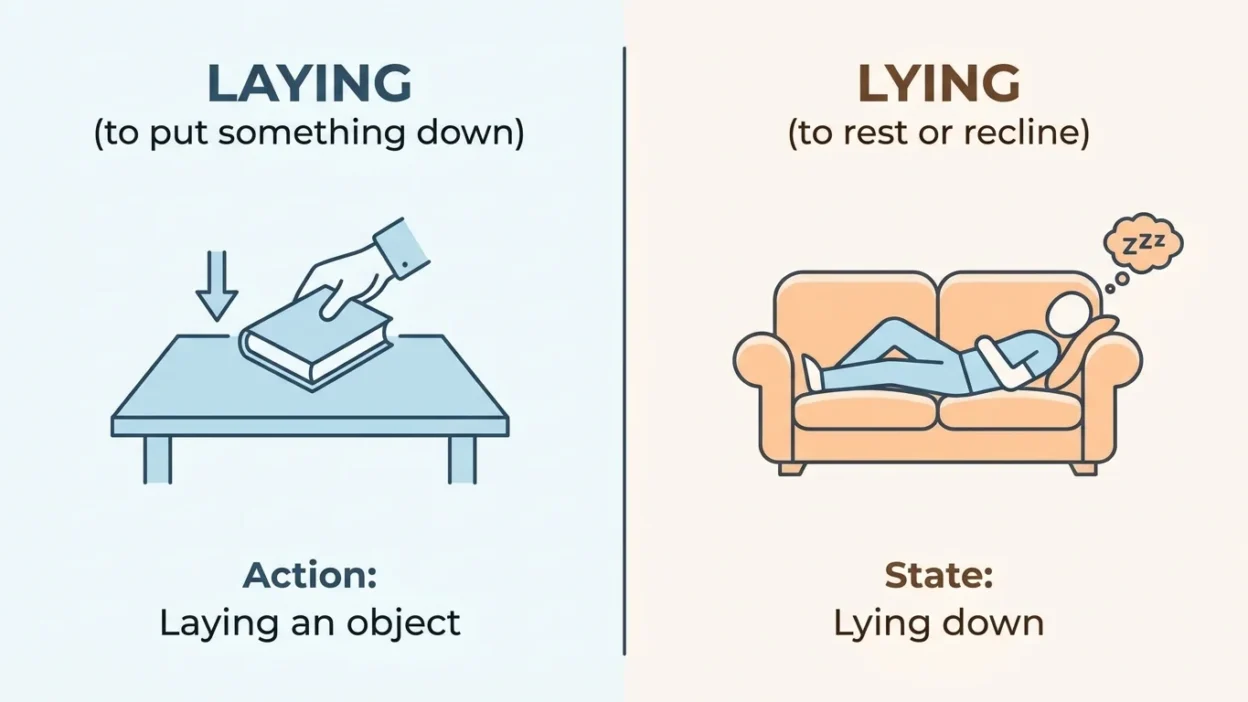
- ✅ Laying = putting or placing something (needs an object)
- ✅ Lying = resting or reclining (no object needed)
👉 Simple rule:
- Placing something → laying
- Resting yourself → lying
What Does “Laying” Mean?
Laying is the present participle of lay, which means to put or place something down. It always needs an object.
Key Idea
👉 You are laying something
Example Sentences
- She is laying the table for dinner.
- He is laying the book on the desk.
- The workers are laying tiles on the floor.
👉 Important: There must be something being placed.
What Does “Lying” Mean?
Lying is the present participle of lie, meaning to rest, recline, or be in a flat position.
Key Idea
👉 You are lying down yourself
Example Sentences
- I am lying on the bed.
- The dog is lying on the floor.
- She is lying in the sun.
👉 Important: No object is needed.
Laying vs Lying: Key Differences
The main difference is whether there is an object.
Comparison Table: Laying vs Lying
| Feature | Laying | Lying |
|---|---|---|
| Meaning | Placing something | Resting/reclining |
| Needs object? | ✔ Yes | ✖ No |
| Verb base | Lay | Lie |
| Example | Laying the book | Lying on the couch |
Why This Is So Confusing
The confusion comes from related verb forms:
- Lay (present) → laying
- Lie (present) → lying
- Lie (past) → lay
👉 Yes, the past of lie is lay that’s what makes this tricky!
When Should You Use “Laying”?
Use laying when you are placing something somewhere.
Examples
- “She is laying the baby in the crib.”
- “He is laying his phone on the table.”
👉 Ask yourself: What am I placing?
When Should You Use “Lying”?
Use lying when someone is resting or reclining.
Examples
- “I am lying down.”
- “He is lying on the sofa.”
👉 Ask yourself: Am I resting myself?
Common Mistakes to Avoid
1. Saying “Laying Down” Instead of “Lying Down”
❌ I am laying down
✔ I am lying down
👉 You’re not placing yourself you’re resting.
2. Forgetting the Object Rule
❌ She is laying on the bed
✔ She is lying on the bed
👉 No object → use lying
3. Mixing Up Verb Forms
Always check whether something is being placed or someone is resting.
Helpful Tip to Remember
👉 Laying = placing something
👉 Lying = resting yourself
Memory trick:
- Laying → “pLaying” (you place something)
- Lying → “reclining” (both have “i”)
More Examples in Context
Laying
- “They are laying bricks.”
- “She is laying out clothes.”
Lying
- “He is lying in bed.”
- “The cat is lying by the window.”
Synonyms and Related Words
For Laying
- Placing
- Putting
- Setting
For Lying
- Resting
- Reclining
- Stretching out
👉 These can help simplify your writing.
Laying vs Lying in American and British English
- Both forms follow the same rules in American and British English
- No spelling differences
- The confusion exists worldwide
👉 This is a universal grammar challenge!
FAQs
1. What is the main difference between laying and lying?
Laying needs an object; lying does not.
2. Which is correct: “laying down” or “lying down”?
Lying down is correct when you mean resting.
3. Why do people confuse these words?
Because of overlapping verb forms like “lay” being the past of “lie.”
4. Can “laying” ever be correct?
Yes, when you are placing something (e.g., laying the table).
5. Is “lying” only for rest?
Yes, in this context it means reclining (not telling a lie).
6. What’s the easiest way to remember?
Check if there’s an object involved.
7. Can I avoid confusion?
Yes just ask: Am I placing something or resting?
Summary
Understanding laying vs lying comes down to one simple rule: objects. Laying means placing something and always requires an object, while lying means resting and does not require one. The confusion happens because of tricky verb forms, but the core difference is actually straightforward.
Once you focus on whether something is being placed or someone is resting, you’ll find it much easier to choose the correct word.
Actionable Takeaway
Next time you write, remember:
👉 Laying = placing something (needs object)
👉 Lying = resting yourself (no object)
Quick check: Is something being placed?
If yes → laying
If no → lying