Have you ever wondered whether to write “onstage” as one word or “on stage” as two? You’re not alone. Both forms appear in writing, and while they’re closely related, they’re used in slightly different ways.
In this simple, friendly guide, we’ll break down onstage vs on stage, explain the correct usage, give clear examples, and help you choose the right form with confidence.
Quick Answer
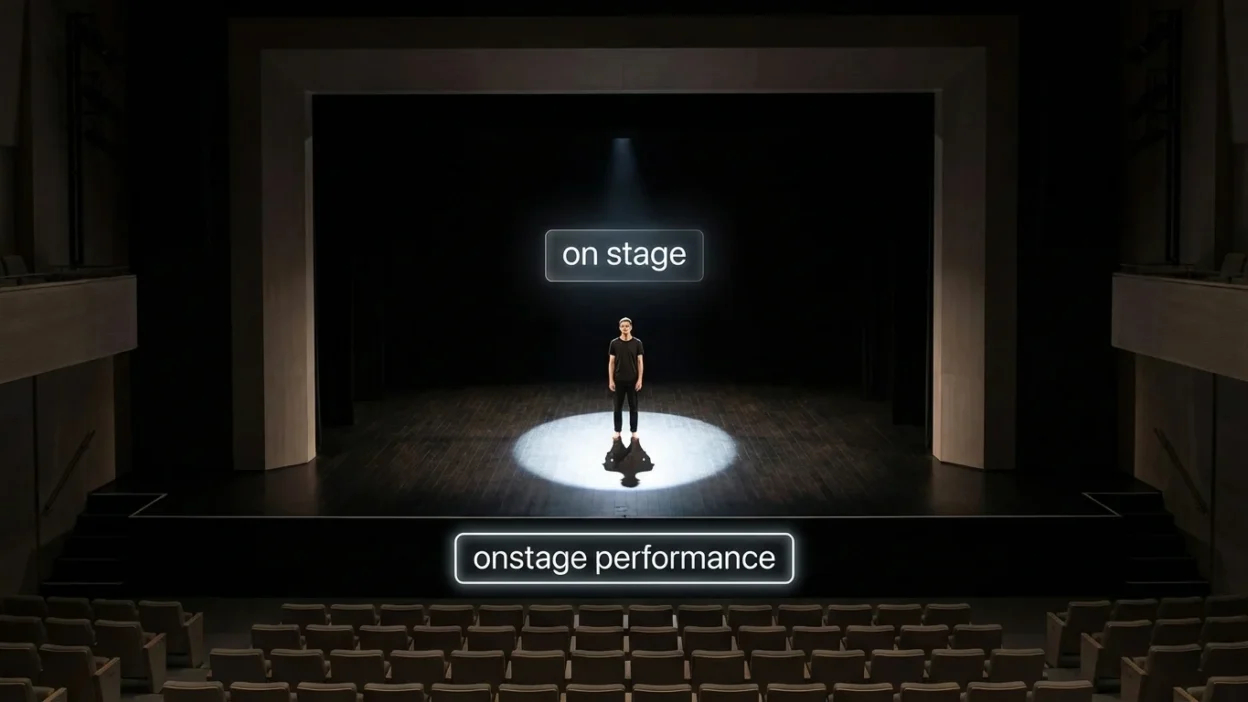
- ✅ On stage = more common and standard (two words)
- ✅ Onstage = correct but less common, often used as an adjective or adverb
👉 Simple rule:
- General use → on stage
- Describing something (adjective/adverb) → onstage
What Does “On Stage” Mean?
On stage is a phrase that means physically being on a stage or platform, especially during a performance.
Common Uses of “On Stage”
- Talking about performers or events
- Describing location
- Everyday and formal writing
Example Sentences
- The singer walked on stage confidently.
- The actors are already on stage.
- She felt nervous standing on stage.
👉 Tone: Natural, widely used, and standard in most contexts
What Does “Onstage” Mean?
Onstage is a single-word form often used as an adjective or adverb, especially in more formal or descriptive writing.
Common Uses of “Onstage”
- Describing actions happening on stage
- Used before nouns (adjective form)
- More common in journalism or theater writing
Example Sentences
- His onstage performance was incredible.
- She has strong onstage presence.
- The actor spoke onstage during the finale.
👉 Tone: Slightly more formal and descriptive
Onstage vs On Stage: Key Differences
The difference comes down to structure and usage.
Comparison Table: Onstage vs On Stage
| Feature | On Stage | Onstage |
|---|---|---|
| Form | Two words (phrase) | One word |
| Usage | General, location-based | Descriptive (adjective/adverb) |
| Tone | Neutral and common | Slightly formal |
| Example | She stood on stage | Onstage performance |
When Should You Use “On Stage”?
Use on stage when referring to someone’s physical position or location.
Best Situations for “On Stage”
- Talking about performers
- Describing where something happens
- Everyday writing
Examples
- “He is on stage right now.”
- “The band came on stage at 8 PM.”
👉 Think of on stage as location-focused.
When Should You Use “Onstage”?
Use onstage when describing something related to stage performance.
Best Situations for “Onstage”
- Before nouns (adjective)
- Formal or descriptive writing
- Theater or performance contexts
Examples
- “Her onstage energy was amazing.”
- “They had great onstage chemistry.”
👉 Think of onstage as description-focused.
Common Mistakes to Avoid
1. Using “Onstage” for Location
❌ He is onstage right now
✔ He is on stage right now
👉 Use on stage for physical position
2. Splitting Adjective Form Incorrectly
❌ On stage performance
✔ Onstage performance
👉 Combine it when describing a noun
3. Mixing Both Forms Randomly
Be consistent based on how you’re using the word.
Helpful Tip to Remember
👉 On stage = where (location)
👉 Onstage = what kind (description)
Memory trick:
- “On stage” = place
- “Onstage” = performance style
More Examples in Context
On Stage
- “She walked on stage to applause.”
- “All performers are on stage.”
Onstage
- “His onstage presence is powerful.”
- “The play featured strong onstage dialogue.”
Synonyms and Related Words
For On Stage
- Performing
- In front of an audience
- Live
For Onstage
- Theatrical
- Performance-based
- Live-action
👉 These can help diversify your writing.
Onstage vs On Stage in American and British English
- Both forms are used in American and British English
- On stage is more commonly used in both
- Onstage appears more in formal or media writing
👉 No major regional difference just usage preference.
FAQs
1. Are onstage and on stage the same?
They are similar, but used differently. On stage refers to location, while onstage is descriptive.
2. Which is more common?
On stage is more commonly used in everyday writing.
3. Can I use onstage in sentences?
Yes, especially as an adjective (e.g., onstage performance).
4. Is “on stage” always correct?
Yes, especially when referring to physical position.
5. Can I say “on stage presence”?
It’s better to say onstage presence.
6. Which is better for formal writing?
Both are correct, but onstage may sound more polished in descriptive contexts.
7. Are there spelling differences worldwide?
No, both forms are used the same way in American and British English.
Summary
Understanding onstage vs on stage comes down to how the word is used. On stage is a two word phrase used to describe location, while onstage is a one-word form used as an adjective or adverb to describe performance-related qualities.
Using the correct form helps your writing sound natural and precise. In most cases, on stage is the safer and more common choice, while onstage adds a more polished, descriptive tone when needed.
Actionable Takeaway
Next time you write, remember:
👉 On stage = location (where something happens)
👉 Onstage = description (type of performance)
A quick check of context will help you choose the right form every time.