
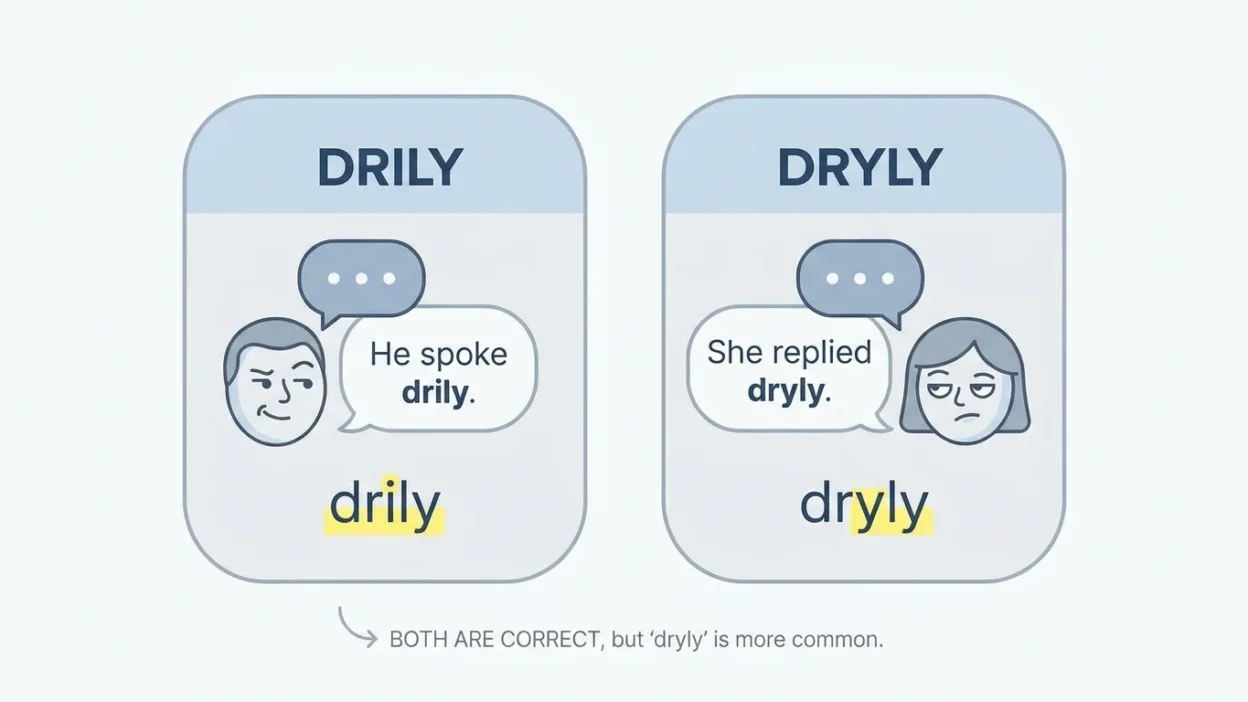
Have you ever written the word “drily” or “dryly” and stopped to wonder which spelling is actually correct? You are not alone. These two words look different, but surprisingly, both are accepted in English.
The confusion happens because English allows two spelling variations for the adverb form of “dry.” While one version is more common today, the other is still considered correct by major dictionaries.
In this guide, we’ll explain drily vs dryly, show the differences, provide examples, and help you choose the best spelling with confidence.
Quick Answer
✅ Both drily and dryly are correct
⭐ Dryly is more common in modern English
⭐ Drily is less common but still accepted
👉 Simple rule: Use dryly for everyday writing unless a style guide prefers drily.
What Do “Drily” and “Dryly” Mean?
Both drily and dryly are adverbs that describe something said or done in a dry manner.
Common Meanings
- In a sarcastic or unemotional way
- Without much emotion
- In a literal dry condition without moisture
Example Sentences
- “That was helpful,” she said dryly.
- “I expected this outcome,” he replied drily.
- The clothes dried drily in the warm air.
👉 In most cases, the word is used to describe humor, speech, or tone.
Drily vs Dryly: Key Differences
The meanings are exactly the same. The only real difference is spelling preference and frequency of use.
Comparison Table: Drily vs Dryly
| Feature | Drily | Dryly |
|---|---|---|
| Correct spelling | ✔ Yes | ✔ Yes |
| More common | Less common | More common |
| Meaning | Same | Same |
| Modern usage | Rareer | Preferred |
| Recommended for everyday writing | Sometimes | Yes |
Why Are There Two Spellings?
English sometimes allows multiple adverb forms for adjectives ending in “y.”
The adjective is:
- dry
Possible adverb forms:
- drily
- dryly
Unlike many spelling differences, this is not mainly about American vs British English. Both spellings appear in both varieties of English.
However, dryly is generally more popular in modern writing.
When Should You Use “Dryly”?
Use dryly in most modern writing situations.
Best Situations
- Blogs and articles
- Professional communication
- Creative writing
- Everyday English
Examples
- She smiled dryly at the joke.
- “Wonderful,” he said dryly.
- The professor dryly corrected the mistake.
👉 Think of dryly as the safer and more natural modern choice.
When Should You Use “Drily”?
Use drily if:
- A style guide prefers it
- You want a more literary or traditional feel
- You are following older writing conventions
Examples
- He drily noted the obvious problem.
- “How surprising,” she remarked drily.
👉 Drily is correct but less commonly seen today.
Common Mistakes to Avoid
1. Thinking One Spelling Is Wrong
❌ Drily is incorrect
✔ Both spellings are correct
2. Using Rare Forms Accidentally
Some writers use drily without realizing dryly is more familiar to readers.
3. Mixing Styles
Choose one spelling and stay consistent throughout your writing.
Helpful Tip to Remember
👉 Dryly is more common and modern
👉 Drily is more traditional but still correct
Memory trick:
- Dryly keeps the full word “dry”
- That makes it easier for many readers to recognize
More Examples in Context
Dryly
- He dryly commented on the situation.
- She answered dryly without smiling.
- The comedian spoke dryly throughout the show.
Drily
- The author drily described the event.
- “Of course,” he said drily.
Synonyms and Related Words
Depending on context, you can also use:
- Sarcastically
- Coolly
- Ironically
- Emotionlessly
- Flatly
👉 These alternatives can add variety to your writing.
American vs British English Note
Unlike many spelling pairs, drily vs dryly is not strongly divided by American and British English.
Both versions are accepted in:
- American English
- British English
However, dryly is more widely used overall.
FAQs
1. Which is correct: drily or dryly?
Both are correct English spellings.
2. Which spelling is more common?
Dryly is more common in modern writing.
3. Is drily old fashioned?
Not exactly, but it feels more traditional and literary.
4. Do drily and dryly mean different things?
No, they have the same meaning.
5. Which spelling should I use in professional writing?
Dryly is usually the safer choice.
6. Are both accepted in dictionaries?
Yes, major dictionaries accept both spellings.
7. Can I use both in one article?
It is better to choose one spelling and stay consistent.
Summary
Understanding drily vs dryly is simple once you know the rule. Both spellings are correct and mean the same thing. However, dryly is more common in modern English and is usually the preferred choice for everyday writing.
Drily still appears in books and formal writing, but many readers find dryly more natural and familiar. Choosing one consistent spelling will help your writing look polished and professional.
Actionable Takeaway
Next time you write the word, remember:
👉 Dryly is the modern common choice
👉 Drily is correct but less common
For most writing, using dryly is the easiest and safest option.