
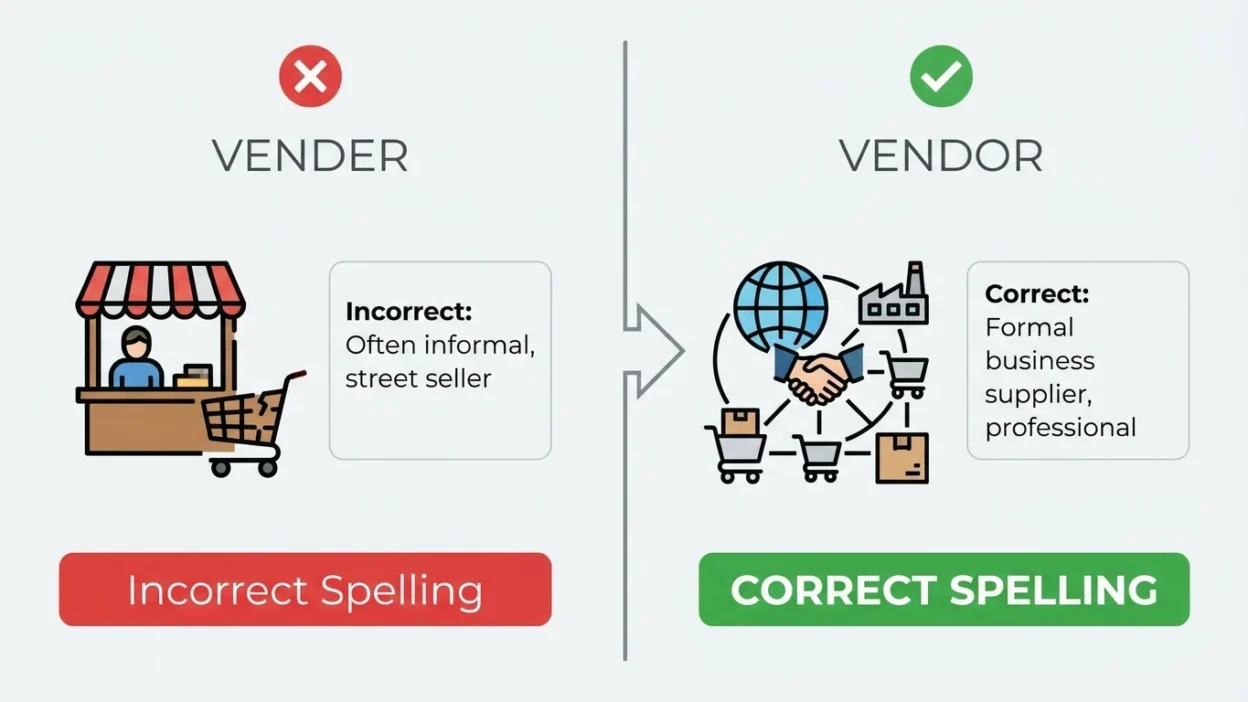
Have you ever typed “vender” and wondered if it should actually be “vendor”? You are not alone. These two words look very similar, but only one is commonly accepted in modern English.
In business, technology, and everyday communication, using the correct spelling matters because the wrong version can appear unprofessional or confusing.
In this guide, we’ll explain vender vs vendor, show the correct spelling, provide examples, highlight common mistakes, and help you remember the difference easily.
Quick Answer
✅ Vendor is the standard and correct spelling in modern English
⚠️ Vender exists but is extremely rare and usually avoided
👉 Simple rule: Use vendor in almost all situations.
What Does “Vendor” Mean?
A vendor is a person or company that sells products or services.
Common Meanings
- A seller or supplier
- A business providing goods
- A company offering services or software
Example Sentences
- The food vendor opened early.
- We contacted the software vendor for support.
- Street vendors lined the market road.
👉 Vendor is commonly used in business, retail, technology, and commerce.
What About “Vender”?
The word vender technically exists as a rare variant related to the verb vend, which means “to sell.”
However:
- It is rarely used in modern English
- Most dictionaries label it uncommon
- Native speakers almost always use vendor instead
Rare Example
- He was once called a vender of fine wines.
Even here, vendor sounds more natural today.
Vender vs Vendor: Key Differences
Comparison Table: Vender vs Vendor
| Feature | Vendor | Vender |
|---|---|---|
| Standard modern spelling | ✔ Yes | ✖ Usually no |
| Commonly used | ✔ Very common | ✖ Rare |
| Professional writing | ✔ Preferred | ✖ Avoid |
| Business and technology use | ✔ Yes | ✖ Almost never |
| Recommended | ✔ Always | ✖ Usually avoid |
Why “Vendor” Is Preferred
Modern English strongly favors vendor because it became the dominant standard spelling over time.
You will commonly see vendor in:
- Business contracts
- E commerce
- Technology industries
- Retail systems
- Corporate communication
Common Phrases
- Software vendor
- Approved vendor
- Street vendor
- Vendor management
- Vendor agreement
👉 “Vendor” is the accepted professional standard.
When Should You Use “Vendor”?
Use vendor in nearly every situation involving selling or supplying goods and services.
Best Situations
- Business writing
- Technology and software
- Retail and commerce
- Academic writing
- Professional communication
Examples
- The vendor delivered the products on time.
- Our company works with multiple vendors.
- She bought lunch from a street vendor.
Should You Ever Use “Vender”?
In modern writing, usually no.
Although some dictionaries recognize vender as a variant, it sounds outdated or incorrect to most readers.
Better Choice
✔ Vendor
Avoid
❌ Vender
👉 Unless you are discussing historical language usage, vendor is almost always the right choice.
Common Mistakes to Avoid
1. Using “Vender” in Professional Writing
❌ The vender supplied new equipment
✔ The vendor supplied new equipment
2. Assuming Both Are Equally Common
They are not. Vendor is overwhelmingly preferred.
3. Mixing Spellings
Choose vendor consistently.
Helpful Tip to Remember
👉 Vendor is the modern standard spelling
Memory trick:
- Think of “vendor machine”
- Not “vender machine”
Since you often hear “vendor” in business and technology, it becomes easier to remember.
More Examples in Context
Correct Usage with Vendor
- The vendor updated the software.
- Food vendors filled the festival.
- We approved a new vendor last week.
- The online vendor offered free shipping.
Rare Usage with Vender
- Historical texts may mention a vender.
👉 In modern English, vendor is almost always preferred.
Synonyms and Related Words
Depending on context, you can also use:
- Seller
- Supplier
- Merchant
- Retailer
- Provider
👉 These words can sometimes replace vendor naturally.
American vs British English Note
Unlike many spelling differences, vendor is standard in both:
- American English
- British English
The spelling vender is rare in both varieties.
FAQs
1. Which is correct: vender or vendor?
Vendor is the standard and preferred spelling.
2. Is “vender” a real word?
Yes, but it is very rare and outdated in modern usage.
3. Which spelling should I use professionally?
Always use vendor.
4. Is “vendor” used in both American and British English?
Yes, vendor is standard in both.
5. Why do people write “vender”?
Usually because of spelling confusion with the verb “vend.”
6. Is “vender” wrong?
Not technically, but it is usually avoided.
7. Which spelling is better for SEO?
Vendor is far more searchable and widely recognized.
Summary
Understanding vender vs vendor is simple once you know the modern standard. Vendor is the correct and widely accepted spelling used in business, retail, technology, and professional communication. While vender technically exists, it is extremely rare and usually considered outdated.
For clear and professional writing, using vendor is the safest and best choice. Most readers expect this spelling, and it appears in nearly all modern English usage.
Actionable Takeaway
Next time you write the word, remember:
👉 Vendor = correct modern standard
👉 Vender = rare and usually avoided
For professional, natural sounding English, stick with vendor every time.