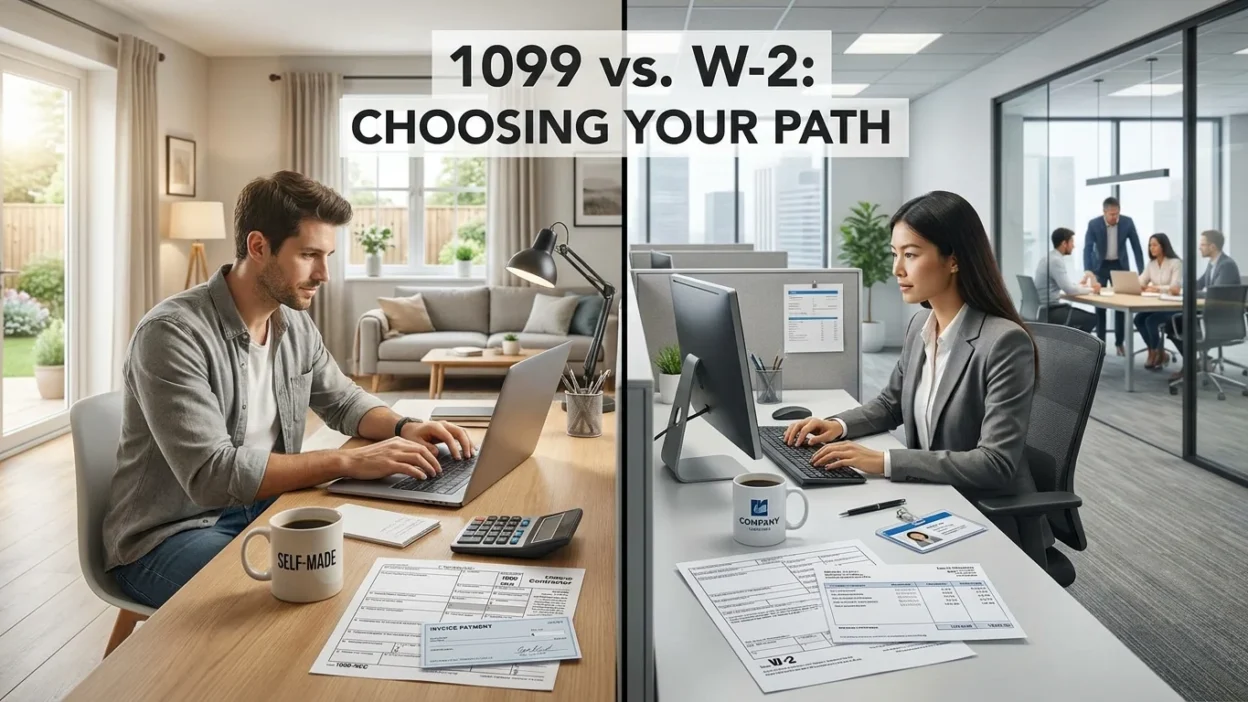
Getting your first job offer or freelance gig can feel exciting until someone asks, “Will you be paid as a W-2 employee or a 1099 contractor?” Suddenly, simple work turns into confusing tax language.
A lot of people assume both are basically the same because either way, you are earning money. But the difference between a 1099 and a W-2 can seriously affect your taxes, benefits, job security, paycheck size, and even your work-life balance.
One option may give you health insurance and stable income. The other may offer flexibility and higher earning potential. Neither is automatically better for everyone.
That is why understanding 1099 vs W-2 matters so much before accepting a job or side hustle.
If you are a freelancer, remote worker, gig worker, creator, consultant, or traditional employee, this guide will help you understand exactly how these two work classifications compare in real life.
Quick Answer: 1099 vs W-2
A W-2 worker is a regular employee whose employer withholds taxes and may provide benefits like health insurance and paid leave. A 1099 worker is an independent contractor responsible for handling their own taxes, benefits, and business expenses.
W-2 jobs offer more stability and protections, while 1099 work usually provides more freedom and flexibility.
What Is a W-2 Employee?
A W-2 employee works directly for a company as an official employee.
The employer controls:
- Your schedule
- Your work responsibilities
- Your work processes
- Tax withholding
At the end of the year, employees receive a W-2 tax form showing:
- Income earned
- Taxes withheld
- Social Security contributions
- Medicare contributions
Common Examples of W-2 Jobs
- Office workers
- Teachers
- Retail employees
- Nurses
- Software engineers
- Customer service staff
What Is a 1099 Worker?
A 1099 worker is an independent contractor or self-employed worker.
Instead of being employed directly, you provide services to clients or businesses independently.
You receive a 1099 tax form showing how much you were paid during the year.
Common Examples of 1099 Work
- Freelancers
- Consultants
- Delivery drivers
- Graphic designers
- Content creators
- Real estate agents
- Independent developers
1099 workers are essentially running their own business, even if it is small.
1099 vs W-2: Main Differences
| Feature | W-2 Employee | 1099 Contractor |
|---|---|---|
| Tax Withholding | Employer handles taxes | You pay your own taxes |
| Benefits | Often included | Usually not included |
| Schedule Control | Employer controls | More personal control |
| Job Stability | Higher | Lower |
| Flexibility | Limited | Higher |
| Paid Time Off | Often included | Usually unpaid |
| Health Insurance | Sometimes provided | Self-paid |
| Retirement Plans | Often available | Self-managed |
| Expense Deductions | Limited | More tax deductions |
| Income Predictability | Stable | Can vary |
Taxes: The Biggest Difference Between 1099 and W-2
Taxes are where most people notice the biggest impact.
W-2 Taxes
Employers automatically withhold:
- Federal taxes
- State taxes
- Social Security
- Medicare
This makes taxes simpler for employees.
1099 Taxes
1099 contractors must:
- Track income
- Save money for taxes
- Pay quarterly estimated taxes
- Handle self-employment taxes
This requires more responsibility.
Why Some People Prefer W-2 Jobs
W-2 jobs provide structure and security.
Benefits of W-2 Employment
Stable Income
You usually receive predictable paychecks.
Employer Benefits
Many companies offer:
- Health insurance
- Retirement plans
- Paid vacation
- Sick leave
- Bonuses
Easier Taxes
You do not need to calculate taxes manually every quarter.
Legal Protections
Employees may receive:
- Overtime protections
- Workers’ compensation
- Unemployment benefits
Why Some People Prefer 1099 Work
1099 work appeals to people who value freedom and independence.
Benefits of 1099 Contracting
Flexible Schedule
You often decide:
- When to work
- Where to work
- Which clients to accept
Higher Income Potential
Many contractors charge premium rates.
Business Tax Deductions
You may deduct:
- Home office expenses
- Equipment
- Internet bills
- Travel expenses
- Software subscriptions
Multiple Income Streams
You can work with several clients at once.
Pros and Cons of W-2 Employment
Pros
- Stable pay
- Benefits included
- Easier tax filing
- Legal protections
- Paid leave
Cons
- Less flexibility
- Fixed schedules
- Limited deductions
- Employer control
- Income ceiling
Pros and Cons of 1099 Work
Pros
- More freedom
- Flexible lifestyle
- Greater tax deductions
- Potentially higher earnings
- Remote work opportunities
Cons
- No employer benefits
- Complex taxes
- Irregular income
- No paid vacation
- Higher financial responsibility
Which Pays More: 1099 or W-2?
It depends.
1099 workers often earn higher hourly rates because they cover:
- Their own taxes
- Insurance
- Retirement
- Equipment
- Unpaid time off
A contractor making $60/hour may not actually keep much more money than a W-2 employee earning $40/hour with benefits.
Is 1099 Better for Remote Work?
Many remote freelancers and creators prefer 1099 work because it offers flexibility.
Popular 1099 remote jobs include:
- Writing
- Graphic design
- Programming
- Video editing
- Marketing
- Consulting
However, many remote employees are still hired as W-2 workers.
Health Insurance: W-2 vs 1099
W-2 Employees
Employers may partially or fully cover:
- Medical insurance
- Dental insurance
- Vision insurance
1099 Contractors
You usually buy your own insurance, which can be expensive.
This is one of the biggest disadvantages of 1099 work.
Retirement Benefits Comparison
W-2 Employees
Employers may offer:
- 401(k) plans
- Matching contributions
- Pension plans
1099 Workers
Contractors manage retirement independently using:
- SEP IRAs
- Solo 401(k)s
- Roth IRAs
Can a Company Misclassify Workers?
Yes.
Some businesses incorrectly classify workers as 1099 contractors to avoid paying benefits or payroll taxes.
A worker may legally qualify as W-2 if the company controls:
- Work schedule
- Work tools
- Daily supervision
- Job methods
Worker classification rules matter legally and financially.
Best Option for Different Types of People
| Situation | Better Choice |
|---|---|
| Stable family income | W-2 |
| Flexible lifestyle | 1099 |
| Freelancers | 1099 |
| Corporate career growth | W-2 |
| Side hustles | 1099 |
| Long-term job security | W-2 |
| Entrepreneurs | 1099 |
| First-time workers | W-2 |
Budget and Financial Planning Differences
W-2 Budgeting
Usually easier because income is stable and taxes are automatically deducted.
1099 Budgeting
Requires discipline because you must:
- Save for taxes
- Track expenses
- Plan for slow months
- Handle insurance costs
Financial planning becomes more important.
Expert Advice Before Choosing 1099 or W-2
Before accepting any job, ask:
- Will benefits be included?
- Is the pay high enough to cover taxes?
- How stable is the work?
- How important is flexibility?
- Can I manage self-employment taxes?
Do not only focus on hourly pay.
Sometimes lower-paying W-2 jobs offer better total value because of benefits and stability.
Best Overall Winner: 1099 vs W-2
W-2 Wins for:
- Stability
- Benefits
- Easier taxes
- Long-term employment
- Predictable income
1099 Wins for:
- Freedom
- Flexibility
- Entrepreneurship
- Remote work
- Tax deductions
Neither is universally better. The right choice depends on your goals and lifestyle.
Final
The difference between 1099 vs W-2 is really about independence versus stability.
If you want predictable income, benefits, and simpler taxes, W-2 employment is usually the safer and easier option.
If you value freedom, flexibility, and higher income potential, 1099 work may fit your lifestyle better.
Many people even combine both by working a W-2 job while building 1099 side income.
The smartest choice is the one that supports your financial goals, stress level, career plans, and preferred lifestyle.
FAQs
What is the main difference between 1099 and W-2?
A W-2 worker is an employee with taxes withheld by the employer, while a 1099 worker is an independent contractor responsible for their own taxes.
Do 1099 workers pay more taxes?
1099 workers often pay more out-of-pocket taxes because they cover the full self-employment tax amount themselves.
Is W-2 better than 1099?
W-2 is better for stability and benefits, while 1099 is better for flexibility and independence.
Can you switch from 1099 to W-2?
Yes, many workers transition between contractor and employee roles depending on career opportunities.
Do 1099 workers get benefits?
Usually no. Independent contractors typically handle their own insurance, retirement, and paid time off.
Can a remote worker be W-2?
Yes, many remote employees are officially hired as W-2 workers.
Is freelancing considered 1099 work?
Yes, most freelancers receive 1099 forms for contract-based work.
Which is better for taxes: 1099 or W-2?
W-2 is simpler for taxes, but 1099 workers may qualify for more deductions.
Do 1099 workers get refunds?
Yes, contractors can still receive tax refunds depending on deductions and estimated payments.
Is Uber driver work considered 1099?
Yes, rideshare drivers are generally classified as independent contractors.