Have you ever wondered whether to say “Myanmar” or “Burma”? Both names refer to the same country in Southeast Asia, but the choice between them can carry historical, political, cultural, and diplomatic significance.
Many people are confused because governments, news organizations, and individuals sometimes use different names depending on context.
In this guide, we’ll explain Myanmar vs Burma, explore the history behind the names, show modern usage, and help you understand why both terms still exist today.
Quick Answer
✅ Myanmar and Burma refer to the same country
General Difference
- Myanmar is the country’s official modern name
- Burma is the older English name still used by some governments and individuals
👉 Simple rule:
- Use Myanmar for official modern references
- Use Burma when discussing history, politics, or older contexts
What Is Myanmar?
Myanmar is the official name currently recognized by:
- The United Nations
- Most governments
- International organizations
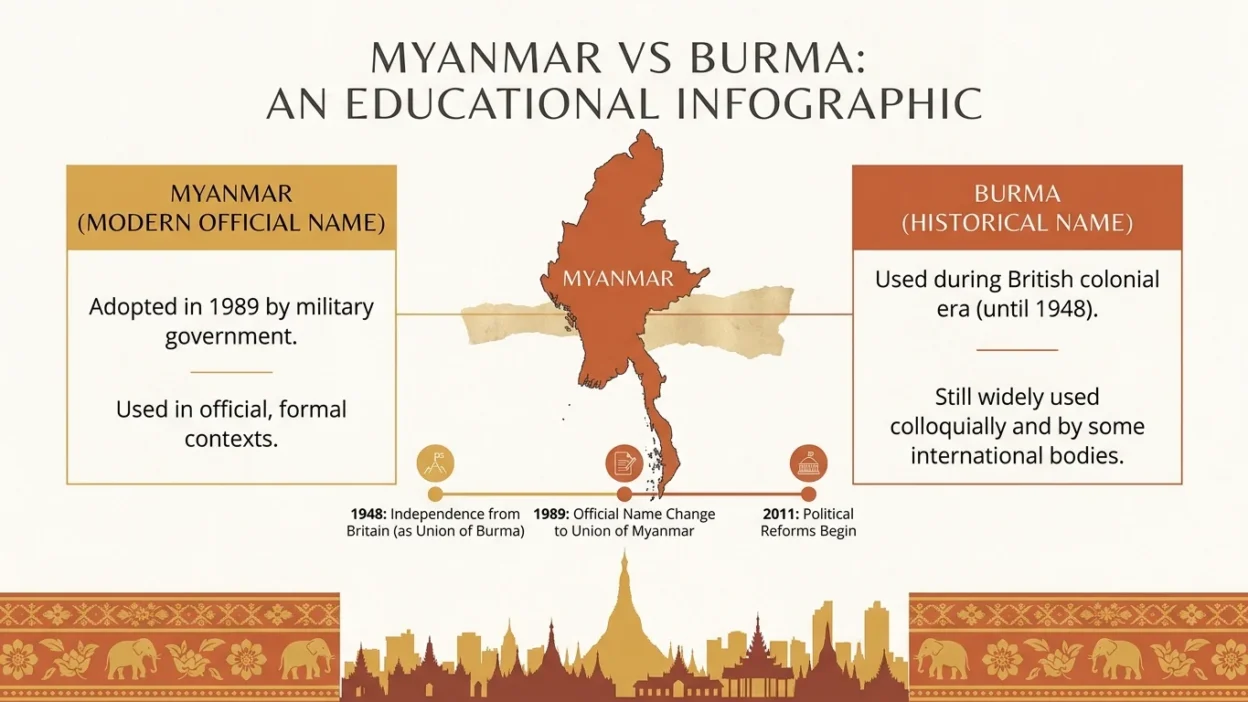
The name Myanmar became officially adopted by the military government in 1989.
Example Sentences
- Myanmar is located in Southeast Asia.
- The capital of Myanmar is Naypyidaw.
- Myanmar shares borders with Thailand, China, and India.
What Is Burma?
Burma was the traditional English name for the country before 1989.
The name comes from:
- Bamar
- The largest ethnic group in the country
Many people still use Burma:
- Historically
- Politically
- Culturally
Example Sentences
- Burma gained independence from Britain in 1948.
- Some activists still prefer the name Burma.
- Older maps often use Burma.
Myanmar vs Burma: Key Differences
Comparison Table: Myanmar vs Burma
| Feature | Myanmar | Burma |
|---|---|---|
| Official modern name | ✔ Yes | ✖ No |
| Historical English name | ✖ No | ✔ Yes |
| Adopted officially | 1989 | Earlier traditional usage |
| Used by United Nations | ✔ Yes | Rarely |
| Political sensitivity | Sometimes | Sometimes |
Why Was the Name Changed?
In 1989, the ruling military government officially changed:
- Burma → Myanmar
Other changes included:
- Rangoon → Yangon
The government argued that:
- Myanmar was more inclusive
- Burma mainly reflected one ethnic group
However, critics argued:
- The military government lacked legitimacy
- The population was not consulted
👉 Because of this, the naming issue became politically sensitive.
Why Do Some People Still Say “Burma”?
Some governments, journalists, and activists continued using Burma because:
- They opposed the military regime
- They preferred the traditional English name
- They viewed the renaming as politically controversial
Over time, many countries gradually shifted toward Myanmar in official use.
Which Name Is More Common Today?
Internationally
Myanmar is now more common in:
- Diplomacy
- International organizations
- Geography
- News reporting
Historically or Politically
Burma still appears in:
- Historical discussions
- Human rights contexts
- Older publications
- Political commentary
👉 Both names remain widely recognized worldwide.
Pronunciation Difference
Myanmar
Usually pronounced:
- MYAN mar
- mee an MAR
Burma
Usually pronounced:
- BUR muh
👉 Pronunciations vary slightly by accent and region.
Common Mistakes to Avoid
1. Thinking They Are Different Countries
Myanmar and Burma refer to the same country.
2. Assuming One Name Is Always Wrong
Both names are used depending on context.
3. Ignoring Political Sensitivity
For some people, the name choice carries political meaning.
Helpful Tip to Remember
👉 Myanmar = official modern name
👉 Burma = historical and traditional English name
Memory trick:
- Modern diplomacy usually says Myanmar
Historical Context
Colonial Period
Under British colonial rule, the country was commonly called:
- Burma
Independence
After independence in 1948, Burma remained the common English name internationally.
1989 Renaming
The military government officially adopted:
- Myanmar
👉 The historical timeline explains why both names still exist.
More Examples in Context
Myanmar
- Myanmar has diverse ethnic communities.
- Tourism in Myanmar grew rapidly during certain periods.
- Myanmar is part of ASEAN.
Burma
- Burma was once part of British India.
- The Burma Road played a role during World War II.
- Some democracy activists still use Burma.
Geography and Culture
Myanmar is known for:
- Buddhist temples
- Diverse ethnic groups
- Rich cultural traditions
- Historic cities like Yangon and Mandalay
The country has a complex modern political history that influences language choices today.
FAQs
1. Are Myanmar and Burma the same country?
Yes, they are the same country.
2. Which name is official?
Myanmar is the official modern name.
3. Why do some people still say Burma?
Because of historical usage and political reasons.
4. When did Burma become Myanmar?
The military government officially changed the name in 1989.
5. Which name does the United Nations use?
The United Nations uses Myanmar.
6. Is Burma incorrect?
No, it is still historically and culturally recognized.
7. Which name should I use?
Myanmar is usually safest for current official references.
Summary
Understanding Myanmar vs Burma is easier once you know the historical and political background. Myanmar is the country’s official modern name adopted in 1989, while Burma is the older English name that remains in historical, cultural, and political use.
Both names refer to the same Southeast Asian country, but the choice of term can sometimes reflect political or historical perspectives.
Actionable Takeaway
Next time you refer to the country, remember:
👉 Myanmar = official modern name
👉 Burma = traditional historical name
Both are understood internationally, but Myanmar is now the standard name in most official global contexts.