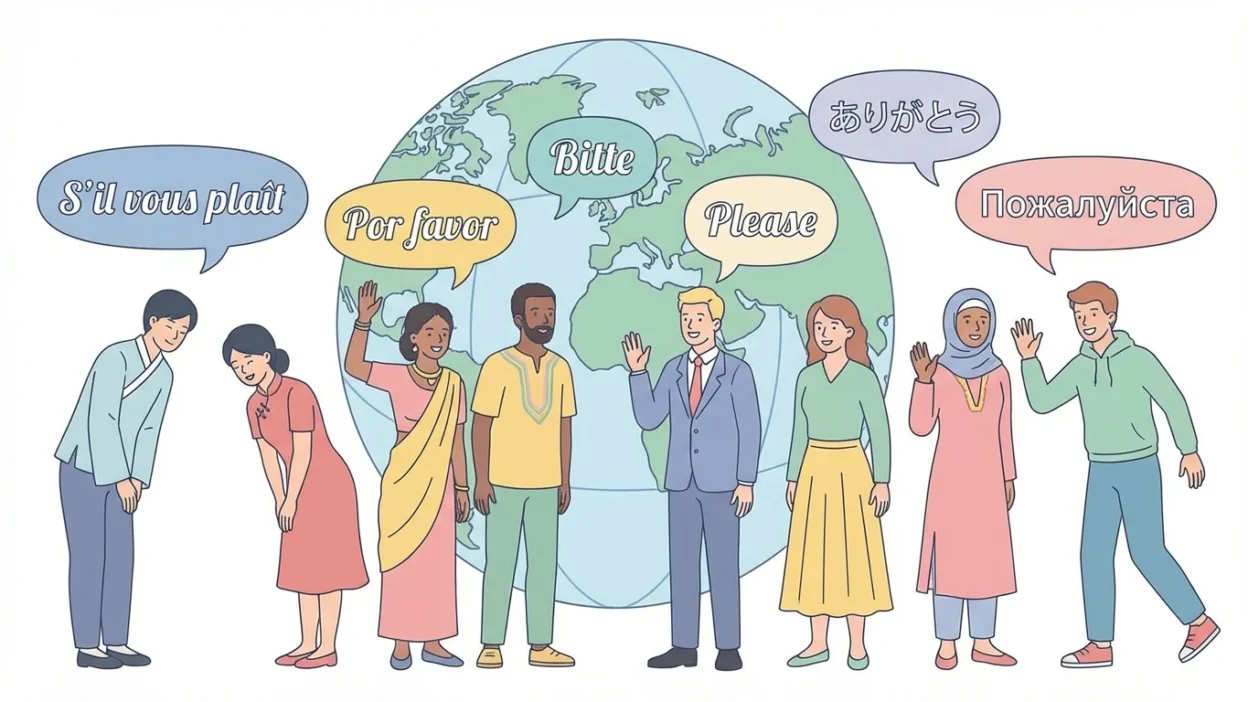
Politeness is universal, and one of the most important words you can learn is “please.” Knowing how to say please in different languages helps you communicate respectfully, build connections, and make a positive impression wherever you go.
In this guide, you’ll discover please in different languages, including pronunciation and real-life examples. Whether you’re traveling, learning, or just curious, these please translations will help you speak more politely across cultures.
Please in All Languages (70 Examples
| Language | Phrase | Example Sentence |
|---|---|---|
| English | Please (pleez) | Please help me with this. |
| Spanish | Por favor (por fa-vor) | Por favor, ayúdame. (Please help me.) |
| French | S’il vous plaît (seel voo pleh) | S’il vous plaît, écoutez-moi. (Please listen to me.) |
| German | Bitte (bit-te) | Bitte helfen Sie mir. (Please help me.) |
| Italian | Per favore (per fa-vo-re) | Per favore, aiutami. (Please help me.) |
| Portuguese | Por favor (por fa-vor) | Por favor, ajude-me. (Please help me.) |
| Dutch | Alstublieft (al-stu-bleeft) | Alstublieft, help mij. (Please help me.) |
| Russian | Пожалуйста (pa-zhal-sta) | Пожалуйста, помогите. (Please help me.) |
| Chinese (Mandarin) | 请 (qing) | 请帮我。(Please help me.) |
| Japanese | お願いします (o-ne-gai shi-mas) | お願いします、助けてください。(Please help me.) |
| Korean | 제발 (je-bal) | 제발 도와주세요. (Please help me.) |
| Arabic | من فضلك (min fad-lak) | من فضلك ساعدني. (Please help me.) |
| Hindi | कृपया (kri-pa-ya) | कृपया मेरी मदद करें। (Please help me.) |
| Urdu | براہ کرم (bara-e-karam) | براہ کرم میری مدد کریں۔ (Please help me.) |
| Turkish | Lütfen (loot-fen) | Lütfen yardım et. (Please help.) |
| Greek | Παρακαλώ (pa-ra-ka-lo) | Παρακαλώ βοηθήστε με. (Please help me.) |
| Polish | Proszę (pro-she) | Proszę pomóż mi. (Please help me.) |
| Swedish | Snälla (snel-la) | Snälla hjälp mig. (Please help me.) |
| Danish | Vær venlig (ver ven-li) | Vær venlig at hjælpe mig. (Please help me.) |
| Norwegian | Vennligst (ven-ligst) | Vennligst hjelp meg. (Please help me.) |
| Finnish | Ole hyvä (o-le hy-va) | Ole hyvä, auta minua. (Please help me.) |
| Czech | Prosím (pro-seem) | Prosím pomozte mi. (Please help me.) |
| Hungarian | Kérem (kay-rem) | Kérem segítsen. (Please help.) |
| Romanian | Vă rog (va rog) | Vă rog ajutați-mă. (Please help me.) |
| Bulgarian | Моля (mo-lya) | Моля помогнете. (Please help.) |
| Ukrainian | Будь ласка (bud las-ka) | Будь ласка допоможіть. (Please help.) |
| Hebrew | בבקשה (be-va-ka-sha) | בבקשה עזור לי. (Please help me.) |
| Thai | กรุณา (ka-ru-na) | กรุณาช่วยฉัน (Please help me.) |
| Vietnamese | Làm ơn (lam un) | Làm ơn giúp tôi. (Please help me.) |
| Indonesian | Tolong (to-long) | Tolong bantu saya. (Please help me.) |
| Malay | Tolong (to-long) | Tolong bantu saya. (Please help me.) |
| Filipino | Pakiusap (pa-ki-u-sap) | Pakiusap tulungan mo ako. (Please help me.) |
| Swahili | Tafadhali (ta-fa-tha-li) | Tafadhali nisaidie. (Please help me.) |
| Zulu | Ngiyacela (ngi-ya-ce-la) | Ngiyacela ngisize. (Please help me.) |
| Afrikaans | Asseblief (as-se-bleef) | Asseblief help my. (Please help me.) |
| Persian | لطفاً (lot-fan) | لطفاً کمک کن. (Please help me.) |
| Bengali | অনুগ্রহ করে (o-nu-gro-ho ko-re) | অনুগ্রহ করে সাহায্য করুন। (Please help me.) |
| Punjabi | ਕਿਰਪਾ ਕਰਕੇ (kir-pa kar-ke) | ਕਿਰਪਾ ਕਰਕੇ ਮਦਦ ਕਰੋ। (Please help me.) |
| Tamil | தயவு செய்து (tha-ya-vu sei-thu) | தயவு செய்து உதவுங்கள். (Please help.) |
| Telugu | దయచేసి (da-ya che-si) | దయచేసి సహాయం చేయండి. (Please help.) |
| Marathi | कृपया (kri-pa-ya) | कृपया मदत करा. (Please help.) |
| Gujarati | કૃપા કરીને (kri-pa ka-ri-ne) | કૃપા કરીને મદદ કરો. (Please help.) |
| Kannada | ದಯವಿಟ್ಟು (da-ya-vit-tu) | ದಯವಿಟ್ಟು ಸಹಾಯ ಮಾಡಿ. (Please help.) |
| Malayalam | ദയവായി (da-ya-va-yi) | ദയവായി സഹായിക്കുക. (Please help.) |
| Sinhala | කරුණාකර (ka-ru-na-ka-ra) | කරුණාකර උදව් කරන්න. (Please help.) |
| Nepali | कृपया (kri-pa-ya) | कृपया मद्दत गर्नुहोस्। (Please help.) |
| Khmer | សូម (soom) | សូមជួយខ្ញុំ។ (Please help me.) |
| Lao | ກະລຸນາ (ka-ru-na) | ກະລຸນາຊ່ວຍຂ້ອຍ. (Please help me.) |
| Burmese | ကျေးဇူးပြု၍ (kye-zu pyu-ywe) | ကျေးဇူးပြု၍ ကူညီပါ။ (Please help.) |
| Mongolian | Гуйя (gui-ya) | Гуйя туслаач. (Please help.) |
| Icelandic | Vinsamlegast (vin-sam-le-gast) | Vinsamlegast hjálpaðu mér. (Please help me.) |
| Irish | Le do thoil (le do hil) | Le do thoil cabhraigh liom. (Please help me.) |
| Welsh | Os gwelwch yn dda (os gwe-lukh un tha) | Os gwelwch yn dda helpwch fi. (Please help me.) |
| Scottish Gaelic | Mas e do thoil e (mas e do hil e) | Mas e do thoil e cuidich mi. (Please help me.) |
| Latvian | Lūdzu (loo-dzu) | Lūdzu palīdziet man. (Please help me.) |
| Lithuanian | Prašau (pra-show) | Prašau padėkite. (Please help.) |
| Estonian | Palun (pa-lun) | Palun aita mind. (Please help me.) |
| Slovak | Prosím (pro-seem) | Prosím pomôžte. (Please help.) |
| Slovenian | Prosim (pro-seem) | Prosim pomagaj. (Please help.) |
| Croatian | Molim (mo-lim) | Molim pomozite. (Please help.) |
| Serbian | Молим (mo-lim) | Молим помозите. (Please help.) |
| Bosnian | Molim (mo-lim) | Molim pomozite. (Please help.) |
| Albanian | Ju lutem (yu lu-tem) | Ju lutem ndihmoni. (Please help.) |
| Macedonian | Ве молам (ve mo-lam) | Ве молам помогнете. (Please help.) |
| Armenian | Խնդրում եմ (khnd-room yem) | Խնդրում եմ օգնեք։ (Please help.) |
| Georgian | გთხოვთ (gt-khovt) | გთხოვთ დამეხმარეთ. (Please help.) |
| Basque | Mesedez (me-se-dez) | Mesedez lagundu. (Please help.) |
| Catalan | Si us plau (see oos plow) | Si us plau ajuda’m. (Please help me. |
How to Say Please in Different Languages
Learning how to say please in different languages is essential for polite communication. It’s one of the first words taught in any language because it shows respect and kindness in conversations.
Please Around the World Cultural Meaning
The use of “please” varies across cultures. In some languages, it is used frequently in daily speech, while in others, politeness is expressed through tone and context. Understanding please around the world helps you communicate more naturally.
Why Learning Please Translations Matters
Knowing please in all languages helps you:
- Show respect in conversations
- Improve communication skills
- Travel more confidently
- Build positive relationships
Conclusion
Exploring please in different languages is a simple yet powerful way to improve your communication. These polite expressions help you connect with people worldwide and make a great impression.
FAQs
1. How do you say please in different languages?
You can say please as “Por favor” in Spanish, “Bitte” in German, and “Bara-e-karam” in Urdu.
2. Is please used in all languages?
Yes, but it may be expressed differently depending on culture and context.
3. Why is learning please important?
It helps you sound polite and respectful in any language.
4. Can I use these phrases in daily conversation?
Yes, these are commonly used and widely accepted.
5. What is the easiest way to learn please translations?
Practice daily and use them in real life conversations.