
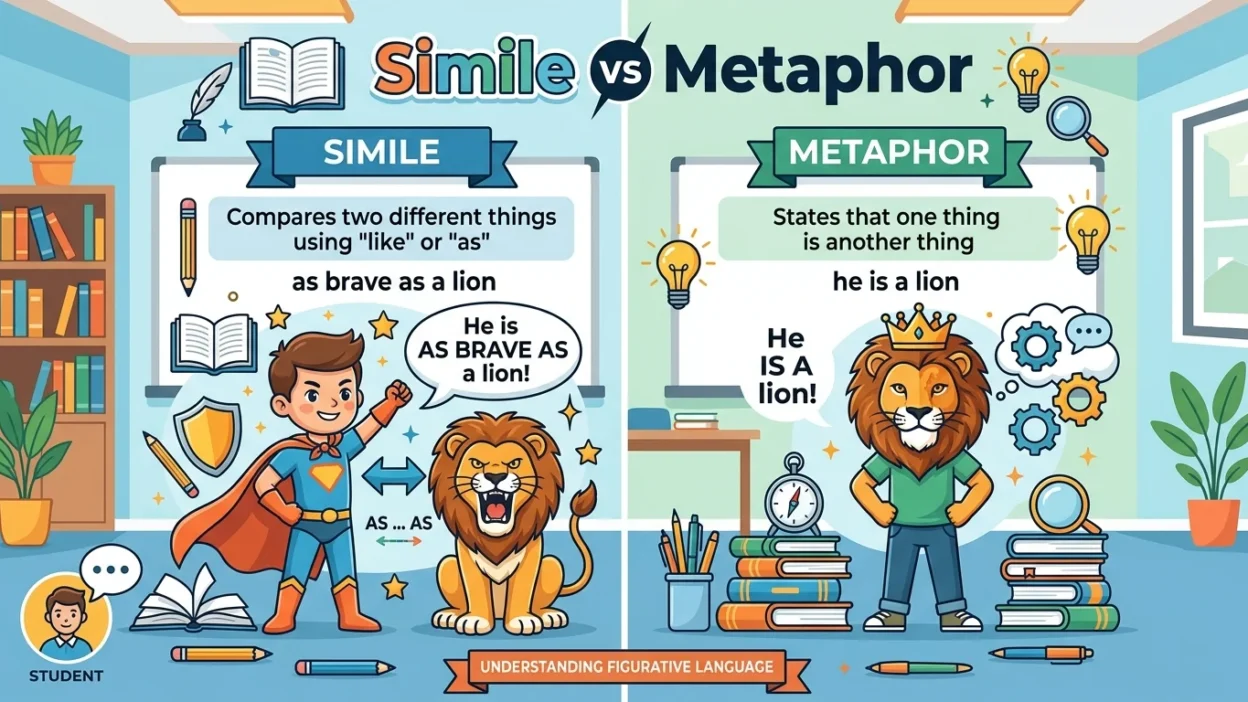
If you’ve ever studied literature, poetry, or creative writing, you’ve likely encountered the terms simile and metaphor. Both are figures of speech used to make writing more vivid, descriptive, and engaging. However, while they share similarities, they work in different ways.
Understanding simile vs metaphor can help you become a stronger writer, improve your communication skills, and better appreciate literature. Whether you’re a student, teacher, writer, or language enthusiast, knowing how to distinguish between these two literary devices is an essential skill.
Quick Answer
- A simile compares two different things using words such as “like” or “as.”
- A metaphor compares two different things by stating that one thing is another.
Simple Examples
Simile:
Metaphor:
Both comparisons create a similar image, but the simile uses “as” while the metaphor makes a direct comparison.
What Is a Simile?
A simile is a figure of speech that compares two different things using words such as:
- Like
- As
- Than
- Similar to
The purpose of a simile is to help readers visualize something by connecting it to a familiar image.
Simile Examples
- He ran like the wind.
- The baby slept as peacefully as a kitten.
- Her eyes sparkled like diamonds.
- The classroom was as quiet as a library.
In each example, the comparison is clearly signaled by words like like or as.
What Is a Metaphor?
A metaphor is a figure of speech that directly states that one thing is another, even though they are not literally the same.
Metaphors create stronger, more dramatic imagery because they do not use comparison words such as like or as.
Metaphor Examples
- Time is a thief.
- The classroom was a zoo.
- Her eyes were diamonds.
- He is a rock during difficult times.
These statements aren’t meant to be taken literally. Instead, they create vivid mental images.
Simile vs Metaphor: Key Differences
| Feature | Simile | Metaphor |
|---|---|---|
| Definition | Comparison using “like” or “as” | Direct comparison |
| Uses Comparison Words | Yes | No |
| Strength of Comparison | More explicit | More direct and powerful |
| Literal Meaning | Clearly symbolic | Symbolic but stated as fact |
| Common Words | Like, as, than | Is, are, was, were |
The easiest way to remember the difference is:
Simile = compares using like or as.
Metaphor = says one thing is another.
Why Writers Use Similes
Similes help readers quickly understand descriptions by relating unfamiliar ideas to familiar ones.
Benefits of Similes
- Easy to understand
- Creates clear imagery
- Adds detail to writing
- Helps explain complex ideas
This comparison instantly creates a visual image.
Why Writers Use Metaphors
Metaphors often create stronger emotional impact and deeper meaning.
Benefits of Metaphors
- Adds depth
- Creates memorable imagery
- Makes writing more powerful
- Encourages interpretation
This metaphor suggests speed, connections, and endless pathways.
Simile vs Metaphor Examples Side by Side
| Simile | Metaphor |
|---|---|
| She is as busy as a bee. | She is a busy bee. |
| The water was like glass. | The water was glass. |
| He fought like a lion. | He was a lion in battle. |
| The stars shone like diamonds. | The stars were diamonds in the sky. |
| Her voice was as smooth as silk. | Her voice was silk. |
Notice how similes use comparison words while metaphors make direct statements.
Simile and Metaphor in Literature
Many famous writers use both literary devices to enhance their work.
This famous metaphor from William Shakespeare compares life to a stage without using “like” or “as.”
Common Mistakes People Make
Thinking Every Comparison Is a Simile
A comparison becomes a simile only when it uses words such as “like” or “as.”
Confusing Metaphors with Literal Statements
Metaphors are symbolic and not meant to be interpreted literally.
Overusing Similes
Too many similes can make writing repetitive.
Mixing Metaphors
Writers sometimes combine unrelated metaphors, creating confusing imagery.
The images don’t fit together naturally.
How to Identify a Simile
Ask yourself:
Does it use “like” or “as”?
If yes, it’s probably a simile.
Is it comparing two different things?
If yes, it’s likely a simile.
How to Identify a Metaphor
Ask yourself:
Is one thing being described as another thing?
Does it avoid words like “like” and “as”?
If yes, it’s likely a metaphor.
When Should You Use a Simile?
Similes work best when:
- Explaining concepts clearly
- Writing for younger audiences
- Creating easy to understand imagery
- Making direct comparisons
When Should You Use a Metaphor?
Metaphors work best when:
- Adding emotional depth
- Creating dramatic impact
- Writing poetry
- Enhancing storytelling
Simile vs Metaphor in Everyday Language
People use these figures of speech constantly without realizing it.
Everyday Similes
- Busy as a bee
- Cold as ice
- Fast as lightning
- Quiet as a mouse
Everyday Metaphors
- Time is money
- Life is a journey
- Knowledge is power
- The world is a stage
These expressions have become part of everyday communication.
American vs British English
The meanings of simile and metaphor are identical in both American and British English.
There are no significant spelling, pronunciation, or usage differences between the two varieties of English regarding these literary terms.
Frequently Asked Questions
What is the main difference between a simile and a metaphor?
A simile uses words like “like” or “as” to make a comparison, while a metaphor makes a direct comparison.
Is “He runs like the wind” a simile?
Yes. The word “like” signals a simile.
Is “He is the wind on the track” a metaphor?
Yes. It directly compares the person to the wind.
Can a sentence contain both a simile and a metaphor?
Yes. Writers sometimes use both devices within the same piece of writing.
Which is stronger, a simile or a metaphor?
Metaphors are often considered stronger because they make direct comparisons.
Are similes and metaphors figures of speech?
Yes. Both are common figures of speech used in literature and everyday language.
Why do writers use similes and metaphors?
They make writing more vivid, descriptive, engaging, and memorable.
Are similes easier to understand than metaphors?
Generally, yes. Similes often provide clearer comparisons because they use words like “like” and “as.”
Summary
Understanding simile vs metaphor is essential for improving both writing and reading comprehension. A simile compares two different things using words such as like or as, while a metaphor makes a direct comparison by stating that one thing is another. Both techniques help create vivid imagery and make language more engaging.
Although they serve similar purposes, similes are usually more explicit and easier to recognize, while metaphors tend to be more powerful and emotionally impactful. Learning when and how to use each device can strengthen your communication and add creativity to your writing.
Actionable Takeaway
Use this simple rule whenever you’re unsure: If the comparison uses “like” or “as,” it’s a simile. If it directly says one thing is another, it’s a metaphor. Remembering this distinction will help you identify and use both literary devices with confidence.