
Have you ever paused while writing and wondered if to use “meters” or “metres”? It’s a common spelling difference that can be confusing especially in scientific or everyday contexts.
In this guide, we’ll break down meters vs metres, explain the meanings, give clear examples, highlight common mistakes, and help you confidently choose the correct spelling.
Quick Answer
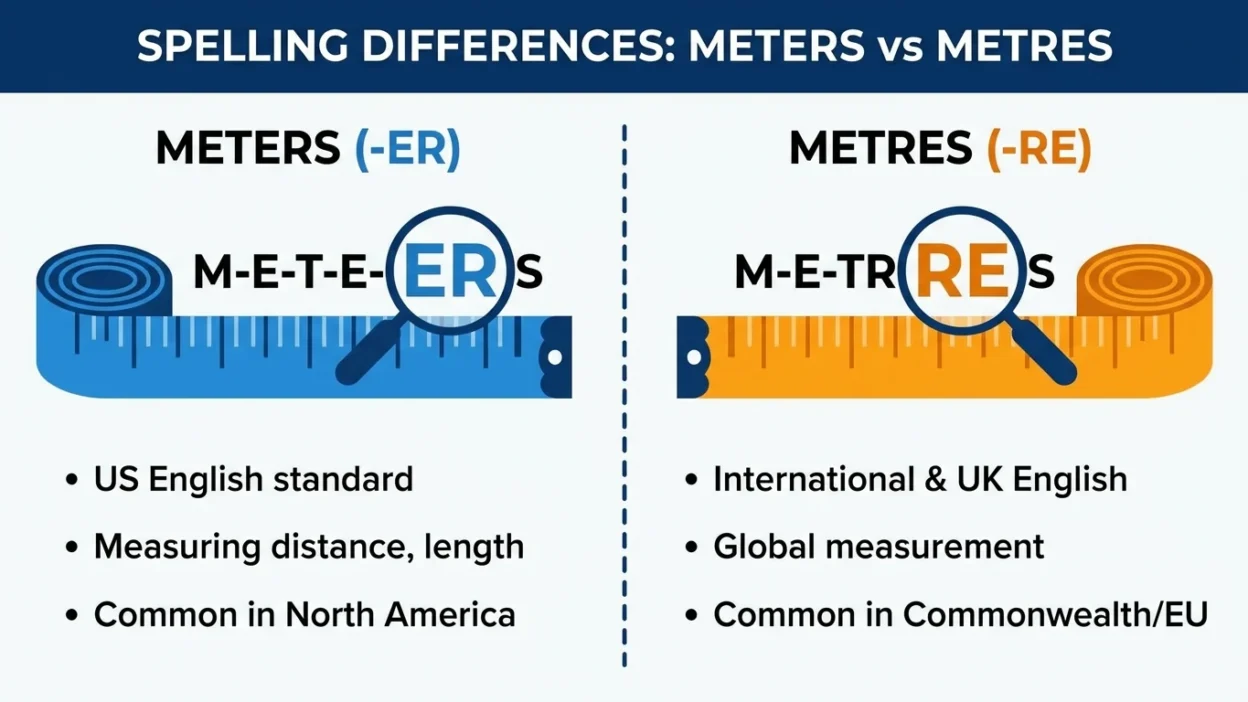
- 🇺🇸 Meters = American English
- 🇬🇧 Metres = British English
👉 Simple rule:
Both are correct just match your audience and stay consistent.
What Do “Meters” and “Metres” Mean?
Both meters and metres are plural forms of meter/metre, a unit of length in the metric system equal to 100 centimeters.
Common Uses
- Measuring distance
- Describing height or length
- Scientific and everyday measurements
Example Sentences
- The room is 5 meters long. (American English)
- The room is 5 metres long. (British English)
- He ran 100 meters/metres in the race.
👉 Meaning is identical only spelling differs.
Meters vs Metres: Key Differences
The difference is purely regional spelling.
Comparison Table: Meters vs Metres
| Feature | Meters 🇺🇸 | Metres 🇬🇧 |
|---|---|---|
| Region | American English | British English |
| Spelling Style | -er | -re |
| Meaning | Same | Same |
| Usage | U.S., global content | UK, Commonwealth countries |
Why Do These Spellings Differ?
This difference follows a familiar English pattern.
Key Pattern
- American English → -er
- meter, center, theater
- British English → -re
- metre, centre, theatre
👉 This is a standard regional spelling difference.
When Should You Use “Meters”?
Use meters if you are writing in American English or for a global audience.
Best Situations
- Blogs and online content
- Scientific writing for U.S. readers
- General global communication
Examples
- “The building is 50 meters tall.”
- “He swam 200 meters.”
👉 Think of meters as the global default.
When Should You Use “Metres”?
Use metres if you are writing in British English or for a UK audience.
Best Situations
- UK-based writing
- Academic or regional publications
- British English style guides
Examples
- “The tower is 50 metres high.”
- “She ran 400 metres.”
👉 Think of metres as region-specific but correct.
Important Note: “Meter” vs “Metre”
There is a slight nuance in British English:
- Metre = unit of length
- Meter = measuring device (e.g., electricity meter)
Example
- The road is 10 metres long.
- The electricity meter is outside.
👉 In American English, meter is used for both.
Common Mistakes to Avoid
1. Mixing Both Spellings
❌ The distance is 100 meters and metres
✔ Choose one style and stay consistent
2. Confusing Device vs Measurement (British English)
❌ The road is 10 meter (UK context)
✔ The road is 10 metres
3. Ignoring Audience
Always match your spelling to your readers.
Helpful Tip to Remember
👉 Meters = American English (-er)
👉 Metres = British English (-re)
Memory trick:
- US → ER (meters)
- UK → RE (metres)
More Examples in Context
Meters (American English)
- “He jumped 2 meters.”
- “The pool is 25 meters long.”
Metres (British English)
- “He jumped 2 metres.”
- “The pool is 25 metres long.”
Synonyms
To enrich your writing, you can also use:
- Distance
- Length
- Measurement
- Unit
👉 These help clarify meaning.
American vs British English Note
- Both meters and metres are correct
- Meaning is the same
- Only spelling varies by region
👉 Consistency is more important than choice.
FAQs
1. Which is correct: meters or metres?
Both are correct depends on American or British English.
2. Which is used in scientific writing?
Both are used, depending on region or style guide.
3. Is “metres” wrong in American English?
Not wrong, but uncommon.
4. Can I use both in one article?
No, it’s best to stay consistent.
5. What is the difference between meter and metre?
In British English, metre is a unit and meter is a device.
6. Which is more common globally?
Meters is more common in global digital content.
7. Which should I use for SEO?
Use the version your audience prefers.
Summary
Understanding meters vs metres is simple: both words refer to the same unit of measurement, but the spelling depends on the version of English you’re using. Meters is American English, while metres is British English.
In British English, there’s also a useful distinction where metre refers to the unit and meter refers to a measuring device. In American English, meter is used for both.
Actionable Takeaway
Next time you write, remember:
👉 Meters = American English (-er)
👉 Metres = British English (-re)
Choose the spelling that matches your audience and stay consistent for clear and professional writing.