Have you ever wondered whether to use “farther” or “further”? These two words are very similar and are often used interchangeably, which makes them one of the most confusing word pairs in English.
The good news is that there is a simple traditional distinction that can help you choose the right word confidently.
In this guide, we’ll explain farther vs further, show the differences, provide examples, highlight common mistakes, and help you remember when to use each one.
Quick Answer
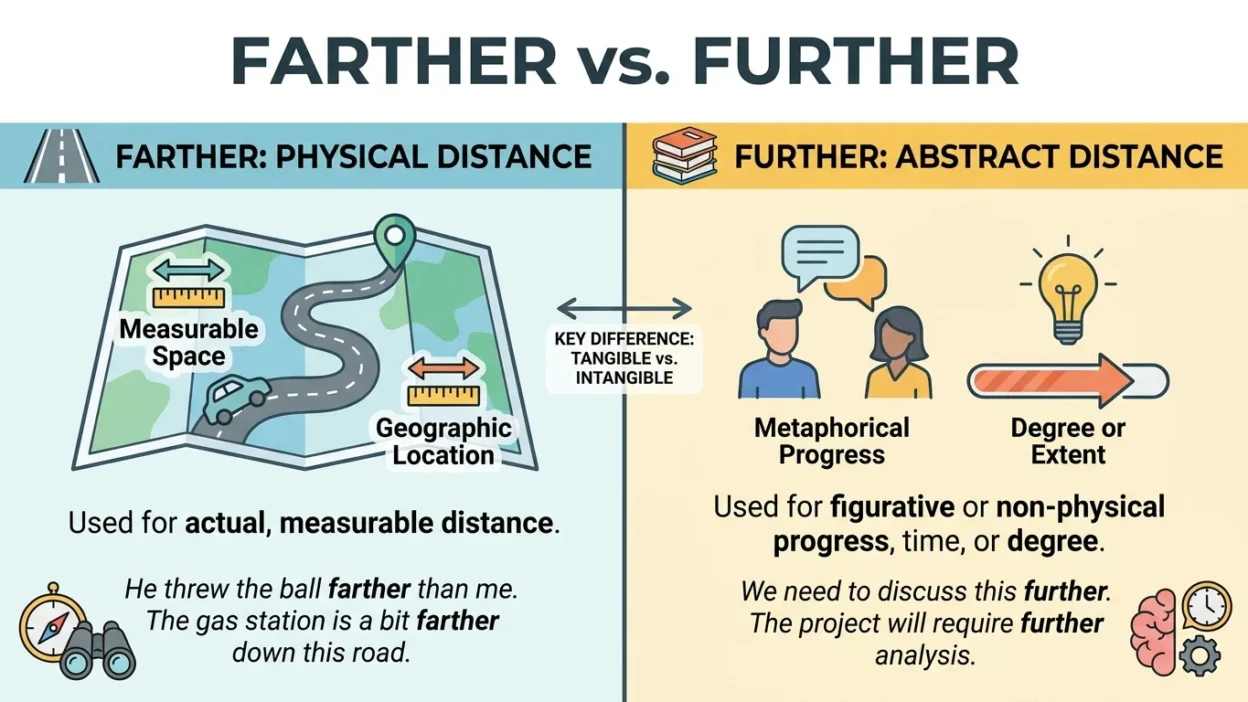
✅ Farther usually refers to physical distance
✅ Further usually refers to figurative or abstract distance
👉 Simple rule:
- Use farther for measurable distance
- Use further for ideas, progress, time, or additional information
What Does “Farther” Mean?
Farther is mainly used for physical distance.
Common Meanings
- More distant in space
- At a greater physical distance
Example Sentences
- We walked farther than expected.
- The store is farther down the road.
- She threw the ball farther this time.
👉 Farther is connected to real measurable distance.
What Does “Further” Mean?
Further usually refers to:
- Additional amount
- Greater degree
- Abstract progress
- Extended discussion or development
Example Sentences
- We need further information.
- Let’s discuss this further.
- Her education helped her further her career.
👉 Further often deals with ideas rather than physical space.
Farther vs Further: Key Differences
Comparison Table: Farther vs Further
| Feature | Farther | Further |
|---|---|---|
| Main use | Physical distance | Figurative or abstract distance |
| Refers to space | ✔ Yes | Sometimes |
| Refers to ideas or progress | ✖ Usually no | ✔ Yes |
| Common in formal writing | Less flexible | More flexible |
| Can mean “additional” | ✖ No | ✔ Yes |
The Traditional Rule
Farther = Physical Distance
Think:
- miles
- roads
- measurable movement
Examples:
- The gas station is farther away.
- We traveled farther north.
Further = Figurative or Additional
Think:
- discussions
- development
- progress
- information
Examples:
- We need further research.
- She explained the topic further.
👉 This traditional rule works in most situations.
Can “Further” Also Mean Physical Distance?
Yes.
Modern English often uses further for both:
- physical distance
- figurative distance
Example:
- We traveled further into the forest.
This is widely accepted.
However:
- farther is usually reserved specifically for physical distance
- further is more flexible overall
👉 That’s why many writers prefer further in general writing.
When Should You Use “Farther”?
Use farther when talking about:
- measurable distance
- actual movement through space
Examples
- The school is farther from my house.
- He ran farther than anyone else.
- Can you throw the frisbee farther?
When Should You Use “Further”?
Use further when talking about:
- additional information
- progress
- ideas
- conversations
- advancement
Examples
- We need further investigation.
- She wants to further her education.
- Let me explain further.
👉 Further is also commonly used in formal and professional writing.
Common Mistakes to Avoid
1. Using “Farther” for Abstract Ideas
❌ We need farther discussion
✔ We need further discussion
2. Forgetting That “Further” Is More Flexible
Further can often work where farther appears.
3. Overthinking Informal Usage
In casual English, many native speakers use further for almost everything.
Helpful Tip to Remember
👉 Farther = physical farness
👉 Further = figurative or additional
Memory trick:
- Farther contains “far”
- Think physical distance
More Examples in Context
Farther
- The beach is farther away than I thought.
- She swam farther than before.
- We drove farther into the mountains.
Further
- Further details will be announced tomorrow.
- He refused to discuss the issue further.
- The company plans to further expand internationally.
Synonyms and Related Words
Synonyms for Farther
- More distant
- More remote
- Beyond
Synonyms for Further
- Additional
- Extended
- Advanced
- Continued
👉 Choosing synonyms can improve clarity and variety.
American vs British English Note
Both farther and further are used in:
- American English
- British English
However:
- Further is becoming more common overall
- Farther remains strongly linked to physical distance
FAQs
1. What is the difference between farther and further?
Farther usually refers to physical distance, while further usually refers to abstract or additional concepts.
2. Can further refer to physical distance?
Yes, modern English commonly allows this.
3. Is farther still correct?
Absolutely. It is still standard English.
4. Which word is more common overall?
Further is more flexible and more commonly used generally.
5. Which should I use in formal writing?
The traditional distinction is safest:
- farther for distance
- further for abstract ideas
6. Can I say “further down the road”?
Yes, that is widely accepted.
7. How can I remember the difference?
Think:
- farther = far in physical space
- further = further discussion or progress
Summary
Understanding farther vs further becomes easier once you know the traditional rule. Farther usually refers to measurable physical distance, while further refers to abstract ideas, additional information, or progress. Although modern English often uses further in both situations, farther still remains the preferred choice for literal distance.
Using the correct word can make your writing clearer, more polished, and more precise.
Actionable Takeaway
Next time you choose between these words, remember:
👉 Farther = physical distance
👉 Further = abstract or additional meaning
If you are talking about miles or movement, use farther. If you are discussing ideas, progress, or extra information, use further.