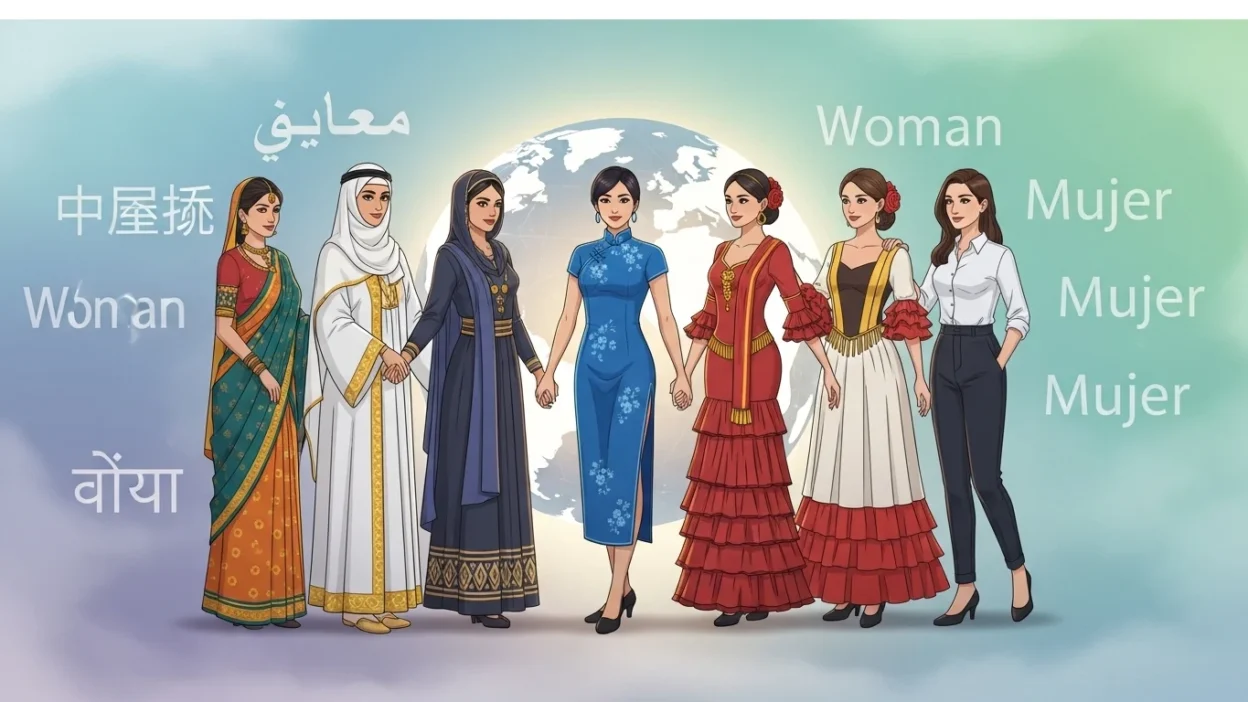
Understanding how to say woman in different languages is not only useful for travel and communication but also helps you connect with cultures around the world. If you’re learning a new language, exploring global vocabulary, or simply curious, this guide provides clear and accurate woman translations across 70 languages.
In this article, you’ll discover how to say woman in different languages, along with pronunciation and real-life examples to make learning easy and practical.
Woman in All Languages 70 Translations Table
Below is a clean, mobile-friendly table showing woman around the world with pronunciation and example sentences.
| Language | Phrase | Example Sentence |
|---|---|---|
| English | Woman (woo-muhn) | The woman is walking. (A woman is walking.) |
| Spanish | Mujer (moo-hair) | La mujer habla. (The woman speaks.) |
| French | Femme (fem) | La femme arrive. (The woman arrives.) |
| German | Frau (frow) | Die Frau lacht. (The woman laughs.) |
| Italian | Donna (don-na) | La donna canta. (The woman sings.) |
| Portuguese | Mulher (moo-lyehr) | A mulher corre. (The woman runs.) |
| Dutch | Vrouw (vrow) | De vrouw leest. (The woman reads.) |
| Russian | Женщина (zhenshchina) | Женщина идет. (The woman walks.) |
| Chinese (Mandarin) | 女人 (nǚ rén) | 她是一个女人。(She is a woman.) |
| Japanese | 女性 (josei) | 女性が来た。(The woman came.) |
| Korean | 여자 (yeo-ja) | 여자가 웃어요. (The woman smiles.) |
| Arabic | امرأة (imra’a) | المرأة تتكلم. (The woman speaks.) |
| Hindi | महिला (mahila) | महिला आई। (The woman came.) |
| Urdu | عورت (aurat) | عورت ہنس رہی ہے۔ (The woman is laughing.) |
| Turkish | Kadın (ka-dun) | Kadın geliyor. (The woman is coming.) |
| Greek | Γυναίκα (yi-ne-ka) | Η γυναίκα μιλάει. (The woman speaks.) |
| Polish | Kobieta (ko-bye-ta) | Kobieta biegnie. (The woman runs.) |
| Swedish | Kvinna (kvin-na) | Kvinnan ler. (The woman smiles.) |
| Norwegian | Kvinne (kvin-ne) | Kvinnen snakker. (The woman speaks.) |
| Danish | Kvinde (kvin-de) | Kvinden går. (The woman walks.) |
| Finnish | Nainen (nai-nen) | Nainen istuu. (The woman sits.) |
| Czech | Žena (zhe-na) | Žena zpívá. (The woman sings.) |
| Slovak | Žena (zhe-na) | Žena číta. (The woman reads.) |
| Hungarian | Nő (nuh) | A nő fut. (The woman runs.) |
| Romanian | Femeie (fe-me-ye) | Femeia vine. (The woman comes.) |
| Bulgarian | Жена (zhe-na) | Жената говори. (The woman speaks.) |
| Ukrainian | Жінка (zhin-ka) | Жінка йде. (The woman walks.) |
| Hebrew | אישה (i-sha) | האישה באה. (The woman came.) |
| Persian | زن (zan) | زن میخندد. (The woman laughs.) |
| Bengali | নারী (na-ree) | নারী হাঁটে। (The woman walks.) |
| Punjabi | ਔਰਤ (aurat) | ਔਰਤ ਆ ਰਹੀ ਹੈ। (The woman is coming.) |
| Tamil | பெண் (pen) | பெண் சிரிக்கிறாள். (The woman smiles.) |
| Telugu | మహిళ (ma-hi-la) | మహిళ వచ్చింది. (The woman came.) |
| Marathi | स्त्री (stree) | स्त्री बोलते. (The woman speaks.) |
| Gujarati | સ્ત્રી (stree) | સ્ત્રી હસે છે. (The woman laughs.) |
| Kannada | ಮಹಿಳೆ (ma-hi-le) | ಮಹಿಳೆ ಓಡುತ್ತಾಳೆ. (The woman runs.) |
| Malayalam | സ്ത്രീ (stree) | സ്ത്രീ വരുന്നു. (The woman comes.) |
| Thai | ผู้หญิง (phu-ying) | ผู้หญิงเดิน. (The woman walks.) |
| Vietnamese | Phụ nữ (phu nu) | Người phụ nữ nói. (The woman speaks.) |
| Indonesian | Wanita (wa-ni-ta) | Wanita datang. (The woman comes.) |
| Malay | Wanita (wa-ni-ta) | Wanita itu tersenyum. (The woman smiles.) |
| Filipino | Babae (ba-ba-eh) | Ang babae ay tumatawa. (The woman laughs.) |
| Swahili | Mwanamke (mwa-nam-ke) | Mwanamke anakuja. (The woman comes.) |
| Zulu | Owesifazane (o-we-si-fa-za-ne) | Owesifazane uyahamba. (The woman walks.) |
| Afrikaans | Vrou (frow) | Die vrou praat. (The woman speaks.) |
| Icelandic | Kona (ko-na) | Konan hlær. (The woman laughs.) |
| Irish | Bean (ban) | Tá an bhean anseo. (The woman is here.) |
| Scottish Gaelic | Boireannach (bo-re-nach) | Tha am boireannach a’ ruith. (The woman runs.) |
| Welsh | Menyw (men-yu) | Mae’r fenyw yn siarad. (The woman speaks.) |
| Estonian | Naine (nai-ne) | Naine tuleb. (The woman comes.) |
| Latvian | Sieviete (see-ve-e-te) | Sieviete skrien. (The woman runs.) |
| Lithuanian | Moteris (mo-te-ris) | Moteris kalba. (The woman speaks.) |
| Slovenian | Ženska (zhen-ska) | Ženska pride. (The woman comes.) |
| Croatian | Žena (zhe-na) | Žena govori. (The woman speaks.) |
| Serbian | Жена (zhe-na) | Жена долази. (The woman comes.) |
| Bosnian | Žena (zhe-na) | Žena ide. (The woman goes.) |
| Albanian | Grua (gru-a) | Gruaja vjen. (The woman comes.) |
| Macedonian | Жена (zhe-na) | Жената зборува. (The woman speaks.) |
| Georgian | ქალი (ka-li) | ქალი მოდის. (The woman comes.) |
| Armenian | Կին (kin) | Կինը խոսում է։ (The woman speaks.) |
| Mongolian | Эмэгтэй (e-meg-tei) | Эмэгтэй ирж байна. (The woman is coming.) |
| Khmer | ស្ត្រី (strey) | ស្ត្រីដើរ។ (The woman walks.) |
| Lao | ແມ່ຍິງ (mae-ying) | ແມ່ຍິງມາ. (The woman comes.) |
| Burmese | မိန်းမ (mein-ma) | မိန်းမလာသည်။ (The woman comes.) |
| Nepali | महिला (ma-hi-la) | महिला आउँछिन्। (The woman comes.) |
| Sinhala | කාන්තාව (kaan-tha-va) | කාන්තාව පැමිණේ. (The woman arrives.) |
| Amharic | ሴት (set) | ሴት ትመጣለች. (The woman comes.) |
| Somali | Haweeney (ha-ween-ey) | Haweeneydu socotaa. (The woman walks.) |
| Malagasy | Vehivavy (ve-hi-va-vi) | Vehivavy mandeha. (The woman walks.) |
| Haitian Creole | Fanm (fahm) | Fanm nan vini. (The woman comes.) |
How to Say Woman in Different Languages
The word “woman” varies widely across cultures, but many languages share similar roots or structures. For example:
- Romance languages like Spanish (mujer) and French (femme) come from Latin origins
- Slavic languages like Polish (kobieta) and Russian (женщина) have unique forms
- Asian languages often use characters or compound words like Chinese (女人)
Learning these variations helps improve both vocabulary and cultural awareness.
Why Learn Woman Translations Around the World?
Knowing woman in all languages can help you:
- Communicate better while traveling
- Understand global conversations
- Improve language learning skills
- Build cultural respect and awareness
It’s especially useful for students, travelers, and content creators working with multilingual audiences.
Tips to Remember Woman in Different Languages
- Focus on pronunciation first
- Practice with simple sentences
- Group languages by region
- Repeat daily for better memory
- Use real-life examples for faster learning
Conclusion
Learning woman in different languages opens the door to understanding cultures, improving communication, and expanding your global knowledge. With 70 translations, pronunciations, and examples, this guide makes it easy to learn and remember.
FAQs
1. How do you say woman in different languages?
You can say “woman” in many ways, such as mujer (Spanish), femme (French), and Frau (German).
2. What is woman in all languages?
There is no single universal word, but this article lists 70 common translations used worldwide.
3. Why are woman translations different?
Languages evolve from different origins, cultures, and histories, which leads to different words.
4. What is the easiest language to learn for this word?
Languages like Spanish, French, and Italian are easier due to similar roots.
5. How can I remember woman in multiple languages?
Practice daily, use flashcards, and learn through sentences for better retention.