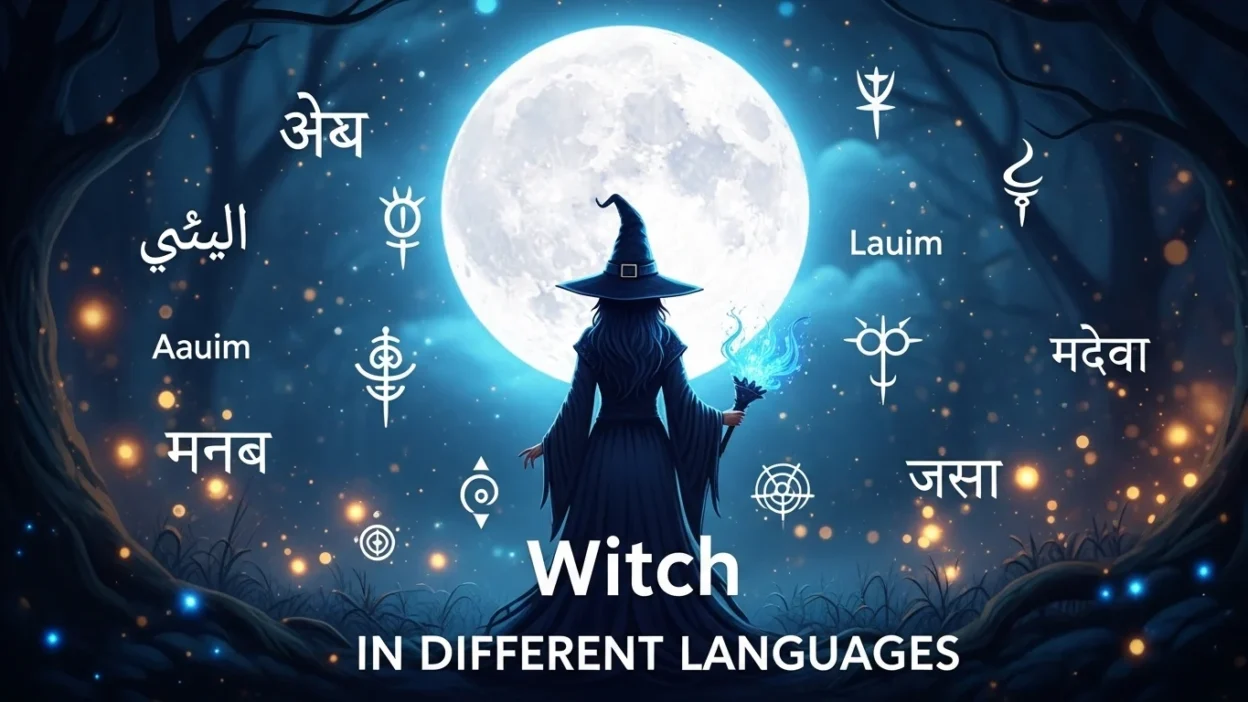
Understanding how to say “witch in different languages” is useful for language learners, writers, travelers, and anyone curious about global cultures. The word “witch” carries different meanings across countries sometimes mystical, sometimes historical, and sometimes symbolic. In this guide, you’ll discover 70 witch translations, complete with pronunciation and real-life examples to help you use them naturally.
Whether you’re searching for how to say witch in different languages or exploring witch in all languages, this article gives you a clear, practical, and easy-to-read resource.
Witch in All Languages (70 Translations Table)
| Language | Phrase | Example Sentence |
|---|---|---|
| English | Witch | The witch lives in the forest. (wich) |
| Spanish | Bruja | La bruja vive en el bosque. (broo-ha) |
| French | Sorcière | La sorcière est vieille. (sor-see-air) |
| German | Hexe | Die Hexe fliegt nachts. (hek-seh) |
| Italian | Strega | La strega canta. (stre-ga) |
| Portuguese | Bruxa | A bruxa é má. (broo-sha) |
| Dutch | Heks | De heks lacht. (heks) |
| Russian | Ведьма | Ведьма летает. (ved-ma) |
| Polish | Wiedźma | Wiedźma mieszka tu. (vyedj-ma) |
| Turkish | Cadı | Cadı geliyor. (ja-duh) |
| Arabic | ساحرة | الساحرة قوية. (sa-hi-ra) |
| Hindi | डायन | डायन डरावनी है। (daayan) |
| Urdu | چڑیل | چڑیل کہانی میں ہے۔ (churail) |
| Bengali | ডাইনি | ডাইনি এসেছে। (dainee) |
| Chinese | 女巫 | 女巫飞行。 (nyu-woo) |
| Japanese | 魔女 | 魔女が来た。 (ma-jo) |
| Korean | 마녀 | 마녀가 웃는다. (ma-nyeo) |
| Thai | แม่มด | แม่มดมาแล้ว (mae-mod) |
| Vietnamese | Phù thủy | Phù thủy xuất hiện. (foo-thwee) |
| Indonesian | Penyihir | Penyihir datang. (pen-yee-hir) |
| Malay | Ahli sihir | Ahli sihir kuat. (ah-li si-hir) |
| Filipino | Bruha | Bruha galit. (broo-ha) |
| Greek | Μάγισσα | Η μάγισσα πετά. (ma-yee-sa) |
| Swedish | Häxa | Häxan skrattar. (hek-sa) |
| Norwegian | Heks | Heksen går. (heks-en) |
| Danish | Heks | Heksen er her. (heks-en) |
| Finnish | Noita | Noita puhuu. (noi-ta) |
| Czech | Čarodějnice | Čarodějnice tančí. (charo-day-nitse) |
| Slovak | Čarodejnica | Čarodejnica letí. (charo-day-nitsa) |
| Hungarian | Boszorkány | Boszorkány él. (bo-sor-kany) |
| Romanian | Vrăjitoare | Vrăjitoare vine. (vra-ji-toa-re) |
| Bulgarian | Вещица | Вещица лети. (vesh-ti-tsa) |
| Serbian | Вештица | Вештица долази. (vesh-ti-tsa) |
| Croatian | Vještica | Vještica priča. (vyesh-ti-tsa) |
| Ukrainian | Відьма | Відьма тут. (vid-ma) |
| Hebrew | מכשפה | מכשפה באה. (mekha-she-fa) |
| Persian | جادوگر | جادوگر آمد. (ja-doo-gar) |
| Swahili | Mchawi | Mchawi anaishi. (m-cha-wee) |
| Zulu | Umthakathi | Umthakathi uyahamba. (oom-ta-ka-ti) |
| Afrikaans | Heks | Heks loop. (heks) |
| Icelandic | Norn | Norn kemur. (norn) |
| Irish | Cailleach | Cailleach anseo. (kal-yakh) |
| Scottish Gaelic | Bana-bhuidseach | Bana-bhuidseach ann. (ba-na-voo-cha) |
| Welsh | Gwrach | Gwrach yma. (goo-rakh) |
| Latvian | Ragana | Ragana nāk. (ra-ga-na) |
| Lithuanian | Ragana | Ragana gyvena. (ra-ga-na) |
| Estonian | Nõid | Nõid tuleb. (no-id) |
| Albanian | Shtrigë | Shtrigë erdhi. (shtri-guh) |
| Macedonian | Вештерка | Вештерка доаѓа. (vesh-ter-ka) |
| Slovenian | Čarovnica | Čarovnica pride. (charov-ni-tsa) |
| Georgian | ჯადოქარი | ჯადოქარი მოვიდა. (ja-do-ka-ri) |
| Armenian | Կախարդ | Կախարդ եկավ. (ka-khard) |
| Mongolian | Шулам | Шулам ирлээ. (shu-lam) |
| Nepali | बोक्सी | बोक्सी आयो। (bok-si) |
| Sinhala | මායාකාරිය | මායාකාරිය ආවා. (maa-ya-ka-ri-ya) |
| Khmer | មន្តអាគម | មន្តអាគមមក។ (mon-ta-a-kom) |
| Lao | ແມ່ມົດ | ແມ່ມົດມາ. (mae-mod) |
| Burmese | စုန်းမ | စုန်းမလာသည်။ (soon-ma) |
| Malagasy | Mpamosavy | Mpamosavy tonga. (mpa-mo-sa-vee) |
| Haitian Creole | Sòsyè | Sòsyè vini. (so-sye) |
| Basque | Sorgin | Sorgin dator. (sor-gin) |
| Catalan | Bruixa | Bruixa arriba. (broo-sha) |
| Galician | Bruxa | Bruxa chega. (broo-sha) |
| Maltese | Saħħara | Saħħara ġiet. (sa-ha-ra) |
| Esperanto | Sorĉistino | Sorĉistino venas. (sor-chi-sti-no) |
| Latin | Saga | Saga venit. (sa-ga) |
How to Say Witch in Different Languages Correctly
When learning witch translations, pronunciation matters just as much as vocabulary. Many languages have unique sounds, so reading the pronunciation guide helps you speak naturally. For example, Spanish “bruja” sounds very different from English, while German “hexe” has a sharper tone.
Using real example sentences makes it easier to remember and apply these words in conversations or writing.
Cultural Meaning of “Witch” Around the World
The meaning of “witch around the world” varies widely. In some cultures, it refers to folklore characters, while in others it connects to history or spirituality. In European traditions, witches are often linked with magic and legends, while in Asian cultures, similar figures may represent mystics or healers.
Understanding these cultural differences helps you use the word respectfully and accurately.
Tips to Learn Witch in All Languages Faster
Learning 70 translations might seem challenging, but simple strategies can help:
- Focus on 5–10 languages at a time
- Practice pronunciation out loud
- Use example sentences daily
- Group similar sounding languages together
Consistency is the key to mastering how to say witch in different languages.
Conclusion
Learning “witch in different languages” opens a window into global cultures, stories, and linguistic diversity.
With 70 translations, pronunciation guides, and example sentences, you now have a complete resource to understand and use the word confidently. Keep practicing, and you’ll quickly remember these terms from around the world.
FAQs
1. What is the most common translation of witch worldwide?
The most widely recognized translations include “bruja” in Spanish, “sorcière” in French, and “hexe” in German.
2. How do you pronounce witch in different languages correctly?
Using simple phonetic pronunciation guides and practicing aloud helps improve accuracy.
3. Are all translations of witch negative?
No, in some cultures the word can represent wisdom, healing, or folklore rather than something negative.
4. Why are there different meanings of witch around the world?
Cultural beliefs, history, and traditions shape how each language interprets the concept.
5. What is the easiest way to remember witch translations?
Practice with real-life sentences and group languages with similar words for faster learning.