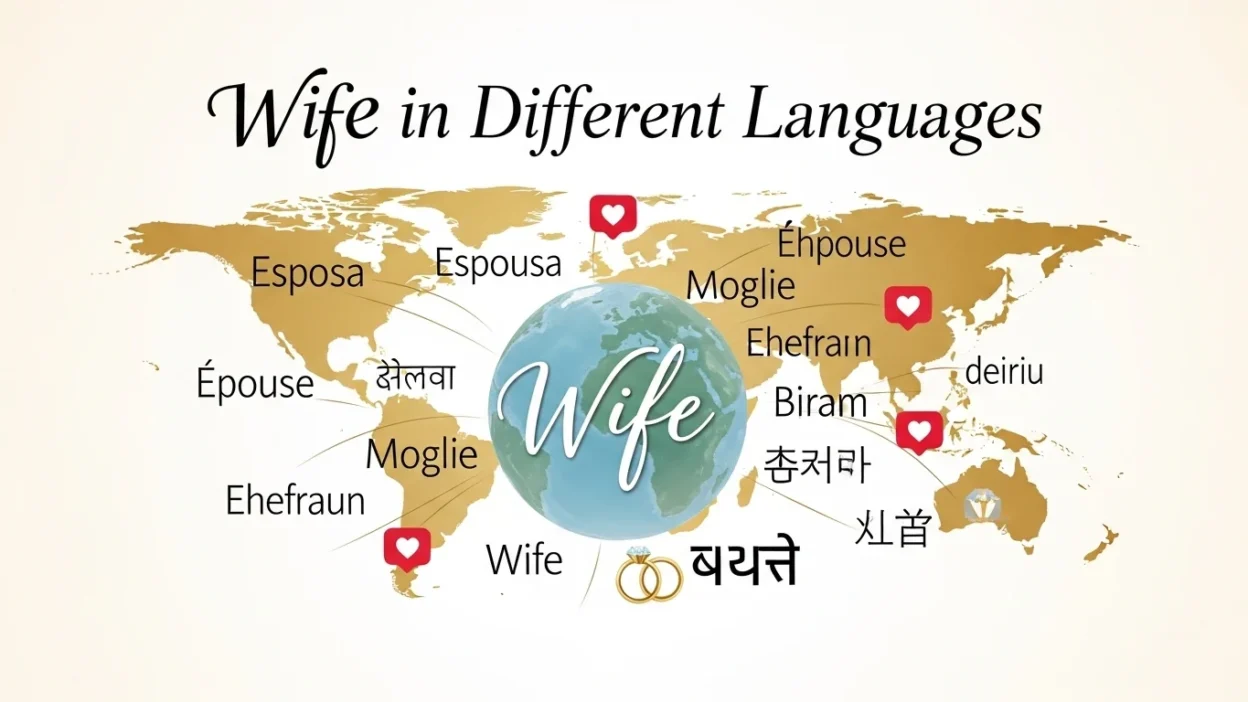
Language connects hearts across cultures. If you’ve ever wondered how to say wife in different languages, you’re in the right place. If you’re writing a romantic message, learning a new language, traveling abroad, or simply curious about global expressions, this guide gives you clear and accurate wife translations from around the world.
In this article, you’ll discover wife in all languages, easy pronunciations, and real life example sentences so you can confidently use each term. Let’s explore how people lovingly refer to their life partners across 70 different languages.
How to Say Wife in Different Languages (70 Global Translations)
Below is a clean, easy to read table featuring 70 languages, the correct native word for “wife,” and a simple example sentence.
| Language | Phrase | Example Sentence |
|---|---|---|
| English | Wife | She is my wife. |
| Spanish | Esposa (eh-SPO-sa) | Ella es mi esposa. (She is my wife.) |
| French | Épouse (ay-POOZ) | Elle est mon épouse. (She is my wife.) |
| German | Ehefrau (EH-heh-frow) | Sie ist meine Ehefrau. (She is my wife.) |
| Italian | Moglie (MO-lyeh) | Lei è mia moglie. (She is my wife.) |
| Portuguese | Esposa (eh-SPO-zah) | Ela é minha esposa. (She is my wife.) |
| Russian | Жена (zhe-NA) | Она моя жена. (She is my wife.) |
| Chinese (Mandarin) | 妻子 (chee-zuh) | 她是我的妻子。 (She is my wife.) |
| Japanese | 妻 (tsu-MA) | 彼女は私の妻です。 (She is my wife.) |
| Korean | 아내 (a-ne) | 그녀는 나의 아내입니다. (She is my wife.) |
| Arabic | زوجة (zaw-ja) | هي زوجتي. (She is my wife.) |
| Hindi | पत्नी (pat-nee) | वह मेरी पत्नी है। (She is my wife.) |
| Urdu | بیوی (bee-vee) | وہ میری بیوی ہے۔ (She is my wife.) |
| Bengali | স্ত্রী (stree) | সে আমার স্ত্রী। (She is my wife.) |
| Punjabi | ਪਤਨੀ (pat-nee) | ਉਹ ਮੇਰੀ ਪਤਨੀ ਹੈ। (She is my wife.) |
| Turkish | Eş (esh) | O benim eşim. (She is my wife.) |
| Greek | Σύζυγος (SEE-zee-ghos) | Είναι η σύζυγός μου. (She is my wife.) |
| Dutch | Vrouw (vrow) | Zij is mijn vrouw. (She is my wife.) |
| Swedish | Fru (froo) | Hon är min fru. (She is my wife.) |
| Norwegian | Kone (KO-neh) | Hun er min kone. (She is my wife.) |
| Danish | Hustru (HOO-stroo) | Hun er min hustru. (She is my wife.) |
| Finnish | Vaimo (VAI-mo) | Hän on vaimoni. (She is my wife.) |
| Polish | Żona (ZHO-na) | Ona jest moją żoną. (She is my wife.) |
| Czech | Manželka (MAN-zhel-ka) | Ona je moje manželka. (She is my wife.) |
| Slovak | Manželka (MAN-zhel-ka) | Ona je moja manželka. (She is my wife.) |
| Hungarian | Feleség (FEH-leh-shayg) | Ő a feleségem. (She is my wife.) |
| Romanian | Soție (so-TSI-eh) | Ea este soția mea. (She is my wife.) |
| Bulgarian | Съпруга (SUP-roo-ga) | Тя е моята съпруга. (She is my wife.) |
| Serbian | Жена (zhe-na) | Она је моја жена. (She is my wife.) |
| Croatian | Supruga (soo-PROO-ga) | Ona je moja supruga. (She is my wife.) |
| Ukrainian | Дружина (droo-ZHY-na) | Вона моя дружина. (She is my wife.) |
| Hebrew | אישה (ee-SHA) | היא אשתי. (She is my wife.) |
| Persian | همسر (ham-sar) | او همسر من است. (She is my wife.) |
| Swahili | Mke (m-keh) | Yeye ni mke wangu. (She is my wife.) |
| Zulu | Inkosikazi (in-ko-si-KA-zi) | Ungumkami. (She is my wife.) |
| Afrikaans | Vrou (frow) | Sy is my vrou. (She is my wife.) |
| Filipino (Tagalog) | Asawa (a-sa-wa) | Siya ang asawa ko. (She is my wife.) |
| Indonesian | Istri (ees-tree) | Dia adalah istri saya. (She is my wife.) |
| Malay | Isteri (ees-te-ree) | Dia ialah isteri saya. (She is my wife.) |
| Thai | ภรรยา (phan-ra-ya) | เธอเป็นภรรยาของฉัน (She is my wife.) |
| Vietnamese | Vợ (vuh) | Cô ấy là vợ tôi. (She is my wife.) |
| Tamil | மனைவி (ma-naivi) | அவள் என் மனைவி. (She is my wife.) |
| Telugu | భార్య (bha-rya) | ఆమె నా భార్య. (She is my wife.) |
| Kannada | ಪತ್ನಿ (pat-ni) | ಅವಳು ನನ್ನ ಪತ್ನಿ. (She is my wife.) |
| Malayalam | ഭാര്യ (bha-rya) | അവൾ എന്റെ ഭാര്യയാണ്. (She is my wife.) |
| Marathi | पत्नी (pat-nee) | ती माझी पत्नी आहे. (She is my wife.) |
| Gujarati | પત્ની (pat-nee) | તે મારી પત્ની છે. (She is my wife.) |
| Nepali | पत्नी (pat-nee) | उनी मेरी पत्नी हुन्। (She is my wife.) |
| Sinhala | බිරිඳ (bi-rin-da) | ඇය මගේ බිරිඳයි. (She is my wife.) |
| Khmer | ភរិយា (phe-ree-ya) | នាងជាភរិយារបស់ខ្ញុំ។ (She is my wife.) |
| Lao | ເມຍ (mia) | ນາງແມ່ນເມຍຂອງຂ້ອຍ. (She is my wife.) |
| Burmese | ဇနီး (za-nee) | သူမသည် ကျွန်ုပ်၏ ဇနီး ဖြစ်သည်။ (She is my wife.) |
| Mongolian | Эхнэр (ekh-ner) | Тэр миний эхнэр. (She is my wife.) |
| Icelandic | Eiginkona (AY-yin-ko-na) | Hún er eiginkona mín. (She is my wife.) |
| Irish | Bean chéile (ban kheh-leh) | Is í mo bhean chéile í. (She is my wife.) |
| Welsh | Gwraig (GOO-ryeg) | Hi yw fy ngwraig. (She is my wife.) |
| Basque | Emazte (eh-MAS-te) | Nire emaztea da. (She is my wife.) |
| Albanian | Grua (GRU-a) | Ajo është gruaja ime. (She is my wife.) |
| Macedonian | Сопруга (so-PROO-ga) | Таа е моја сопруга. (She is my wife.) |
| Lithuanian | Žmona (ZHMO-na) | Ji yra mano žmona. (She is my wife.) |
| Latvian | Sieva (SEE-va) | Viņa ir mana sieva. (She is my wife.) |
| Estonian | Naine (NAI-neh) | Ta on minu naine. (She is my wife.) |
| Haitian Creole | Madanm (ma-dam) | Li se madanm mwen. (She is my wife.) |
| Somali | Xaaska (khaas-ka) | Iyadu waa xaaskeyga. (She is my wife.) |
| Amharic | ሚስት (mist) | እሷ ሚስቴ ናት። (She is my wife.) |
| Yoruba | Iyawo (ee-ya-wo) | O jẹ iyawo mi. (She is my wife.) |
| Igbo | Nwunye (n-woo-nye) | Ọ bụ nwunye m. (She is my wife.) |
| Hausa | Mata (ma-ta) | Ita ce matata. (She is my wife.) |
| Malagasy | Vady (va-dee) | Izy no vadiko. (She is my wife.) |
| Armenian | Կին (keen) | Նա իմ կինն է։ (She is my wife.) |
Wife in All Languages: Why It Matters
Understanding wife in all languages is more than just translation. It reflects cultural values, family traditions, and emotional connection.
In many cultures, the word for wife carries deep respect and honor. For example:
- In Arabic, “Zawja” reflects partnership.
- In Hindi and Urdu, “Patni” and “Biwi” are commonly used in both formal and casual speech.
- In Japanese, “Tsuma” is polite and traditional.
Learning how to say wife around the world helps build cultural awareness and meaningful communication.
Common Variations of Wife Translations
In some languages, there are multiple ways to say wife depending on:
- Formal vs informal speech
- Legal vs affectionate terms
- Cultural traditions
For example:
- Spanish: “Esposa” (formal), “Mujer” (colloquial in some regions)
- French: “Épouse” (formal), “Femme” (common usage)
- German: “Ehefrau” (formal), “Frau” (general term)
This is why understanding context is important when using wife translations globally.
Conclusion
Now you know 70 powerful and meaningful ways to say wife in different languages. From Europe to Asia, Africa to the Americas, every culture has a unique way of expressing marital partnership.
Whether you’re writing a romantic note, learning a new language, or exploring global cultures, these translations help you connect across borders.
Language builds bridges and love makes them stronger.
FAQs
1. How do you say wife in different languages?
You can say wife as “Esposa” in Spanish, “Épouse” in French, “妻 (Tsuma)” in Japanese, “زوجة (Zawja)” in Arabic, and many more as shown in the table above.
2. What is wife in all languages?
There is no single universal word, but every language has its own translation for wife, reflecting its culture and traditions.
3. How do you pronounce wife in different languages?
Each language has a unique pronunciation. For example, Spanish “Esposa” is pronounced eh-SPO-sa, while German “Ehefrau” sounds like EH-heh-frow.
4. What is the most common translation of wife worldwide?
“Esposa,” “Wife,” “Patni,” and “Zawja” are among the most widely spoken global equivalents due to large populations speaking those languages.
5. Why are there different words for wife in some languages?
Some languages use formal and informal versions, or different words depending on legal, social, or affectionate contexts.