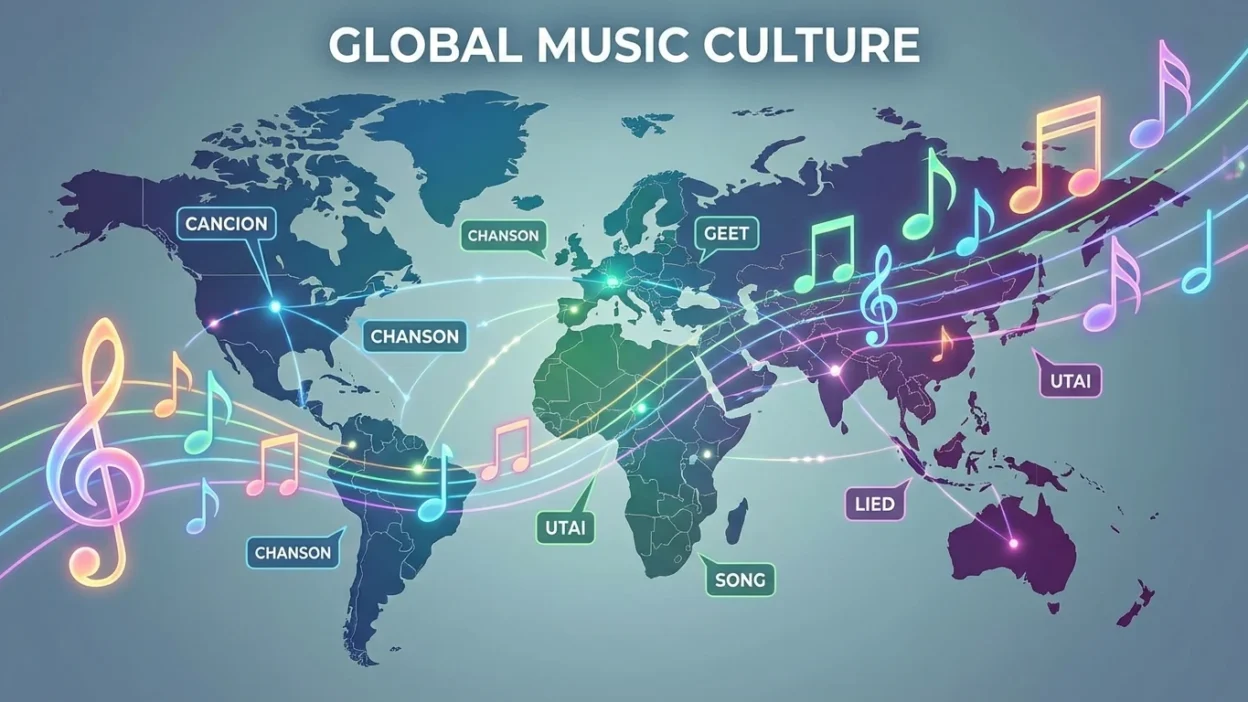
Music is a universal language that connects people across cultures, countries, and generations. No matter where you travel, you will find people expressing emotions, stories, and traditions through music. Because of this, learning song in different languages is a fun way to explore global culture and understand how music is described around the world.
Whether you are a music lover, language learner, or traveler, knowing how to say song in different languages can help you communicate with people from many backgrounds. In this guide, you will discover 70 song translations around the world, along with simple pronunciation and example sentences that show how the word is used in daily conversation.
Song in 70 Different Languages Around the World
| Language | Phrase & Pronunciation | Example Sentence |
|---|---|---|
| English | Song (song) | I love this song. (I enjoy this music.) |
| Spanish | Canción (kan-see-ON) | Me gusta esta canción. (I like this song.) |
| French | Chanson (shan-son) | J’aime cette chanson. (I like this song.) |
| German | Lied (leed) | Ich höre ein Lied. (I listen to a song.) |
| Italian | Canzone (kan-ZO-neh) | Questa canzone è bella. (This song is beautiful.) |
| Portuguese | Canção (kan-sow) | Eu gosto dessa canção. (I like this song.) |
| Dutch | Lied (leed) | Dit lied is mooi. (This song is beautiful.) |
| Russian | Песня (PES-nya) | Мне нравится эта песня. (I like this song.) |
| Ukrainian | Пісня (PEES-nya) | Це гарна пісня. (This is a beautiful song.) |
| Polish | Piosenka (pyo-SEN-ka) | Lubię tę piosenkę. (I like this song.) |
| Czech | Píseň (PEE-sen) | Tato píseň je krásná. (This song is beautiful.) |
| Slovak | Pieseň (PEE-sen) | Táto pieseň je pekná. (This song is nice.) |
| Hungarian | Dal (dal) | Ez egy szép dal. (This is a beautiful song.) |
| Romanian | Cântec (kun-tek) | Îmi place acest cântec. (I like this song.) |
| Greek | Τραγούδι (tra-GOU-thee) | Μου αρέσει αυτό το τραγούδι. (I like this song.) |
| Turkish | Şarkı (shar-kuh) | Bu şarkıyı seviyorum. (I love this song.) |
| Arabic | أغنية (ugh-nee-ya) | أحب هذه الأغنية. (I love this song.) |
| Hebrew | שיר (sheer) | אני אוהב את השיר הזה. (I love this song.) |
| Persian | آهنگ (aa-hang) | من این آهنگ را دوست دارم. (I like this song.) |
| Hindi | गीत (geet) | मुझे यह गीत पसंद है। (I like this song.) |
| Urdu | گانا (gaa-na) | مجھے یہ گانا پسند ہے۔ (I like this song.) |
| Bengali | গান (gaan) | আমি এই গানটি পছন্দ করি। (I like this song.) |
| Punjabi | ਗੀਤ (geet) | ਮੈਨੂੰ ਇਹ ਗੀਤ ਪਸੰਦ ਹੈ। (I like this song.) |
| Gujarati | ગીત (geet) | મને આ ગીત ગમે છે. (I like this song.) |
| Marathi | गाणे (gaa-ne) | मला हे गाणे आवडते. (I like this song.) |
| Tamil | பாடல் (paa-dal) | எனக்கு இந்த பாடல் பிடிக்கும். (I like this song.) |
| Telugu | పాట (paa-ta) | నాకు ఈ పాట నచ్చింది. (I like this song.) |
| Kannada | ಹಾಡು (haa-du) | ನನಗೆ ಈ ಹಾಡು ಇಷ್ಟ. (I like this song.) |
| Malayalam | പാട്ട് (paat-tu) | എനിക്ക് ഈ പാട്ട് ഇഷ്ടമാണ്. (I like this song.) |
| Sinhala | ගීතය (gee-tha-ya) | මට මේ ගීතය හරි ලස්සනයි. (I like this song.) |
| Thai | เพลง (pleng) | ฉันชอบเพลงนี้. (I like this song.) |
| Vietnamese | Bài hát (bai-hat) | Tôi thích bài hát này. (I like this song.) |
| Indonesian | Lagu (la-goo) | Saya suka lagu ini. (I like this song.) |
| Malay | Lagu (la-goo) | Saya suka lagu ini. (I like this song.) |
| Filipino | Kanta (kan-ta) | Gusto ko ang kantang ito. (I like this song.) |
| Chinese (Mandarin) | 歌曲 (guh-chyu) | 我喜欢这首歌曲. (I like this song.) |
| Japanese | 歌 (uta) | この歌が好きです。 (I like this song.) |
| Korean | 노래 (no-rae) | 이 노래를 좋아해요. (I like this song.) |
| Mongolian | Дуу (doo) | Би энэ дууг дуртай. (I like this song.) |
| Swahili | Wimbo (weem-bo) | Napenda wimbo huu. (I like this song.) |
| Zulu | Ingoma (in-go-ma) | Ngiyawuthanda lo mculo. (I like this song.) |
| Afrikaans | Liedjie (leed-kie) | Ek hou van hierdie liedjie. (I like this song.) |
| Somali | Hees (hees) | Waan jeclahay heestan. (I like this song.) |
| Amharic | ዘፈን (ze-fen) | ይህን ዘፈን እወዳለሁ. (I like this song.) |
| Hausa | Waka (wa-ka) | Ina son wannan waka. (I like this song.) |
| Yoruba | Orin (o-rin) | Mo fẹ orin yi. (I like this song.) |
| Igbo | Abụ (a-boo) | A hụrụ m abụ a n’anya. (I like this song.) |
| Danish | Sang (sang) | Jeg kan lide denne sang. (I like this song.) |
| Swedish | Sång (song) | Jag gillar den här sången. (I like this song.) |
| Norwegian | Sang (sang) | Jeg liker denne sangen. (I like this song.) |
| Finnish | Laulu (lau-lu) | Pidän tästä laulusta. (I like this song.) |
| Icelandic | Lag (lag) | Mér líkar þetta lag. (I like this song.) |
| Estonian | Laul (laul) | Mulle meeldib see laul. (I like this song.) |
| Latvian | Dziesma (dzees-ma) | Man patīk šī dziesma. (I like this song.) |
| Lithuanian | Daina (dai-na) | Man patinka ši daina. (I like this song.) |
| Serbian | Песма (pes-ma) | Волим ову песму. (I like this song.) |
| Croatian | Pjesma (pye-sma) | Volim ovu pjesmu. (I like this song.) |
| Bosnian | Pjesma (pye-sma) | Volim ovu pjesmu. (I like this song.) |
| Slovenian | Pesem (pe-sem) | Všeč mi je ta pesem. (I like this song.) |
| Albanian | Këngë (ken-ge) | Më pëlqen kjo këngë. (I like this song.) |
| Macedonian | Песна (pes-na) | Ми се допаѓа оваа песна. (I like this song.) |
| Georgian | სიმღერა (sim-ghera) | ეს სიმღერა მომწონს. (I like this song.) |
| Armenian | Երգ (yerg) | Ես սիրում եմ այս երգը. (I like this song.) |
| Kazakh | Ән (an) | Маған бұл ән ұнайды. (I like this song.) |
| Uzbek | Qo‘shiq (ko-shiq) | Men bu qo‘shiqni yaxshi ko‘raman. (I like this song.) |
| Tajik | Суруд (su-rud) | Ман ин сурудро дӯст медорам. (I like this song.) |
| Nepali | गीत (geet) | मलाई यो गीत मन पर्छ। (I like this song.) |
| Khmer | បទចម្រៀង (bot-cham-rieng) | ខ្ញុំចូលចិត្តបទចម្រៀងនេះ។ (I like this song.) |
| Lao | ເພງ (pheng) | ຂ້ອຍມັກເພງນີ້. (I like this song.) |
The Meaning of Song Around the World
A song is a musical composition that combines lyrics, melody, and rhythm. Throughout history, songs have been used to share stories, celebrate traditions, express emotions, and bring people together.
When exploring song in all languages, you will notice that every culture has its own musical style and traditions. Some songs are used for celebrations, while others tell historical stories or express deep emotions.
How Songs Connect Cultures Worldwide
Music is one of the easiest ways to connect with people from different cultures. Even if you do not understand the language, the melody and rhythm of a song can communicate emotions.
Learning song translations around the world can help you appreciate international music, discover new artists, and understand cultural expressions through lyrics.
Songs also play an important role in:
Cultural celebrations
Religious ceremonies
Entertainment and storytelling
Education and language learning
Why Learning Music Vocabulary in Different Languages Is Helpful
Understanding how to say song in different languages can be useful for travelers, musicians, and language learners. Music vocabulary appears frequently in conversations, media, and entertainment.
Learning these words can help you talk about music preferences, understand song titles, and explore music from different cultures.
Conclusion
Songs are a universal form of expression that connect people across cultures and languages. While the word song may change in pronunciation and spelling across languages, the love for music remains the same worldwide.
By learning song in different languages, you gain insight into global music culture and expand your language knowledge at the same time.
FAQs
What is song called in different languages?
Song has many translations worldwide, including Canción (Spanish), Chanson (French), Lied (German), Canzone (Italian), and 歌 (Japanese).
How do you say song in 10 common languages?
Examples include English (Song), Spanish (Canción), French (Chanson), German (Lied), Italian (Canzone), Portuguese (Canção), Arabic (Ughniya), Hindi (Geet), Chinese (Gēqǔ), and Japanese (Uta).
Why are songs important in every culture?
Songs help people express emotions, celebrate traditions, and share stories across generations.
Is music considered a universal language?
Yes, music is often called a universal language because it can communicate emotions and ideas even without words.
How can learning song vocabulary help with languages?
Music vocabulary appears frequently in daily conversation, media, and entertainment, making it helpful for language learners.