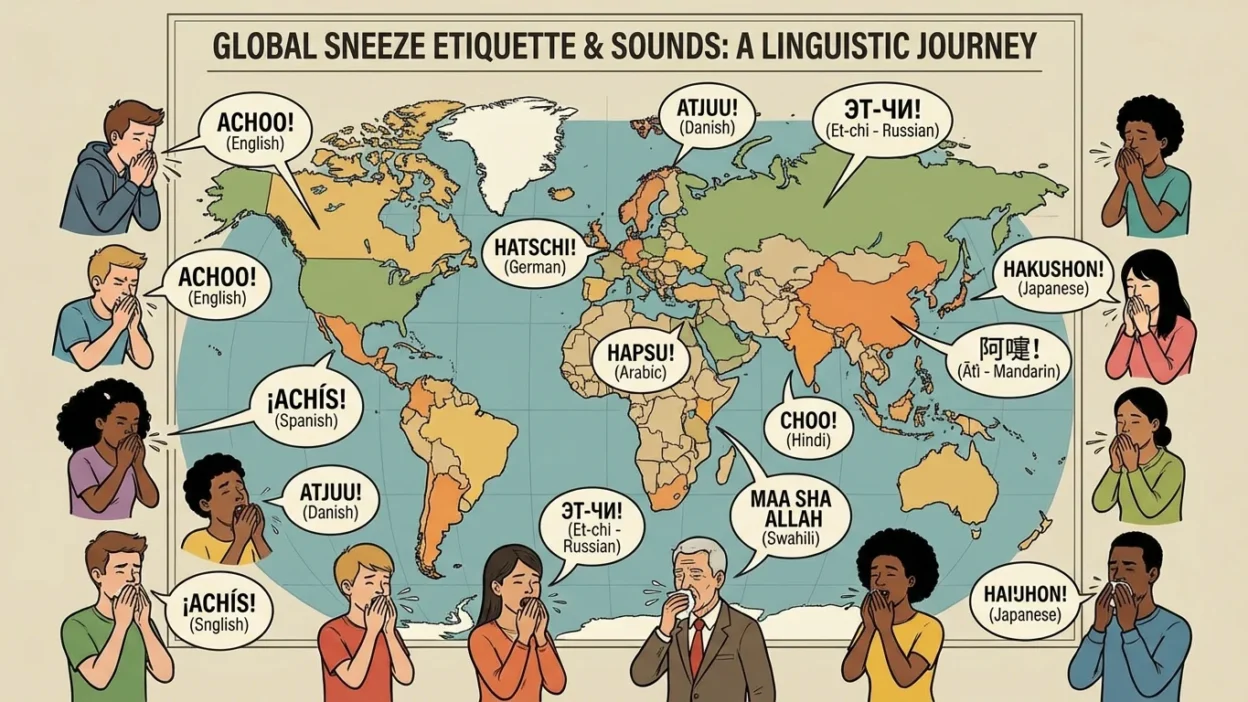
Sneezing is a natural human reaction that happens in every culture. When someone sneezes, people often respond with special words or expressions wishing good health or protection. Because of these cultural traditions, many people search for sneezing in different languages to learn how people react to a sneeze around the world.
Understanding how to say sneezing in different languages is interesting for language learners, travelers, and anyone curious about cultural expressions. In this guide, you will discover 70 sneezing translations around the world, including easy pronunciation and example sentences showing how the word is used in everyday conversation.
Sneezing in 70 Different Languages Around the World
| Language | Phrase & Pronunciation | Example Sentence |
|---|---|---|
| English | Sneeze (sneez) | I had to sneeze suddenly. (A sudden sneeze happened.) |
| Spanish | Estornudar (es-tor-nu-DAR) | Voy a estornudar. (I am going to sneeze.) |
| French | Éternuer (ay-ter-nu-AY) | Je vais éternuer. (I am about to sneeze.) |
| German | Niesen (NEE-zen) | Ich muss niesen. (I need to sneeze.) |
| Italian | Starnutire (star-nu-TEE-re) | Sto per starnutire. (I am about to sneeze.) |
| Portuguese | Espirrar (es-pee-HAHR) | Vou espirrar. (I am going to sneeze.) |
| Dutch | Niezen (NEE-zen) | Ik moet niezen. (I need to sneeze.) |
| Russian | Чихать (chi-HAT) | Я хочу чихать. (I want to sneeze.) |
| Ukrainian | Чхати (kh-HA-ty) | Я починаю чхати. (I am starting to sneeze.) |
| Polish | Kichać (KEE-hach) | Zaraz kichnę. (I will sneeze soon.) |
| Czech | Kýchat (kee-khat) | Musím kýchat. (I need to sneeze.) |
| Slovak | Kýchať (kee-khat) | Idem kýchať. (I am about to sneeze.) |
| Hungarian | Tüsszenteni (tu-sen-te-ni) | Tüsszenteni fogok. (I will sneeze.) |
| Romanian | A strănuta (stra-nu-TA) | O să strănut. (I will sneeze.) |
| Greek | Φτερνίζομαι (fter-NEE-zo-me) | Θα φτερνιστώ. (I will sneeze.) |
| Turkish | Hapşırmak (hap-shur-mak) | Hapşıracağım. (I will sneeze.) |
| Arabic | يعطس (ya-at-sas) | سأعطس. (I will sneeze.) |
| Hebrew | להתעטש (le-hit-a-tesh) | אני עומד להתעטש. (I am about to sneeze.) |
| Persian | عطسه کردن (at-seh kar-dan) | میخواهم عطسه کنم. (I want to sneeze.) |
| Hindi | छींकना (chheen-ka-na) | मुझे छींक आ रही है। (I am about to sneeze.) |
| Urdu | چھینکنا (cheenk-na) | مجھے چھینک آ رہی ہے۔ (I am about to sneeze.) |
| Bengali | হাঁচি দেওয়া (han-chi de-oa) | আমার হাঁচি আসছে। (I am about to sneeze.) |
| Punjabi | ਛੀਕਣਾ (cheek-na) | ਮੈਨੂੰ ਛੀਕ ਆ ਰਹੀ ਹੈ। (I am about to sneeze.) |
| Gujarati | છીંક આવવી (cheenk aa-vi) | મને છીંક આવી રહી છે. (I am about to sneeze.) |
| Marathi | शिंक येणे (shink ye-ne) | मला शिंक येत आहे. (I am about to sneeze.) |
| Tamil | தும்மல் (thum-mal) | எனக்கு தும்மல் வருகிறது. (I am about to sneeze.) |
| Telugu | తుమ్ము (thum-mu) | నాకు తుమ్ము వస్తోంది. (I am about to sneeze.) |
| Kannada | ತുമ್ಮು (tum-mu) | ನನಗೆ ತುಮ್ಮು ಬರುತ್ತಿದೆ. (I am about to sneeze.) |
| Malayalam | തുമ്മൽ (thum-mal) | എനിക്ക് തുമ്മൽ വരുന്നു. (I am about to sneeze.) |
| Sinhala | කිවිසුම (ki-vi-su-ma) | මට කිවිසුම එනවා. (I am about to sneeze.) |
| Thai | จาม (jaam) | ฉันกำลังจะจาม. (I am about to sneeze.) |
| Vietnamese | Hắt hơi (hat-hoi) | Tôi sắp hắt hơi. (I am about to sneeze.) |
| Indonesian | Bersin (ber-sin) | Saya akan bersin. (I will sneeze.) |
| Malay | Bersin (ber-sin) | Saya mahu bersin. (I want to sneeze.) |
| Filipino | Bumahin (boo-ma-hin) | Babahing ako. (I will sneeze.) |
| Chinese (Mandarin) | 打喷嚏 (da-pen-tee) | 我要打喷嚏. (I will sneeze.) |
| Japanese | くしゃみ (ku-sha-mi) | くしゃみが出そうです。 (I am about to sneeze.) |
| Korean | 재채기 (jae-chae-gi) | 재채기가 나와요. (I am sneezing.) |
| Mongolian | Найтаах (nai-taakh) | Би найтаах гэж байна. (I will sneeze.) |
| Swahili | Kupiga chafya (ku-pee-ga cha-fya) | Nitapiga chafya. (I will sneeze.) |
| Zulu | Thimula (thi-mu-la) | Ngizothimula. (I will sneeze.) |
| Afrikaans | Nies (nees) | Ek gaan nies. (I will sneeze.) |
| Somali | Hindhiso (hin-dhi-so) | Waxaan hindhiso doonaa. (I will sneeze.) |
| Amharic | ማስነጠስ (mas-ne-tes) | እኔ እስነጠሳለሁ. (I will sneeze.) |
| Hausa | Atishawa (a-ti-sha-wa) | Zan yi atishawa. (I will sneeze.) |
| Yoruba | Sneeze – Rirun imu (ree-run ee-mu) | Mo fẹ rirun imu. (I will sneeze.) |
| Igbo | Ịchịrị imi (ee-chee-ree ee-mee) | Aga m achịrị imi. (I will sneeze.) |
| Danish | Nyse (NYE-se) | Jeg vil nyse. (I will sneeze.) |
| Swedish | Nysa (NYE-sa) | Jag ska nysa. (I will sneeze.) |
| Norwegian | Nyse (NYE-se) | Jeg må nyse. (I need to sneeze.) |
| Finnish | Aivastaa (ai-vas-taa) | Minä aivastan. (I sneeze.) |
| Icelandic | Hnerra (hner-ra) | Ég þarf að hnerra. (I need to sneeze.) |
| Estonian | Aevastama (ae-vas-ta-ma) | Ma hakkan aevastama. (I will sneeze.) |
| Latvian | Šķaudīt (shkau-deet) | Es šķaudīšu. (I will sneeze.) |
| Lithuanian | Čiaudėti (chee-au-de-ti) | Aš čiaudėsiu. (I will sneeze.) |
| Serbian | Кихати (ki-ha-ti) | Морам да кихнем. (I need to sneeze.) |
| Croatian | Kihati (ki-ha-ti) | Moram kihnuti. (I need to sneeze.) |
| Bosnian | Kihati (ki-ha-ti) | Moram kihnuti. (I need to sneeze.) |
| Slovenian | Kihati (ki-ha-ti) | Moram kihati. (I need to sneeze.) |
| Albanian | Teshtij (tesh-tij) | Do të teshtij. (I will sneeze.) |
| Macedonian | Кивам (ki-vam) | Ќе кивнам. (I will sneeze.) |
| Georgian | დაცემინება (da-tse-mi-ne-ba) | მე დაცემინებას ვაპირებ. (I will sneeze.) |
| Armenian | Փռշտալ (prsh-tal) | Ես պատրաստվում եմ փռշտալ. (I will sneeze.) |
| Kazakh | Түшкіру (tush-ki-ru) | Мен түшкіремін. (I sneeze.) |
| Uzbek | Aksirmoq (ak-sir-moq) | Men aksiraman. (I sneeze.) |
| Tajik | Атса задан (at-sa za-dan) | Ман атса мезанам. (I sneeze.) |
| Nepali | हाछ्युँ गर्नु (ha-chyun gar-nu) | मलाई हाछ्युँ आउँदैछ। (I am about to sneeze.) |
| Khmer | កណ្តាស់ (kan-das) | ខ្ញុំកណ្តាស់។ (I sneeze.) |
| Lao | ຈາມ (jaam) | ຂ້ອຍຈາມ. (I sneeze.) |
Cultural Reactions to Sneezing Around the World
In many cultures, sneezing is followed by a polite response wishing good health. For example, English speakers say “Bless you,” while Spanish speakers often say “Salud,” which means health.
When learning sneezing in all languages, it becomes clear that many cultures developed special responses because people historically believed sneezing could affect a person’s health or spirit.
Why Sneezing Expressions Are Different in Every Language
Languages often create unique words for natural body reactions such as sneezing, coughing, and laughing. These expressions reflect cultural habits, pronunciation patterns, and historical beliefs.
Understanding sneezing translations around the world helps language learners recognize everyday vocabulary used in normal conversations.
Why Learning Everyday Action Words Helps Language Learners
Common actions like sneezing, laughing, eating, and sleeping are frequently used in daily conversation. Learning how to say sneezing in different languages helps learners build practical vocabulary that appears in real-life situations.
It also helps travelers understand conversations in social environments, schools, workplaces, and public places.
Conclusion
Sneezing is a universal human reaction, but the words used to describe it vary across cultures and languages. From Europe to Asia and Africa, each language has its own unique way to express this simple action.
By exploring sneezing in different languages, you can expand your vocabulary while learning how everyday actions are described around the world.
FAQs
What is sneezing called in different languages?
Sneezing has many translations, including Estornudar (Spanish), Éternuer (French), Niesen (German), Hapşırmak (Turkish), and 打喷嚏 (Chinese).
What do people say after someone sneezes in different cultures?
Common responses include Bless you (English), Salud (Spanish), Gesundheit (German), and Santé (French).
Why do people say bless you after sneezing?
Historically, people believed sneezing could affect a person’s health, so they offered blessings or good wishes.
Is sneezing vocabulary useful for language learners?
Yes, everyday action words like sneezing appear frequently in daily conversations.
Why do sneezing words sound different across languages?
Each language has unique sounds and pronunciation patterns, which create different words for the same action.