
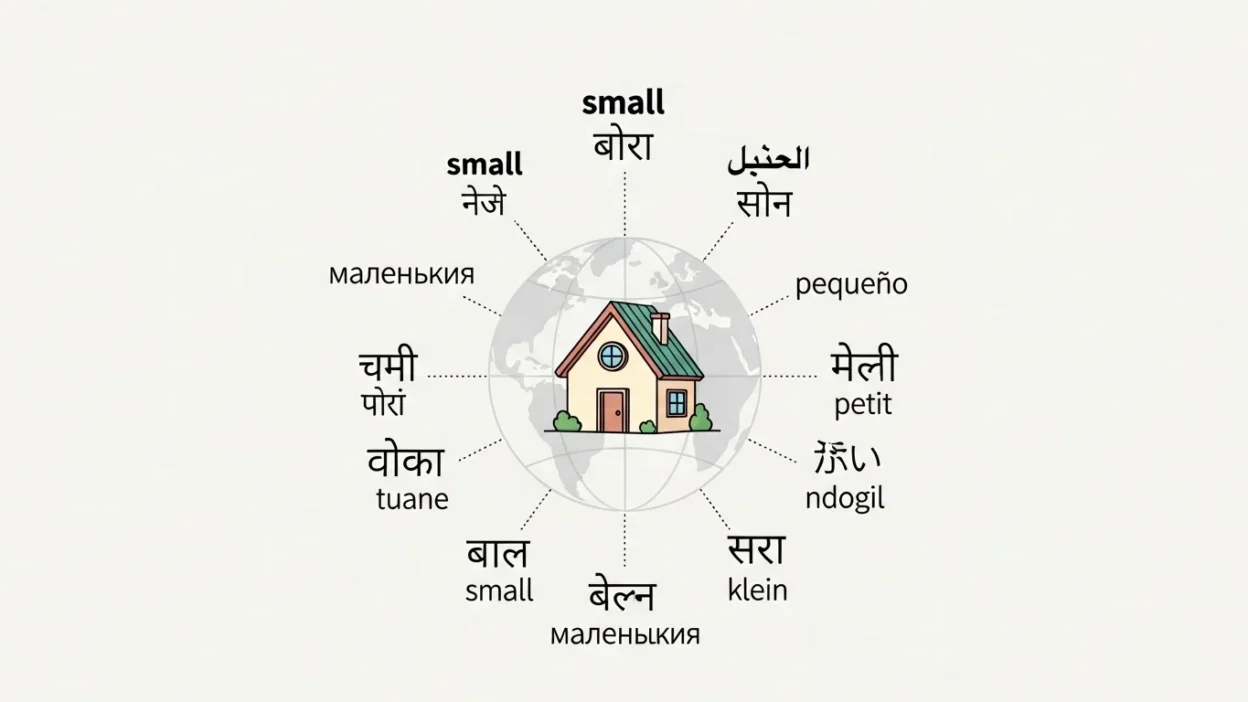
Understanding how to say “small in different languages” opens the door to global communication, cultural awareness, and everyday conversation skills. Whether you’re learning a new language, traveling, or simply curious, knowing how to express basic adjectives like “small” is incredibly useful.
In this guide, you’ll discover how to say small in different languages, with real life examples, easy pronunciation, and practical meanings. This list is perfect for learners, bloggers, and anyone interested in small translations around the world.
Small in Different Languages (70 Languages Table)
| Language | Phrase or Example Sentence | Example Sentence Meaning |
|---|---|---|
| English | Small (smol) – This is a small house | This house is small |
| Spanish | Pequeño (peh-keh-nyo) – Casa pequeña | The house is small |
| French | Petit (puh-tee) – Une petite maison | A small house |
| German | Klein (kline) – Ein kleines Haus | A small house |
| Italian | Piccolo (pee-koh-lo) – Casa piccola | Small house |
| Portuguese | Pequeno (peh-keh-no) – Casa pequena | Small house |
| Dutch | Klein (kline) – Klein huis | Small house |
| Russian | Маленький (ma-len-kee) – Маленький дом | Small house |
| Chinese (Mandarin) | 小 (xiǎo) – 小房子 | Small house |
| Japanese | 小さい (chiisai) – 小さい家 | Small house |
| Korean | 작은 (ja-geun) – 작은 집 | Small house |
| Arabic | صغير (sagheer) – بيت صغير | Small house |
| Hindi | छोटा (chhota) – छोटा घर | Small house |
| Urdu | چھوٹا (chhota) – چھوٹا گھر | Small house |
| Turkish | Küçük (koo-chook) – Küçük ev | Small house |
| Greek | Μικρός (mikros) – Μικρό σπίτι | Small house |
| Polish | Mały (mawy) – Mały dom | Small house |
| Swedish | Liten (lee-ten) – Litet hus | Small house |
| Danish | Lille (lee-le) – Lille hus | Small house |
| Norwegian | Liten (lee-ten) – Lite hus | Small house |
| Finnish | Pieni (pee-eh-nee) – Pieni talo | Small house |
| Czech | Malý (ma-lee) – Malý dům | Small house |
| Slovak | Malý (ma-lee) – Malý dom | Small house |
| Hungarian | Kicsi (kee-chee) – Kicsi ház | Small house |
| Romanian | Mic (meek) – Casă mică | Small house |
| Bulgarian | Малък (ma-luk) – Малка къща | Small house |
| Serbian | Мали (ma-lee) – Мала кућа | Small house |
| Croatian | Mali (ma-lee) – Mala kuća | Small house |
| Ukrainian | Малий (ma-lyi) – Малий будинок | Small house |
| Hebrew | קטן (katan) – בית קטן | Small house |
| Persian | کوچک (koochak) – خانه کوچک | Small house |
| Thai | เล็ก (lek) – บ้านเล็ก | Small house |
| Vietnamese | Nhỏ (nyaw) – Nhà nhỏ | Small house |
| Indonesian | Kecil (keh-cheel) – Rumah kecil | Small house |
| Malay | Kecil (keh-cheel) – Rumah kecil | Small house |
| Filipino | Maliit (ma-lee-it) – Maliit na bahay | Small house |
| Swahili | Ndogo (n-doh-go) – Nyumba ndogo | Small house |
| Zulu | Ncane (n-tsa-ne) – Indlu encane | Small house |
| Afrikaans | Klein (klayn) – Klein huis | Small house |
| Icelandic | Lítill (lee-till) – Lítið hús | Small house |
| Irish | Beag (byag) – Teach beag | Small house |
| Scottish Gaelic | Beag (byak) – Taigh beag | Small house |
| Welsh | Bach (bahkh) – Tŷ bach | Small house |
| Estonian | Väike (vai-keh) – Väike maja | Small house |
| Latvian | Mazs (mazs) – Mazs nams | Small house |
| Lithuanian | Mažas (ma-zhas) – Mažas namas | Small house |
| Albanian | Vogël (vo-gul) – Shtëpi e vogël | Small house |
| Macedonian | Мал (mal) – Мала куќа | Small house |
| Georgian | პატარა (patara) – პატარა სახლი | Small house |
| Armenian | Փոքր (pok’r) – Փոքր տուն | Small house |
| Mongolian | Жижиг (jijig) – Жижиг байшин | Small house |
| Nepali | सानो (sano) – सानो घर | Small house |
| Sinhala | කුඩා (kuda) – කුඩා ගෙය | Small house |
| Tamil | சிறியது (siriyadhu) – சிறிய வீடு | Small house |
| Telugu | చిన్న (chinna) – చిన్న ఇల్లు | Small house |
| Kannada | ಸಣ್ಣ (sanna) – ಸಣ್ಣ ಮನೆ | Small house |
| Bengali | ছোট (chhoto) – ছোট বাড়ি | Small house |
| Punjabi | ਛੋਟਾ (chhota) – ਛੋਟਾ ਘਰ | Small house |
| Marathi | लहान (lahan) – लहान घर | Small house |
| Gujarati | નાનું (naanu) – નાનું ઘર | Small house |
| Lao | ນ້ອຍ (noi) – ເຮືອນນ້ອຍ | Small house |
| Khmer | តូច (touch) – ផ្ទះតូច | Small house |
| Burmese | သေး (thay) – သေးအိမ် | Small house |
| Amharic | ትንሽ (tinish) – ትንሽ ቤት | Small house |
| Somali | Yar (yar) – Guri yar | Small house |
| Malagasy | Kely (keh-lee) – Trano kely | Small house |
| Haitian Creole | Ti (tee) – Ti kay | Small house |
| Esperanto | Malgranda (mal-gran-da) – Malgranda domo | Small house |
Why Learn “Small” in Different Languages?
Learning small in all languages is helpful for:
- Describing objects, places, and people
- Building basic vocabulary quickly
- Improving travel communication
- Enhancing cultural understanding
It’s one of the most commonly used adjectives worldwide, making it essential for beginners.
Common Usage of “Small” Around the World
Across languages, “small” is often used in:
- Daily conversations (small house, small car)
- Shopping (small size, small portion)
- Emotions (small problem, small detail)
Understanding these variations helps you sound more natural when speaking.
Tips to Remember “Small” Translations Easily
- Group similar words (e.g., malý, mali, малый)
- Practice with real-life objects
- Repeat with pronunciation daily
- Use flashcards or language apps
Consistency makes learning faster and more effective.
Conclusion
Exploring how to say small in different languages is a simple yet powerful way to expand your vocabulary and connect with people globally.
With 70 translations and examples, you now have a strong foundation to understand and use this essential word anywhere in the world.
FAQs
1. What is “small” in most languages?
Many languages use short, simple words like klein, petit, malý, or kecil.
2. How do you say small in Asian languages?
In Chinese it’s xiǎo, Japanese chiisai, and Korean jageun.
3. Is “small” easy to learn in different languages?
Yes, it’s a basic adjective and commonly used, making it easy to remember.
4. Why should I learn small translations?
It helps in daily conversation, travel, and basic communication.
5. Are there similar words for small across languages?
Yes, many European and Slavic languages have similar-sounding words.