Pronouns are one of the most important parts of any language. They help us replace names, make sentences smoother, and communicate naturally. If you’re learning languages or exploring grammar, understanding pronouns in different languages is a powerful step toward fluency.
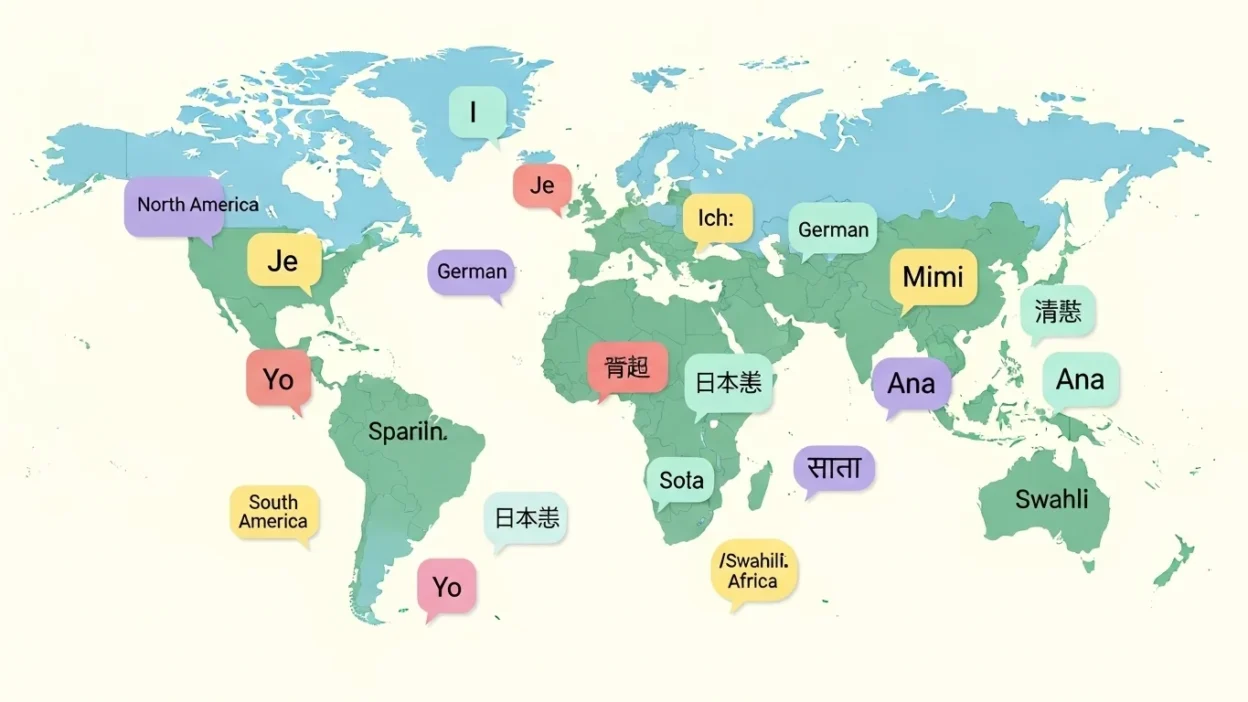
In this complete guide, you’ll discover 70 languages, each with pronouns, pronunciation, and real-life examples. This makes it perfect for learners who want to understand pronouns in all languages in a simple and practical way.
Pronouns in All Languages 70 Examples Table
| Language | Phrase / Example Sentence | Meaning |
|---|---|---|
| English | I (eye) – I am happy | I am happy |
| Spanish | Yo (yo) – Yo estoy feliz | I am happy |
| French | Je (zhuh) – Je suis content | I am happy |
| Italian | Io (ee-oh) – Io sono felice | I am happy |
| Portuguese | Eu (eh-oo) – Eu estou feliz | I am happy |
| German | Ich (ikh) – Ich bin glücklich | I am happy |
| Dutch | Ik (ik) – Ik ben blij | I am happy |
| Swedish | Jag (yag) – Jag är glad | I am happy |
| Danish | Jeg (yai) – Jeg er glad | I am happy |
| Norwegian | Jeg (yai) – Jeg er glad | I am happy |
| Finnish | Minä (mee-na) – Minä olen iloinen | I am happy |
| Icelandic | Ég (yehg) – Ég er glaður | I am happy |
| Russian | Я (ya) – Я счастлив | I am happy |
| Ukrainian | Я (ya) – Я щасливий | I am happy |
| Polish | Ja (ya) – Ja jestem szczęśliwy | I am happy |
| Czech | Já (yaa) – Já jsem šťastný | I am happy |
| Slovak | Ja (ya) – Ja som šťastný | I am happy |
| Hungarian | Én (ayn) – Én boldog vagyok | I am happy |
| Romanian | Eu (eh-oo) – Eu sunt fericit | I am happy |
| Greek | Εγώ (e-go) – Εγώ είμαι χαρούμενος | I am happy |
| Turkish | Ben (ben) – Ben mutluyum | I am happy |
| Arabic | أنا (ana) – أنا سعيد | I am happy |
| Hebrew | אני (ani) – אני שמח | I am happy |
| Persian | من (man) – من خوشحالم | I am happy |
| Hindi | मैं (main) – मैं खुश हूँ | I am happy |
| Urdu | میں (main) – میں خوش ہوں | I am happy |
| Punjabi | ਮੈਂ (main) – ਮੈਂ ਖੁਸ਼ ਹਾਂ | I am happy |
| Bengali | আমি (ami) – আমি খুশি | I am happy |
| Gujarati | હું (hu) – હું ખુશ છું | I am happy |
| Marathi | मी (mee) – मी आनंदी आहे | I am happy |
| Tamil | நான் (naan) – நான் மகிழ்ச்சியாக இருக்கிறேன் | I am happy |
| Telugu | నేను (nenu) – నేను సంతోషంగా ఉన్నాను | I am happy |
| Kannada | ನಾನು (naanu) – ನಾನು ಸಂತೋಷವಾಗಿದ್ದೇನೆ | I am happy |
| Malayalam | ഞാൻ (nyan) – ഞാൻ സന്തോഷവാനാണ് | I am happy |
| Sinhala | මම (mama) – මම සතුටින් | I am happy |
| Thai | ฉัน (chan) – ฉันมีความสุข | I am happy |
| Vietnamese | Tôi (toy) – Tôi vui | I am happy |
| Indonesian | Saya (sa-ya) – Saya senang | I am happy |
| Malay | Saya (sa-ya) – Saya gembira | I am happy |
| Filipino | Ako (a-ko) – Ako ay masaya | I am happy |
| Chinese (Mandarin) | 我 (wo) – 我很开心 | I am happy |
| Japanese | 私 (watashi) – 私は嬉しい | I am happy |
| Korean | 나 (na) – 나는 행복하다 | I am happy |
| Mongolian | Би (bi) – Би баяртай байна | I am happy |
| Swahili | Mimi (mee-mee) – Mimi nina furaha | I am happy |
| Zulu | Mina (mee-na) – Mina ngijabule | I am happy |
| Afrikaans | Ek (ek) – Ek is gelukkig | I am happy |
| Hausa | Ni (nee) – Ni ina farin ciki | I am happy |
| Yoruba | Emi (eh-mee) – Emi dun | I am happy |
| Somali | Aniga (a-nee-ga) – Aniga waan faraxsanahay | I am happy |
| Amharic | እኔ (eh-neh) – እኔ ደስ ይላል | I am happy |
| Malagasy | Izaho (ee-za-hoo) – Izaho faly | I am happy |
| Hawaiian | Au (ow) – Au hauʻoli | I am happy |
| Maori | Au (ow) – Kei te harikoa au | I am happy |
| Samoan | Aʻu (ah-oo) – Ua ou fiafia | I am happy |
| Tongan | Au (ow) – ʻOku ou fiefia | I am happy |
| Fijian | Au (ow) – Au marau | I am happy |
| Estonian | Mina (mee-na) – Mina olen õnnelik | I am happy |
| Latvian | Es (es) – Es esmu laimīgs | I am happy |
| Lithuanian | Aš (ash) – Aš esu laimingas | I am happy |
| Albanian | Unë (oo-neh) – Unë jam i lumtur | I am happy |
| Serbian | Ја (ya) – Ја сам срећан | I am happy |
| Croatian | Ja (ya) – Ja sam sretan | I am happy |
| Slovenian | Jaz (yaz) – Jaz sem srečen | I am happy |
| Bulgarian | Аз (az) – Аз съм щастлив | I am happy |
| Georgian | მე (me) – მე ბედნიერი ვარ | I am happy |
| Armenian | Ես (yes) – Ես ուրախ եմ | I am happy |
| Basque | Ni (nee) – Ni pozik nago | I am happy |
| Catalan | Jo (zho) – Jo estic feliç | I am happy |
| Galician | Eu (eh-oo) – Eu estou feliz | I am happy |
How Pronouns Work in Different Languages Around the World
Pronouns like “I,” “you,” “he,” and “they” may seem simple, but they vary widely across languages. Some languages use gender-specific pronouns, while others use neutral forms.
For example:
- English uses “I” for the speaker
- Japanese has multiple forms depending on formality
- Arabic changes pronouns based on gender
Learning how pronouns work in different languages helps you understand sentence structure and cultural communication styles.
Why Learn Pronouns in All Languages
Understanding pronouns in all languages is essential because:
- They are used in almost every sentence
- They help you speak naturally and fluently
- They improve grammar and comprehension
- They reveal cultural and social differences
Without pronouns, communication becomes repetitive and unnatural.
Common Types of Pronouns Around the World
Most languages include similar types of pronouns:
- Personal pronouns (I, you, he, she)
- Possessive pronouns (my, your)
- Demonstrative pronouns (this, that)
- Relative pronouns (who, which)
However, their usage and forms can vary greatly.
Conclusion
Exploring pronouns in different languages gives you a deeper understanding of how communication works globally.
Even a simple pronoun like “I” can reveal cultural, grammatical, and linguistic diversity across the world.
FAQs
1. What are pronouns in different languages?
Pronouns are words that replace nouns, and every language has its own versions.
2. How to say “I” in different languages?
You can say yo, je, ich, main, watashi, and many more depending on the language.
3. Are pronouns the same in all languages?
No, they differ in form, gender, and usage.
4. Why are pronouns important?
They make sentences shorter, clearer, and more natural.
5. Do all languages have pronouns?
Yes, but their structure and usage can vary widely.