
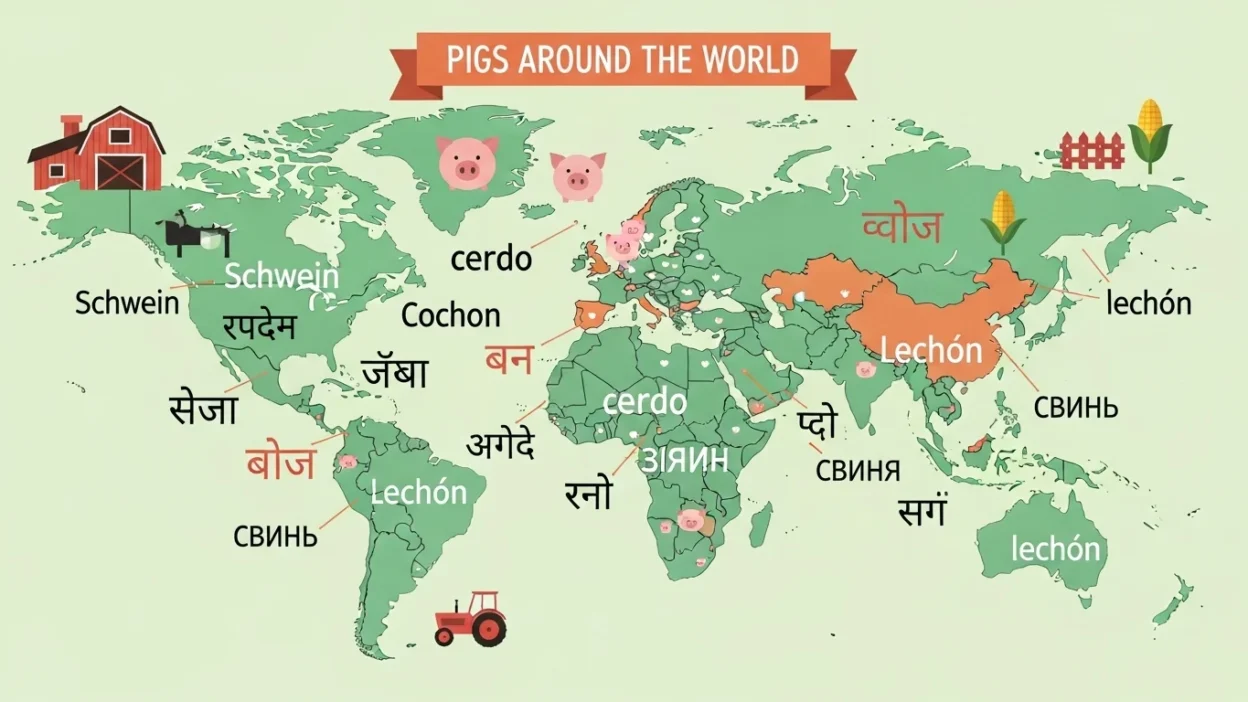
Animals are an important part of culture, language, and everyday conversation. The word pig is commonly used when talking about farm animals, food, stories, or even expressions in many cultures. Learning pig in different languages helps expand your vocabulary and gives you insight into how people around the world refer to this well-known animal.
In this guide, you will discover how to say pig in different languages, including pronunciation and example sentences. This list will help you understand pig translations around the world in a simple and practical way.
Pig in Different Languages
| Language | Phrase | Example Sentence |
|---|---|---|
| English | Pig (pig) | The pig is eating in the farm. (A farm animal eating) |
| Spanish | Cerdo (ser-do) | El cerdo está en la granja. (The pig is on the farm) |
| French | Cochon (ko-shon) | Le cochon est rose. (The pig is pink) |
| German | Schwein (sh-vine) | Das Schwein läuft im Hof. (The pig runs in the yard) |
| Italian | Maiale (my-ah-le) | Il maiale è grande. (The pig is big) |
| Portuguese | Porco (por-ko) | O porco está na fazenda. (The pig is on the farm) |
| Dutch | Varken (var-ken) | Het varken eet voedsel. (The pig eats food) |
| Russian | Свинья (sveen-ya) | Свинья на ферме. (The pig is on the farm) |
| Chinese (Mandarin) | 猪 (zhu) | 猪在农场里. (The pig is on the farm) |
| Japanese | 豚 (buta) | 豚が農場にいます. (The pig is on the farm) |
| Korean | 돼지 (dwe-ji) | 돼지가 농장에 있다. (The pig is on the farm) |
| Arabic | خنزير (khin-zeer) | الخنزير في المزرعة. (The pig is on the farm) |
| Hindi | सूअर (soo-ar) | सूअर खेत में है। (The pig is in the field) |
| Urdu | سور (soor) | سور کھیت میں ہے۔ (The pig is in the field) |
| Turkish | Domuz (do-muz) | Domuz çiftlikte. (The pig is on the farm) |
| Greek | Χοίρος (hee-ros) | Ο χοίρος στο αγρόκτημα. (The pig is on the farm) |
| Polish | Świnia (shvee-nya) | Świnia jest na farmie. (The pig is on the farm) |
| Swedish | Gris (grees) | Grisen är på gården. (The pig is in the yard) |
| Danish | Gris (grees) | Grisen er på gården. (The pig is in the yard) |
| Norwegian | Gris (grees) | Grisen er på gården. (The pig is in the yard) |
| Finnish | Sika (see-ka) | Sika on maatilalla. (The pig is on the farm) |
| Czech | Prase (pra-se) | Prase je na farmě. (The pig is on the farm) |
| Slovak | Prasa (pra-sa) | Prasa je na farme. (The pig is on the farm) |
| Hungarian | Disznó (dees-no) | A disznó a farmon van. (The pig is on the farm) |
| Romanian | Porc (pork) | Porcul este la fermă. (The pig is on the farm) |
| Bulgarian | Прасе (pra-se) | Прасето е във фермата. (The pig is on the farm) |
| Serbian | Свиња (svee-nya) | Свиња је на фарми. (The pig is on the farm) |
| Croatian | Svinja (svee-nya) | Svinja je na farmi. (The pig is on the farm) |
| Slovenian | Prašič (pra-shich) | Prašič je na kmetiji. (The pig is on the farm) |
| Ukrainian | Свиня (sveen-ya) | Свиня на фермі. (The pig is on the farm) |
| Hebrew | חזיר (kha-zeer) | החזיר בחווה. (The pig is on the farm) |
| Persian | خوک (khook) | خوک در مزرعه است. (The pig is on the farm) |
| Thai | หมู (moo) | หมูอยู่ในฟาร์ม. (The pig is on the farm) |
| Vietnamese | Lợn (lun) | Con lợn ở trang trại. (The pig is on the farm) |
| Indonesian | Babi (ba-bee) | Babi ada di peternakan. (The pig is on the farm) |
| Malay | Babi (ba-bee) | Babi di ladang. (The pig is on the farm) |
| Filipino | Baboy (ba-boy) | Ang baboy ay nasa bukid. (The pig is on the farm) |
| Swahili | Nguruwe (ngu-roo-we) | Nguruwe yuko shambani. (The pig is on the farm) |
| Zulu | Ingulube (in-gu-loo-be) | Ingulube isefamini. (The pig is on the farm) |
| Afrikaans | Vark (vark) | Die vark is op die plaas. (The pig is on the farm) |
| Icelandic | Svín (sveen) | Svín er á bænum. (The pig is on the farm) |
| Irish | Muc (muk) | Tá muc ar an bhfeirm. (The pig is on the farm) |
| Welsh | Mochyn (mokh-in) | Mae mochyn ar y fferm. (The pig is on the farm) |
| Estonian | Siga (see-ga) | Siga on farmis. (The pig is on the farm) |
| Latvian | Cūka (tsoo-ka) | Cūka ir fermā. (The pig is on the farm) |
| Lithuanian | Kiaulė (kee-au-le) | Kiaulė ūkyje. (The pig is on the farm) |
| Albanian | Derr (derr) | Derr është në fermë. (The pig is on the farm) |
| Macedonian | Свиња (svee-nya) | Свиња е на фарма. (The pig is on the farm) |
| Georgian | ღორი (gho-ri) | ღორი ფერმაშია. (The pig is on the farm) |
| Armenian | խոզ (khoz) | Խոզը ֆերմայում է։ (The pig is on the farm) |
| Mongolian | Гахай (ga-hai) | Гахай ферм дээр байна. (The pig is on the farm) |
| Nepali | सुँगुर (sun-gur) | सुँगुर खेतमा छ। (The pig is in the field) |
| Sinhala | ඌරා (oo-ra) | ඌරා ගොවිපොළේ ඇත. (The pig is on the farm) |
| Bengali | শূকর (shu-kor) | শূকর খামারে আছে। (The pig is on the farm) |
| Tamil | பன்றி (pan-ri) | பன்றி பண்ணையில் உள்ளது. (The pig is on the farm) |
| Telugu | పంది (pan-dee) | పంది ఫారంలో ఉంది. (The pig is on the farm) |
| Kannada | ಹಂದಿ (han-dee) | ಹಂದಿ ಕೃಷಿಯಲ್ಲಿ ಇದೆ. (The pig is on the farm) |
| Marathi | डुक्कर (duk-kar) | डुक्कर शेतात आहे. (The pig is on the farm) |
| Gujarati | ડુક્કર (duk-kar) | ડુક્કર ખેતરમાં છે. (The pig is on the farm) |
| Punjabi | ਸੂਰ (soor) | ਸੂਰ ਖੇਤ ਵਿੱਚ ਹੈ। (The pig is in the field) |
| Khmer | ជ្រូក (chrook) | ជ្រូកនៅកសិដ្ឋាន. (The pig is on the farm) |
| Lao | ໝູ (moo) | ໝູຢູ່ໃນຟາມ. (The pig is on the farm) |
| Burmese | ဝက် (wet) | ဝက်သည်လယ်တွင်ရှိသည်. (The pig is on the farm) |
| Amharic | አሳማ (a-sa-ma) | አሳማ በእርሻ ነው. (The pig is on the farm) |
| Somali | Doofaar (doo-faar) | Doofaarku beerta ayuu joogaa. (The pig is on the farm) |
| Hausa | Alade (a-la-de) | Alade yana gona. (The pig is on the farm) |
| Yoruba | Ẹlẹdẹ (e-le-de) | Ẹlẹdẹ wa lori oko. (The pig is on the farm) |
| Igbo | Ezi (e-zee) | Ezi nọ n’ugbo. (The pig is on the farm) |
What the Word Pig Means in Different Cultures
The pig is a well-known animal around the world, often associated with farming, food, and traditional stories. In some cultures, pigs symbolize prosperity and wealth, while in others they may represent different cultural beliefs.
Understanding pig translations in different languages helps you see how cultures interpret animals in unique ways.
How Pig Is Used in Everyday Language
The word “pig” is commonly used in agriculture, education, and storytelling. It may also appear in idioms and expressions in many languages.
Examples include:
- Talking about farm animals
- Teaching children about animals
- Using animal names in stories and lessons
Learning how to say pig in different languages can help students, travelers, and language learners communicate more effectively.
Why Learning Animal Names in Different Languages Is Useful
Animal names are often among the first vocabulary words learned in a new language. They are simple, practical, and commonly used in daily conversations.
Knowing pig in all languages can help improve language skills, cultural understanding, and global communication.
Conclusion
The word pig may seem simple, but it appears in nearly every language and culture around the world. By learning these 70 translations, you gain a better understanding of global languages and expand your vocabulary.
If you are studying languages or exploring cultural differences, these translations provide valuable knowledge.
FAQs
1. What is pig called in different languages?
Pig has many translations worldwide, such as Cerdo in Spanish, Cochon in French, and Schwein in German.
2. Why learn pig in different languages?
Learning animal names helps improve vocabulary and cultural awareness.
3. How do you say pig in Asian languages?
Examples include 猪 (Chinese), 豚 (Japanese), 돼지 (Korean), and หมู (Thai).
4. Are animal names useful when learning languages?
Yes, they are often basic vocabulary and helpful for beginners.
5. Can learning words like pig help with travel?
Yes, knowing simple vocabulary helps when visiting farms, markets, or talking with locals.