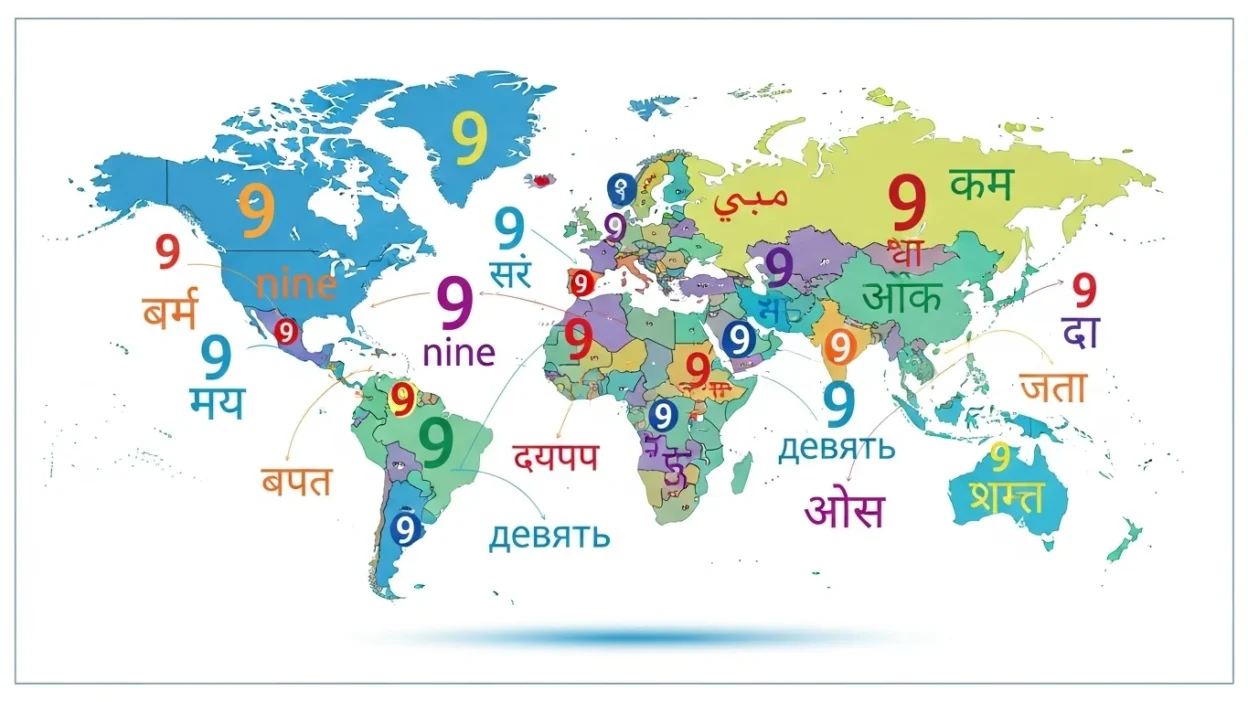
Numbers are the foundation of every language, and learning them is one of the easiest ways to start exploring new cultures. If you’re curious about nine in different languages, this guide gives you a complete and practical list.
Whether you’re a student, traveler, or language enthusiast, discovering nine in all languages will help you build vocabulary and understand how counting works globally.
Nine in All Languages 70 Translations Table
| Language | Phrase / Example Sentence | Meaning |
|---|---|---|
| English | Nine (nine) – I have nine books | I have nine books |
| Spanish | Nueve (nweh-veh) – Tengo nueve libros | I have nine books |
| French | Neuf (nuhf) – J’ai neuf livres | I have nine books |
| Italian | Nove (noh-veh) – Ho nove libri | I have nine books |
| Portuguese | Nove (noh-veh) – Tenho nove livros | I have nine books |
| German | Neun (noyn) – Ich habe neun Bücher | I have nine books |
| Dutch | Negen (neh-ghen) – Ik heb negen boeken | I have nine books |
| Swedish | Nio (nee-oh) – Jag har nio böcker | I have nine books |
| Danish | Ni (nee) – Jeg har ni bøger | I have nine books |
| Norwegian | Ni (nee) – Jeg har ni bøker | I have nine books |
| Finnish | Yhdeksän (uh-dek-san) – Minulla on yhdeksän kirjaa | I have nine books |
| Icelandic | Níu (nee-oo) – Ég á níu bækur | I have nine books |
| Russian | Девять (dyev-yat) – У меня девять книг | I have nine books |
| Ukrainian | Дев’ять (dyev-yat) – У мене дев’ять книг | I have nine books |
| Polish | Dziewięć (jeh-vyench) – Mam dziewięć książek | I have nine books |
| Czech | Devět (deh-vyet) – Mám devět knih | I have nine books |
| Slovak | Deväť (deh-vyat) – Mám deväť kníh | I have nine books |
| Hungarian | Kilenc (kee-lents) – Kilenc könyvem van | I have nine books |
| Romanian | Nouă (no-uh) – Am nouă cărți | I have nine books |
| Greek | Εννέα (en-neh-ah) – Έχω εννέα βιβλία | I have nine books |
| Turkish | Dokuz (do-kooz) – Dokuz kitabım var | I have nine books |
| Arabic | تسعة (tis-ah) – لدي تسعة كتب | I have nine books |
| Hebrew | תשע (te-sha) – יש לי תשע ספרים | I have nine books |
| Persian | نه (noh) – من نه کتاب دارم | I have nine books |
| Hindi | नौ (nau) – मेरे पास नौ किताबें हैं | I have nine books |
| Urdu | نو (nau) – میرے پاس نو کتابیں ہیں | I have nine books |
| Punjabi | ਨੌਂ (naun) – ਮੇਰੇ ਕੋਲ ਨੌਂ ਕਿਤਾਬਾਂ ਹਨ | I have nine books |
| Bengali | নয় (noy) – আমার নয়টি বই আছে | I have nine books |
| Gujarati | નવ (nav) – મારા પાસે નવ પુસ્તકો છે | I have nine books |
| Marathi | नऊ (nau) – माझ्याकडे नऊ पुस्तके आहेत | I have nine books |
| Tamil | ஒன்பது (on-ba-thu) – எனக்கு ஒன்பது புத்தகங்கள் உள்ளன | I have nine books |
| Telugu | తొమ్మిది (tom-mi-di) – నాకు తొమ్మిది పుస్తకాలు ఉన్నాయి | I have nine books |
| Kannada | ಒಂಬತ್ತು (om-bat-tu) – ನನಗೆ ಒಂಬತ್ತು ಪುಸ್ತಕಗಳಿವೆ | I have nine books |
| Malayalam | ഒമ്പത് (om-bath) – എനിക്ക് ഒമ്പത് പുസ്തകങ്ങൾ ഉണ്ട് | I have nine books |
| Sinhala | නවය (na-va-ya) – මට නවය පොත් ඇත | I have nine books |
| Thai | เก้า (gao) – ฉันมีเก้าหนังสือ | I have nine books |
| Vietnamese | Chín (cheen) – Tôi có chín cuốn sách | I have nine books |
| Indonesian | Sembilan (sem-bee-lan) – Saya punya sembilan buku | I have nine books |
| Malay | Sembilan (sem-bee-lan) – Saya ada sembilan buku | I have nine books |
| Filipino | Siyam (see-yam) – May siyam akong libro | I have nine books |
| Chinese (Mandarin) | 九 (jyo) – 我有九本书 | I have nine books |
| Japanese | 九 (kyu) – 九冊あります | I have nine books |
| Korean | 아홉 (a-hop) – 나는 아홉 권의 책이 있다 | I have nine books |
| Mongolian | Ес (yes) – Надад есөн ном байна | I have nine books |
| Swahili | Tisa (tee-sa) – Nina vitabu tisa | I have nine books |
| Zulu | Isishiyagalolunye (ee-see-shee-ya-ga-lo-loon-yeh) – Nginezincwadi eziyisishiyagalolunye | I have nine books |
| Afrikaans | Nege (neh-ghe) – Ek het nege boeke | I have nine books |
| Hausa | Tara (ta-ra) – Ina da littattafai tara | I have nine books |
| Yoruba | Mẹ́sàn (meh-san) – Mo ni iwe mẹ́sàn | I have nine books |
| Somali | Sagaal (sa-gaal) – Waxaan hayaa sagaal buug | I have nine books |
| Amharic | ዘጠኝ (ze-tegn) – እኔ ዘጠኝ መጽሐፍ አለኝ | I have nine books |
| Malagasy | Sivy (see-vee) – Manana boky sivy aho | I have nine books |
| Hawaiian | ʻEiwa (ay-ee-wa) – He ʻeiwa kaʻu puke | I have nine books |
| Maori | Iwa (ee-wa) – E iwa aku pukapuka | I have nine books |
| Samoan | Iva (ee-va) – E iva aʻu tusi | I have nine books |
| Tongan | Hiva (hee-va) – ʻOku ʻi ai hiva ʻa ʻeku tohi | I have nine books |
| Fijian | Ciwa (thee-wa) – Au e ciwa na noqu ivola | I have nine books |
| Estonian | Üheksa (oo-hek-sa) – Mul on üheksa raamatut | I have nine books |
| Latvian | Deviņi (de-vee-nyee) – Man ir deviņi grāmatas | I have nine books |
| Lithuanian | Devyni (de-vee-nee) – Turiu devynias knygas | I have nine books |
| Albanian | Nëntë (nen-teh) – Kam nëntë libra | I have nine books |
| Serbian | Девет (de-vet) – Имам девет књига | I have nine books |
| Croatian | Devet (de-vet) – Imam devet knjiga | I have nine books |
| Slovenian | Devet (de-vet) – Imam devet knjig | I have nine books |
| Bulgarian | Девет (de-vet) – Имам девет книги | I have nine books |
| Georgian | ცხრა (tskh-ra) – მე მაქვს ცხრა წიგნი | I have nine books |
| Armenian | Ինը (ee-neh) – Ես ունեմ ինը գիրք | I have nine books |
| Basque | Bederatzi (beh-deh-rat-zee) – Bederatzi liburu ditut | I have nine books |
| Catalan | Nou (noh) – Tinc nou llibres | I have nine books |
| Galician | Nove (noh-veh) – Teño nove libros | I have nine books |
How to Say Nine in Different Languages Around the World
Numbers like nine are essential in every language. While many European languages share similar roots (like nove, neuf, nueve), others have completely unique forms.
Learning how to say nine in different languages helps you recognize patterns and improves your counting skills globally.
Why Learn Nine in All Languages
Understanding nine in all languages is useful because:
- It strengthens basic vocabulary
- Helps in travel and daily conversations
- Builds a foundation for learning numbers
- Improves memory and language recognition
Numbers are often the first step in mastering any language.
Common Use of Number Nine Around the World
The number nine appears frequently in:
- Counting and mathematics
- Dates and time
- Cultural symbolism (lucky or special number in some cultures)
This makes nine translations both practical and culturally interesting.
Conclusion
Exploring nine in different languages is a simple yet powerful way to connect with global languages.
From nueve to neuf to nau, each version reflects linguistic diversity and cultural richness.
FAQs
1. How to say nine in different languages?
You can say nueve, neuf, nove, neun, nau, and many more.
2. Is nine similar in all languages?
Many European languages share similar words, but others differ greatly.
3. Why learn numbers in different languages?
They are essential for communication, travel, and daily use.
4. What is nine in Asian languages?
Examples include kyu (Japanese), jiu (Chinese), nau (Hindi).
5. Is nine a special number worldwide?
In some cultures, it is considered lucky or symbolic.