
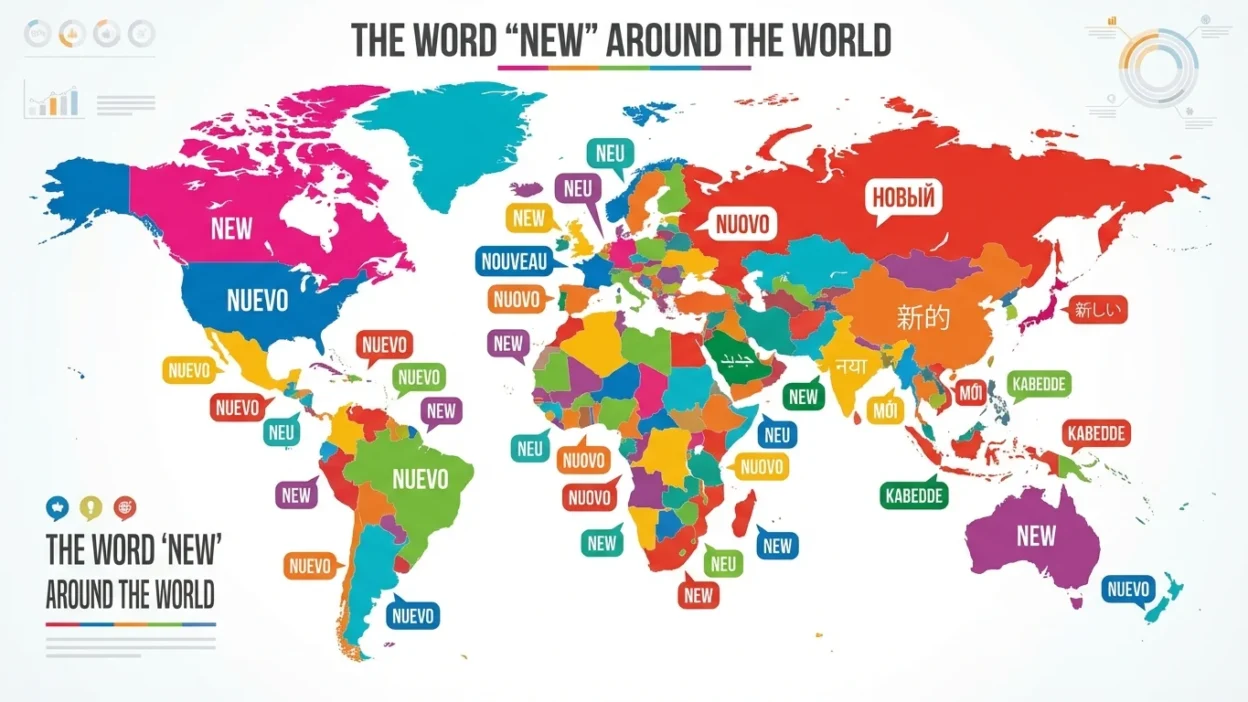
The word new is one of the most common and useful words in everyday language. People use it to describe something recent, modern, fresh, or just created. If talking about a new phone, new house, new job, or new ideas, the concept exists in every culture and language.
Learning new in different languages is helpful for travelers, language learners, and anyone interested in global communication. Understanding how to say new in different languages can improve vocabulary and help you communicate when discussing products, places, or experiences. In this guide, you will discover 70 new translations around the world, including pronunciation and example sentences that show how the word is used in daily conversations.
New in 70 Different Languages Around the World
| Language | Phrase & Pronunciation | Example Sentence |
|---|---|---|
| English | New (nyoo) | I bought a new phone. (Recently purchased.) |
| Spanish | Nuevo (NWE-vo) | Compré un teléfono nuevo. (I bought a new phone.) |
| French | Nouveau (noo-VO) | J’ai une nouvelle voiture. (I have a new car.) |
| German | Neu (noy) | Ich habe ein neues Haus. (I have a new house.) |
| Italian | Nuovo (NWUO-vo) | Ho un telefono nuovo. (I have a new phone.) |
| Portuguese | Novo (NO-vo) | Eu comprei um carro novo. (I bought a new car.) |
| Dutch | Nieuw (neeuw) | Ik heb een nieuwe fiets. (I have a new bike.) |
| Russian | Новый (no-viy) | У меня новый телефон. (I have a new phone.) |
| Ukrainian | Новий (no-viy) | У мене новий телефон. (I have a new phone.) |
| Polish | Nowy (NO-vy) | Mam nowy samochód. (I have a new car.) |
| Czech | Nový (NO-vee) | Mám nový dům. (I have a new house.) |
| Slovak | Nový (NO-vee) | Kúpil som nový telefón. (I bought a new phone.) |
| Hungarian | Új (ooj) | Van egy új autóm. (I have a new car.) |
| Romanian | Nou (no) | Am un telefon nou. (I have a new phone.) |
| Greek | Νέος (NE-os) | Έχω ένα νέο σπίτι. (I have a new house.) |
| Turkish | Yeni (ye-ni) | Yeni bir telefon aldım. (I bought a new phone.) |
| Arabic | جديد (ja-deed) | اشتريت هاتفًا جديدًا. (I bought a new phone.) |
| Hebrew | חדש (kha-dash) | קניתי טלפון חדש. (I bought a new phone.) |
| Persian | جدید (ja-did) | من یک گوشی جدید خریدم. (I bought a new phone.) |
| Hindi | नया (na-ya) | मैंने नया फोन खरीदा। (I bought a new phone.) |
| Urdu | نیا (na-ya) | میں نے نیا فون خریدا۔ (I bought a new phone.) |
| Bengali | নতুন (no-tun) | আমি নতুন ফোন কিনেছি। (I bought a new phone.) |
| Punjabi | ਨਵਾਂ (na-van) | ਮੈਂ ਨਵਾਂ ਫੋਨ ਖਰੀਦਿਆ। (I bought a new phone.) |
| Gujarati | નવું (na-vu) | મેં નવો ફોન ખરીદ્યો. (I bought a new phone.) |
| Marathi | नवीन (na-veen) | मी नवीन फोन घेतला. (I bought a new phone.) |
| Tamil | புதிய (pu-thi-ya) | நான் புதிய தொலைபேசி வாங்கினேன். (I bought a new phone.) |
| Telugu | కొత్త (kot-tha) | నేను కొత్త ఫోన్ కొనుగోలు చేశాను. (I bought a new phone.) |
| Kannada | ಹೊಸ (ho-sa) | ನಾನು ಹೊಸ ಫೋನ್ ಖರೀದಿಸಿದೆ. (I bought a new phone.) |
| Malayalam | പുതിയ (pu-thi-ya) | ഞാൻ പുതിയ ഫോൺ വാങ്ങി. (I bought a new phone.) |
| Sinhala | නව (na-va) | මම නව දුරකථනයක් ගත්තෙමි. (I bought a new phone.) |
| Thai | ใหม่ (mai) | ฉันซื้อโทรศัพท์ใหม่. (I bought a new phone.) |
| Vietnamese | Mới (moi) | Tôi mua điện thoại mới. (I bought a new phone.) |
| Indonesian | Baru (ba-ru) | Saya membeli ponsel baru. (I bought a new phone.) |
| Malay | Baru (ba-ru) | Saya beli telefon baru. (I bought a new phone.) |
| Filipino | Bago (ba-go) | Bumili ako ng bagong telepono. (I bought a new phone.) |
| Chinese (Mandarin) | 新 (shin) | 我买了新手机. (I bought a new phone.) |
| Japanese | 新しい (a-ta-ra-shii) | 新しい電話を買いました。 (I bought a new phone.) |
| Korean | 새로운 (sae-ro-un) | 새 휴대폰을 샀어요. (I bought a new phone.) |
| Mongolian | Шинэ (shi-ne) | Би шинэ утас авсан. (I bought a new phone.) |
| Swahili | Mpya (m-pya) | Nimenunua simu mpya. (I bought a new phone.) |
| Zulu | Entsha (ent-sha) | Ngithenge ifoni entsha. (I bought a new phone.) |
| Afrikaans | Nuwe (nu-ve) | Ek het ‘n nuwe foon gekoop. (I bought a new phone.) |
| Somali | Cusub (ku-sub) | Waxaan iibsaday telefoon cusub. (I bought a new phone.) |
| Amharic | አዲስ (a-dis) | አዲስ ስልክ ገዛሁ. (I bought a new phone.) |
| Hausa | Sabon (sa-bon) | Na sayi sabon waya. (I bought a new phone.) |
| Yoruba | Tuntun (toon-toon) | Mo ra foonu tuntun. (I bought a new phone.) |
| Igbo | Ọhụrụ (o-hu-ru) | Azụrụ m ekwentị ọhụrụ. (I bought a new phone.) |
| Danish | Ny (ny) | Jeg købte en ny telefon. (I bought a new phone.) |
| Swedish | Ny (ny) | Jag köpte en ny telefon. (I bought a new phone.) |
| Norwegian | Ny (ny) | Jeg kjøpte en ny telefon. (I bought a new phone.) |
| Finnish | Uusi (oo-si) | Ostin uuden puhelimen. (I bought a new phone.) |
| Icelandic | Nýr (neer) | Ég keypti nýjan síma. (I bought a new phone.) |
| Estonian | Uus (uus) | Ostsin uue telefoni. (I bought a new phone.) |
| Latvian | Jauns (youns) | Es nopirku jaunu telefonu. (I bought a new phone.) |
| Lithuanian | Naujas (nau-yas) | Aš nusipirkau naują telefoną. (I bought a new phone.) |
| Serbian | Нов (nov) | Купио сам нов телефон. (I bought a new phone.) |
| Croatian | Nov (nov) | Kupio sam novi telefon. (I bought a new phone.) |
| Bosnian | Nov (nov) | Kupio sam novi telefon. (I bought a new phone.) |
| Slovenian | Nov (nov) | Kupil sem nov telefon. (I bought a new phone.) |
| Albanian | I ri (ee ree) | Bleva një telefon të ri. (I bought a new phone.) |
| Macedonian | Нов (nov) | Купив нов телефон. (I bought a new phone.) |
| Georgian | ახალი (a-kha-li) | ახალი ტელეფონი ვიყიდე. (I bought a new phone.) |
| Armenian | Նոր (nor) | Ես նոր հեռախոս գնեցի. (I bought a new phone.) |
| Kazakh | Жаңа (zha-na) | Мен жаңа телефон сатып алдым. (I bought a new phone.) |
| Uzbek | Yangi (yan-gi) | Men yangi telefon oldim. (I bought a new phone.) |
| Tajik | Нав (nav) | Ман телефони нав харидам. (I bought a new phone.) |
| Nepali | नयाँ (na-ya) | मैले नयाँ फोन किनेँ। (I bought a new phone.) |
| Khmer | ថ្មី (thmey) | ខ្ញុំទិញទូរស័ព្ទថ្មី. (I bought a new phone.) |
| Lao | ໃໝ່ (mai) | ຂ້ອຍຊື້ໂທລະສັບໃໝ່. (I bought a new phone.) |
The Meaning of “New” Across Cultures
The word new usually describes something recent, modern, or freshly created. Across cultures, the concept often represents change, innovation, progress, or fresh beginnings.
When exploring new in all languages, you will notice that most languages have a simple and commonly used word to describe something that did not exist before or has just been obtained.
How the Word New Is Used in Daily Life
People frequently use the word new in everyday conversations. Common situations include:
Buying new items
Starting a new job
Moving to a new house
Experiencing something for the first time
Understanding new translations around the world helps people communicate easily when discussing products, experiences, or updates.
Why Learning Basic Adjectives in Different Languages Helps
Adjectives like new, old, big, small, and beautiful are essential vocabulary for language learners. Knowing how to say new in different languages makes it easier to describe objects, places, and experiences in everyday conversations.
These simple words are also common in travel, shopping, and social interactions.
Conclusion
The word new is simple but powerful. It represents change, improvement, and fresh opportunities. Although the pronunciation changes from language to language, the meaning remains universal.
By learning new in different languages, you expand your vocabulary while gaining insight into how cultures describe fresh ideas, objects, and experiences.
FAQs
What is the word new in different languages?
The word new has many translations, including Nuevo (Spanish), Nouveau (French), Neu (German), Nuovo (Italian), and 新 (Chinese).
How do you say new in 10 common languages?
Examples include English (New), Spanish (Nuevo), French (Nouveau), German (Neu), Italian (Nuovo), Portuguese (Novo), Arabic (Jadid), Hindi (Naya), Chinese (Xin), and Japanese (Atarashii).
Why is the word new used so often?
People frequently use the word new to describe recent items, experiences, ideas, and changes.
Is new an important word for language learners?
Yes, it is a basic adjective used in everyday conversations about objects, people, and experiences.
Do all languages have a word for new?
Yes, every language has a word to describe something recent, fresh, or newly created.