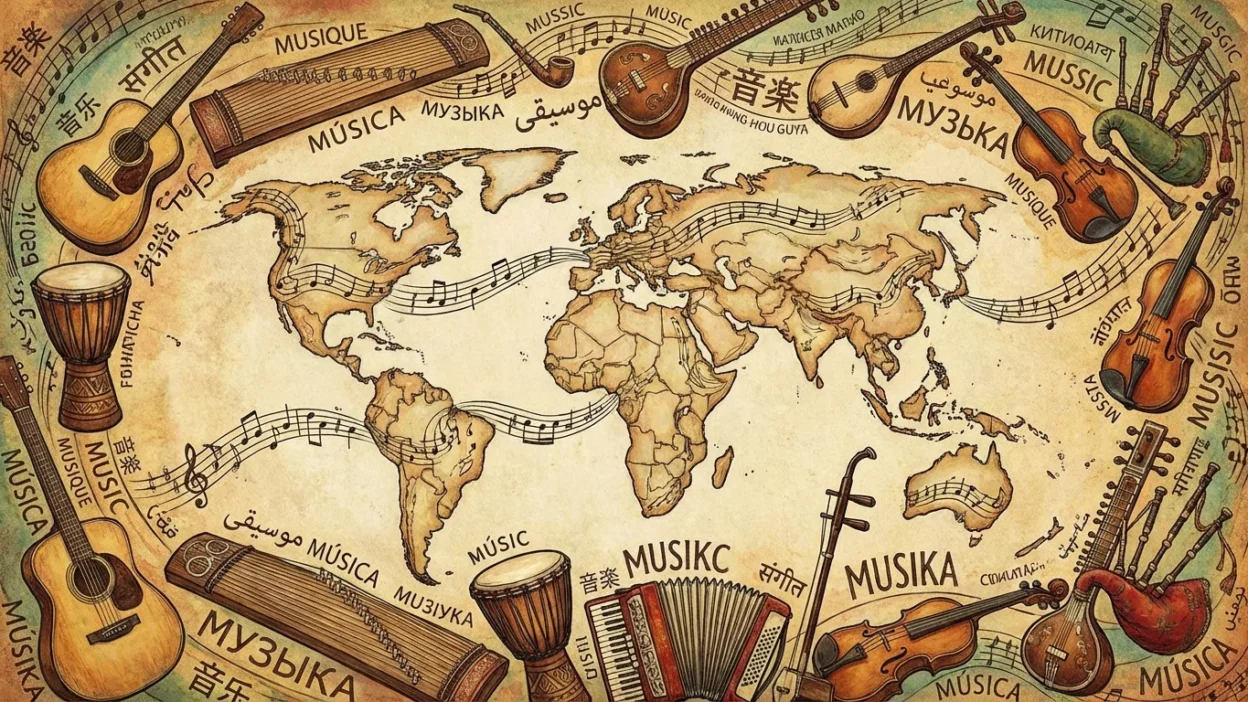
The word music is a universal language that connects people across cultures, emotions, and traditions. If it’s classical melodies, modern songs, or cultural rhythms, music plays a powerful role in everyday life.
Learning music in different languages is helpful for travelers, students, and anyone passionate about global culture. It allows you to communicate your interests and understand how different cultures express sound and art. In this guide, you’ll discover 70 music translations around the world, along with pronunciation and simple example sentences.
Music in 70 Different Languages Around the World
| Language | Phrase & Pronunciation | Example Sentence |
|---|---|---|
| English | Music (MYOO-zik) | I love music. |
| Spanish | Música (MOO-see-ka) | Me encanta la música. |
| French | Musique (myoo-ZEEK) | J’aime la musique. |
| German | Musik (moo-ZEEK) | Ich liebe Musik. |
| Italian | Musica (MOO-zee-ka) | Amo la musica. |
| Portuguese | Música (MOO-zi-ka) | Eu amo música. |
| Dutch | Muziek (mu-ZEEK) | Ik hou van muziek. |
| Russian | Музыка (MOO-zy-ka) | Я люблю музыку. |
| Ukrainian | Музика (MOO-zy-ka) | Я люблю музику. |
| Polish | Muzyka (mu-ZI-ka) | Kocham muzykę. |
| Czech | Hudba (HOOD-ba) | Miluji hudbu. |
| Slovak | Hudba (HOOD-ba) | Milujem hudbu. |
| Hungarian | Zene (ZE-ne) | Szeretem a zenét. |
| Romanian | Muzică (MOO-zi-ka) | Iubesc muzica. |
| Greek | Μουσική (moo-see-KEE) | Αγαπώ τη μουσική. |
| Turkish | Müzik (mew-ZEEK) | Müziği seviyorum. |
| Arabic | موسيقى (moo-see-qa) | أحب الموسيقى. |
| Hebrew | מוזיקה (moo-zi-ka) | אני אוהב מוזיקה. |
| Persian | موسیقی (moo-see-ghee) | من موسیقی را دوست دارم. |
| Hindi | संगीत (san-geet) | मुझे संगीत पसंद है। |
| Urdu | موسیقی (moo-see-qi) | مجھے موسیقی پسند ہے۔ |
| Bengali | সঙ্গীত (shon-geet) | আমি সঙ্গীত ভালোবাসি। |
| Punjabi | ਸੰਗੀਤ (san-geet) | ਮੈਨੂੰ ਸੰਗੀਤ ਪਸੰਦ ਹੈ। |
| Gujarati | સંગીત (san-geet) | મને સંગીત ગમે છે. |
| Marathi | संगीत (san-geet) | मला संगीत आवडते. |
| Tamil | இசை (i-sai) | எனக்கு இசை பிடிக்கும். |
| Telugu | సంగీతం (san-gee-tam) | నాకు సంగీతం ఇష్టం. |
| Kannada | ಸಂಗೀತ (san-geet) | ನನಗೆ ಸಂಗೀತ ಇಷ್ಟ. |
| Malayalam | സംഗീതം (san-gee-tham) | എനിക്ക് സംഗീതം ഇഷ്ടമാണ്. |
| Sinhala | සංගීත (san-geetha) | මට සංගීතය ආසයි. |
| Thai | ดนตรี (don-tree) | ฉันชอบดนตรี. |
| Vietnamese | Âm nhạc (am nyak) | Tôi yêu âm nhạc. |
| Indonesian | Musik (moo-sik) | Saya suka musik. |
| Malay | Muzik (moo-zik) | Saya suka muzik. |
| Filipino | Musika (moo-si-ka) | Gusto ko ang musika. |
| Chinese (Mandarin) | 音乐 (yin yue) | 我喜欢音乐. |
| Japanese | 音楽 (on-gaku) | 音楽が好きです。 |
| Korean | 음악 (eu-mak) | 나는 음악을 좋아한다. |
| Mongolian | Хөгжим (hug-jim) | Би хөгжимд дуртай. |
| Swahili | Muziki (mu-zee-ki) | Ninapenda muziki. |
| Zulu | Umculo (um-ku-lo) | Ngiyawuthanda umculo. |
| Afrikaans | Musiek (mu-seek) | Ek hou van musiek. |
| Somali | Muusig (moo-sig) | Waxaan jeclahay muusig. |
| Amharic | ሙዚቃ (mu-zi-ka) | ሙዚቃን እወዳለሁ. |
| Hausa | Kiɗa (kee-da) | Ina son kiɗa. |
| Yoruba | Orin (o-rin) | Mo nifẹ orin. |
| Igbo | Egwu (e-gwu) | A hụrụ m egwu n’anya. |
| Danish | Musik (moo-sik) | Jeg elsker musik. |
| Swedish | Musik (moo-sik) | Jag älskar musik. |
| Norwegian | Musikk (moo-sik) | Jeg elsker musikk. |
| Finnish | Musiikki (moo-see-ki) | Rakastan musiikkia. |
| Icelandic | Tónlist (tone-list) | Ég elska tónlist. |
| Estonian | Muusika (moo-si-ka) | Ma armastan muusikat. |
| Latvian | Mūzika (moo-zi-ka) | Es mīlu mūziku. |
| Lithuanian | Muzika (moo-zi-ka) | Aš myliu muziką. |
| Serbian | Музика (moo-zi-ka) | Волим музику. |
| Croatian | Glazba (GLAZ-ba) | Volim glazbu. |
| Bosnian | Muzika (moo-zi-ka) | Volim muziku. |
| Slovenian | Glasba (GLAZ-ba) | Obožujem glasbo. |
| Albanian | Muzikë (moo-zi-ke) | Unë dua muzikë. |
| Macedonian | Музика (moo-zi-ka) | Сакам музика. |
| Georgian | მუსიკა (moo-si-ka) | მე მიყვარს მუსიკა. |
| Armenian | Երաժշտություն (e-ra-zhsh-tu-tyun) | Ես սիրում եմ երաժշտություն. |
| Kazakh | Музыка (moo-zi-ka) | Мен музыканы жақсы көремін. |
| Uzbek | Musiqa (moo-si-qa) | Men musiqa yaxshi ko‘raman. |
| Tajik | Мусиқӣ (moo-see-qi) | Ман мусиқиро дӯст медорам. |
| Nepali | संगीत (san-geet) | मलाई संगीत मन पर्छ। |
| Khmer | តន្ត្រី (ton-trey) | ខ្ញុំស្រលាញ់តន្ត្រី. |
| Lao | ດົນຕີ (don-tee) | ຂ້ອຍມັກດົນຕີ. |
The Meaning of “Music” in Different Languages
The word music refers to vocal or instrumental sounds combined in a way that expresses emotion, rhythm, and harmony. It is a universal form of art found in every culture.
When exploring music in all languages, you’ll notice that many terms are closely related due to shared cultural or historical influences.
How the Word Music Is Used in Everyday Life
People commonly use the word music when talking about:
Entertainment and hobbies
Cultural traditions
Emotions and mood
Events and celebrations
Understanding music translations around the world helps you express your interests and connect with others.
Why Learning Music Vocabulary in Different Languages Is Important
Music is a global passion. Knowing how to say music in different languages allows you to communicate easily in social, cultural, and travel situations.
It also enhances your appreciation for global art and creativity.
Conclusion
The word music connects people across borders and cultures. While each language has its own way of saying it, the meaning remains universal.
By learning music in different languages, you expand your vocabulary and deepen your connection with cultures around the world.
FAQs
What is music in different languages?
Examples include Música (Spanish), Musique (French), Musik (German), Sangeet (Hindi), and 音乐 (Chinese).
How do you say music in 10 common languages?
English (Music), Spanish (Música), French (Musique), German (Musik), Italian (Musica), Arabic (Musiqa), Hindi (Sangeet), Chinese (Yin Yue), Japanese (Ongaku), and Turkish (Müzik).
Is the word music similar across languages?
Yes, many languages use similar forms due to shared roots.
Why is music vocabulary useful?
It is commonly used in daily conversations and cultural discussions.
Is music a universal concept?
Yes, every culture has its own form of music and expression.