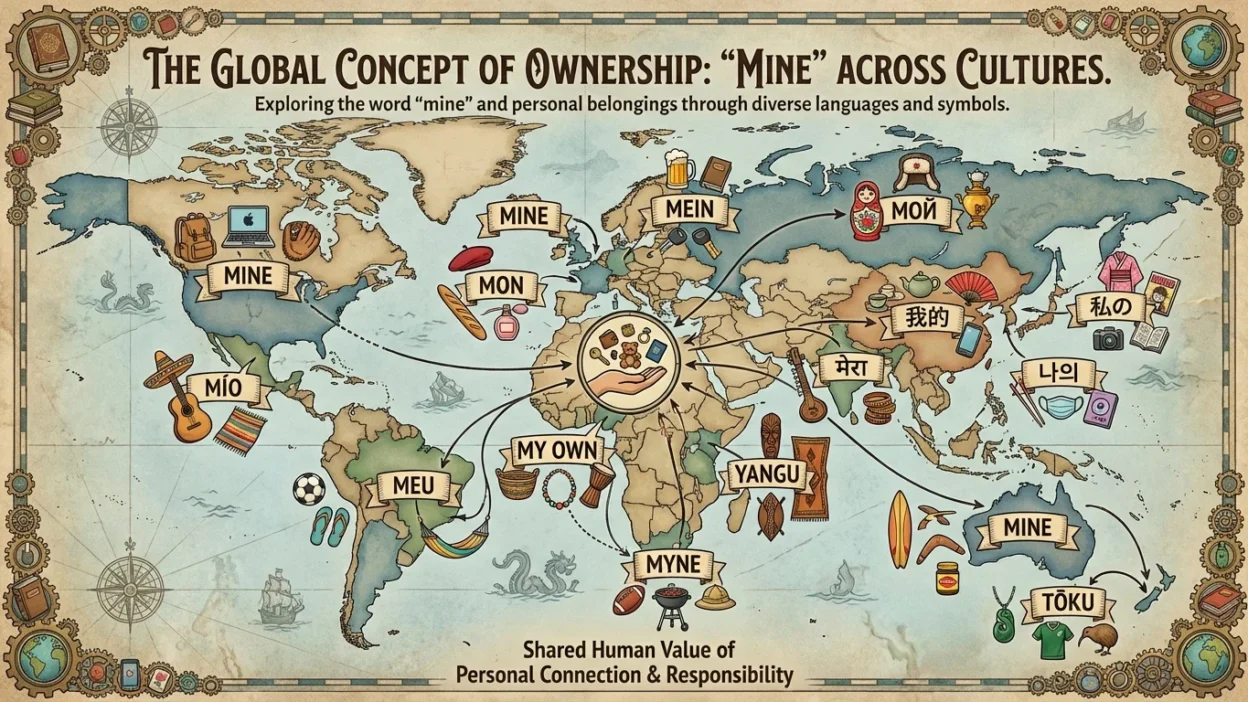
The word “mine” is commonly used in everyday conversations to show ownership or possession. People use it when talking about something that belongs to them, such as “This book is mine” or “That car is mine.” Although the meaning is simple, every language has its own way of expressing possession.
Learning mine in different languages helps language learners understand how ownership works across cultures. It is also useful when traveling, communicating internationally, or studying grammar in new languages.
In this guide, you will explore 70 translations of “mine” around the world, along with pronunciation and example sentences to show how the word is used naturally.
Mine in 70 Different Languages Around the World
| Language | Phrase & Pronunciation | Example Sentence |
|---|---|---|
| English | Mine (main) | This phone is mine. |
| Spanish | Mío / Mía (MEE-o) | Este libro es mío. |
| French | Le mien / La mienne (luh MYEN) | Ce stylo est le mien. |
| German | Mein / Meins (mine) | Das Auto ist meins. |
| Italian | Mio / Mia (MEE-o) | Questo telefono è mio. |
| Portuguese | Meu / Minha (meh-oo) | Este carro é meu. |
| Dutch | Mijn (mine) | Dit huis is mijn. |
| Russian | Мой / Моё (moy) | Эта книга моя. |
| Ukrainian | Мій (miy) | Цей телефон мій. |
| Polish | Mój (mooy) | Ten dom jest mój. |
| Czech | Můj (mooy) | Ten telefon je můj. |
| Slovak | Môj (mooy) | Tento dom je môj. |
| Hungarian | Enyém (eh-NYAME) | Ez a könyv az enyém. |
| Romanian | Al meu (al meh-oo) | Acest telefon este al meu. |
| Greek | Δικός μου (thee-KOS moo) | Αυτό το βιβλίο είναι δικό μου. |
| Turkish | Benim (be-NIM) | Bu araba benim. |
| Arabic | لي / خاصتي (lee) | هذا الكتاب لي. |
| Hebrew | שלי (sheh-LEE) | הטלפון הזה שלי. |
| Persian | مال من (maal-e-man) | این کتاب مال من است. |
| Hindi | मेरा (ME-ra) | यह फोन मेरा है। |
| Urdu | میرا (ME-ra) | یہ فون میرا ہے۔ |
| Bengali | আমার (a-mar) | এই বইটা আমার। |
| Punjabi | ਮੇਰਾ (ME-ra) | ਇਹ ਕਿਤਾਬ ਮੇਰੀ ਹੈ। |
| Gujarati | મારું (ma-ru) | આ ફોન મારું છે. |
| Marathi | माझे (ma-jhe) | हे पुस्तक माझे आहे. |
| Tamil | என்னுடைய (en-nu-dai-ya) | இது என்னுடையது. |
| Telugu | నాది (naa-di) | ఈ ఫోన్ నాది. |
| Kannada | ನನ್ನದು (nan-na-du) | ಇದು ನನ್ನದು. |
| Malayalam | എന്റെ (en-te) | ഇത് എന്റെ പുസ്തകമാണ്. |
| Sinhala | මගේ (ma-ge) | මේ පොත මගේ. |
| Thai | ของฉัน (khong-chan) | โทรศัพท์นี้ของฉัน. |
| Vietnamese | Của tôi (koo-a toy) | Điện thoại này là của tôi. |
| Indonesian | Milikku (mi-lik-ku) | Buku ini milikku. |
| Malay | Milik saya (mi-lik sa-ya) | Kereta ini milik saya. |
| Filipino | Akin (a-kin) | Ang librong ito ay akin. |
| Chinese (Mandarin) | 我的 (wo-de) | 这个手机是我的. |
| Japanese | 私の (wa-ta-shi no) | これは私の本です。 |
| Korean | 내 것 (nae geot) | 이 책은 내 것이다. |
| Mongolian | Миний (mi-niy) | Энэ ном минийх. |
| Swahili | Yangu (yan-goo) | Kitabu hiki ni changu. |
| Zulu | Yami (ya-mi) | Le ncwadi ingeyami. |
| Afrikaans | Myne (mine) | Hierdie huis is myne. |
| Somali | Kayga (kay-ga) | Buuggan waa kayga. |
| Amharic | የኔ (ye-ne) | ይህ መጽሐፍ የኔ ነው. |
| Hausa | Nawa (na-wa) | Wannan littafi nawa ne. |
| Yoruba | Tèmi (te-mi) | Iwe yi tèmi ni. |
| Igbo | Nke m (n-ke m) | Akwụkwọ a bụ nke m. |
| Danish | Min (min) | Denne bog er min. |
| Swedish | Min (min) | Den här boken är min. |
| Norwegian | Min (min) | Denne bilen er min. |
| Finnish | Minun (mi-nun) | Tämä kirja on minun. |
| Icelandic | Minn (minn) | Þetta er minn bíll. |
| Estonian | Minu (mi-nu) | See raamat on minu. |
| Latvian | Mans (mans) | Šī grāmata ir mana. |
| Lithuanian | Mano (ma-no) | Ši knyga yra mano. |
| Serbian | Моје (mo-ye) | Ово је моје. |
| Croatian | Moje (mo-ye) | Ovo je moje. |
| Bosnian | Moje (mo-ye) | Ovo je moje. |
| Slovenian | Moj (moy) | Ta telefon je moj. |
| Albanian | Imi / Ime (ee-mee) | Ky libër është imi. |
| Macedonian | Мое (mo-ye) | Ова книга е мое. |
| Georgian | ჩემი (che-mi) | ეს წიგნი ჩემია. |
| Armenian | Իմը (im-uh) | Այս գիրքը իմն է. |
| Kazakh | Менің (me-ning) | Бұл кітап менің. |
| Uzbek | Mening (me-ning) | Bu telefon mening. |
| Tajik | Моли ман (mo-li-man) | Ин китоб моли ман аст. |
| Nepali | मेरो (me-ro) | यो किताब मेरो हो। |
| Khmer | របស់ខ្ញុំ (ro-bos kh-nyom) | សៀវភៅនេះរបស់ខ្ញុំ. |
| Lao | ຂອງຂ້ອຍ (khong khoy) | ປື້ມນີ້ແມ່ນຂອງຂ້ອຍ. |
The Meaning of “Mine” in Different Languages
The word mine expresses ownership. In English, it replaces a noun phrase to show something belongs to someone. For example, instead of saying “my book,” people can say “the book is mine.”
When exploring mine in all languages, you will notice that some languages change the word depending on gender, number, or grammatical structure.
How “Mine” Is Used in Everyday Conversation
People commonly use the word mine in situations such as:
Showing ownership of objects
Talking about personal belongings
Distinguishing items from others
Casual daily conversations
Understanding mine translations around the world helps learners express possession clearly in different languages.
Why Learning Possessive Words in Different Languages Is Important
Possessive words are essential for communication. Learning how to say mine in different languages helps people talk about their belongings, clarify ownership, and understand grammar patterns in new languages.
It also improves everyday conversation skills for travelers and language learners.
Conclusion
Although the word mine changes from language to language, its meaning remains the same everywhere: showing possession or ownership.
By learning mine in different languages, you gain practical vocabulary that can be used in daily communication across cultures.
FAQs
What does the word mine mean in different languages?
The word mine refers to something that belongs to the speaker, expressing ownership or possession.
How do you say mine in 10 common languages?
English (Mine), Spanish (Mío), French (Le mien), German (Mein), Italian (Mio), Arabic (Li), Hindi (Mera), Chinese (Wo de), Japanese (Watashi no), and Turkish (Benim).
Why do some languages have different forms of mine?
Many languages change possessive words depending on gender, number, or grammar rules.
Is learning possessive words important in language learning?
Yes, possessive words are essential for everyday conversations and basic grammar.
Can the word mine replace nouns in sentences?
Yes, it often replaces a noun phrase to avoid repetition, such as “The book is mine.”