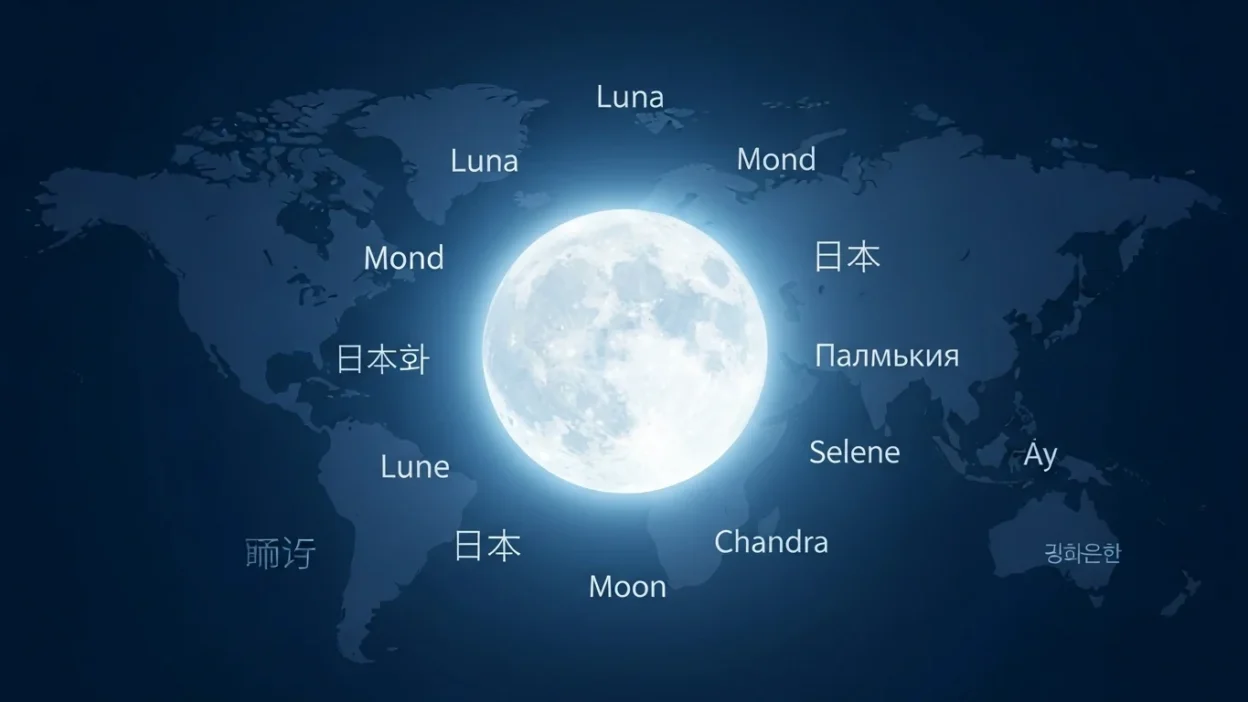
The word “luna” is deeply connected to the moon, beauty, and mystery across cultures. If you’re curious about language learning, naming ideas, or global meanings, exploring luna in different languages opens a fascinating window into how people around the world describe the moon.
In this guide, you’ll discover 70 languages, each showing how to say luna, along with pronunciation and real life examples. This makes it perfect for learners, writers, and anyone interested in global language diversity.
Luna in All Languages 70 Translations Table
Below is a clean, easy-to-read table showing how to say luna in different languages, including pronunciation and usage.
| Language | Phrase / Example Sentence | Meaning |
|---|---|---|
| Spanish | Luna (loo-nah) – La luna es hermosa | The moon is beautiful |
| Italian | Luna (loo-nah) – La luna brilla | The moon shines |
| Portuguese | Lua (loo-ah) – A lua está cheia | The moon is full |
| French | Lune (loon) – La lune est claire | The moon is bright |
| Romanian | Lună (loo-nuh) – Luna apare noaptea | The moon appears at night |
| Latin | Luna (loo-nah) – Luna lucet | The moon shines |
| English | Moon (moon) – The moon is bright | The moon is bright |
| German | Mond (mohnd) – Der Mond scheint | The moon shines |
| Dutch | Maan (mahn) – De maan is mooi | The moon is beautiful |
| Swedish | Måne (moh-neh) – Månen lyser | The moon shines |
| Danish | Måne (moh-neh) – Månen er klar | The moon is clear |
| Norwegian | Måne (moh-neh) – Månen er lys | The moon is bright |
| Finnish | Kuu (koo) – Kuu paistaa | The moon shines |
| Icelandic | Tungl (toongl) – Tunglið skín | The moon shines |
| Russian | Луна (loo-nah) – Луна яркая | The moon is bright |
| Ukrainian | Місяць (mee-syats) – Місяць світить | The moon shines |
| Polish | Księżyc (ksheh-zhits) – Księżyc świeci | The moon shines |
| Czech | Měsíc (mye-seets) – Měsíc svítí | The moon shines |
| Slovak | Mesiac (meh-shats) – Mesiac svieti | The moon shines |
| Hungarian | Hold (hold) – A hold fényes | The moon is bright |
| Greek | Σελήνη (seh-lee-nee) – Η σελήνη λάμπει | The moon shines |
| Turkish | Ay (eye) – Ay parlak | The moon is bright |
| Arabic | قمر (qamar) – القمر جميل | The moon is beautiful |
| Hebrew | ירח (yeh-rahkh) – הירח זורח | The moon shines |
| Persian | ماه (mah) – ماه روشن است | The moon is bright |
| Hindi | चाँद (chaand) – चाँद सुंदर है | The moon is beautiful |
| Urdu | چاند (chaand) – چاند روشن ہے | The moon is bright |
| Punjabi | ਚੰਦ (chand) – ਚੰਦ ਸੋਹਣਾ ਹੈ | The moon is beautiful |
| Bengali | চাঁদ (chand) – চাঁদ উজ্জ্বল | The moon is bright |
| Gujarati | ચંદ્ર (chandra) – ચંદ્ર ચમકે છે | The moon shines |
| Marathi | चंद्र (chandra) – चंद्र चमकतो | The moon shines |
| Tamil | நிலா (nila) – நிலா அழகு | The moon is beautiful |
| Telugu | చంద్రుడు (chandru-du) – చంద్రుడు ప్రకాశిస్తాడు | The moon shines |
| Kannada | ಚಂದ್ರ (chandra) – ಚಂದ್ರ ಪ್ರಕಾಶಮಾನ | The moon is bright |
| Malayalam | ചന്ദ്രൻ (chandran) – ചന്ദ്രൻ തെളിയും | The moon shines |
| Sinhala | සඳ (sanda) – සඳ ලස්සනයි | The moon is beautiful |
| Thai | ดวงจันทร์ (duang jan) – ดวงจันทร์สวย | The moon is beautiful |
| Vietnamese | Mặt trăng (mat trang) – Mặt trăng sáng | The moon is bright |
| Indonesian | Bulan (boo-lan) – Bulan bersinar | The moon shines |
| Malay | Bulan (boo-lan) – Bulan cantik | The moon is beautiful |
| Filipino | Buwan (boo-wan) – Ang buwan ay maliwanag | The moon is bright |
| Chinese (Mandarin) | 月亮 (yweh-lyang) – 月亮很美 | The moon is beautiful |
| Japanese | 月 (tsuki) – 月が明るい | The moon is bright |
| Korean | 달 (dal) – 달이 밝다 | The moon is bright |
| Mongolian | Сар (sar) – Сар гэрэлтэнэ | The moon shines |
| Swahili | Mwezi (meh-wee-zee) – Mwezi unang’aa | The moon shines |
| Zulu | Inyanga (in-yan-ga) – Inyanga ikhanya | The moon shines |
| Afrikaans | Maan (mahn) – Die maan skyn | The moon shines |
| Hausa | Wata (wah-tah) – Wata tana haske | The moon shines |
| Yoruba | Oṣupa (oh-shoo-pah) – Oṣupa n tan | The moon shines |
| Somali | Dayax (dah-yakh) – Dayax waa iftiin | The moon is bright |
| Amharic | ጨረቃ (che-re-ka) – ጨረቃ ብሩህ ናት | The moon is bright |
| Malagasy | Volana (voo-lah-na) – Volana mamirapiratra | The moon shines |
| Hawaiian | Mahina (mah-hee-nah) – He nani ka mahina | The moon is beautiful |
| Maori | Marama (mah-rah-mah) – He ataahua te marama | The moon is beautiful |
| Samoan | Masina (mah-see-nah) – E matagofie le masina | The moon is beautiful |
| Tongan | Mahina (mah-hee-nah) – ʻOku fakaʻofoʻofa ʻa e mahina | The moon is beautiful |
| Fijian | Vula (voo-lah) – E rairai na vula | The moon shines |
| Estonian | Kuu (koo) – Kuu paistab | The moon shines |
| Latvian | Mēness (meh-ness) – Mēness spīd | The moon shines |
| Lithuanian | Mėnulis (meh-noo-lis) – Mėnulis šviečia | The moon shines |
| Albanian | Hënë (huh-neh) – Hëna ndriçon | The moon shines |
| Serbian | Месец (meh-setz) – Месец сија | The moon shines |
| Croatian | Mjesec (mye-sek) – Mjesec sjaji | The moon shines |
| Slovenian | Luna (loo-nah) – Luna sije | The moon shines |
| Bulgarian | Луна (loo-nah) – Луната свети | The moon shines |
| Georgian | მთვარე (mtva-re) – მთვარე ანათებს | The moon shines |
| Armenian | Լուսին (loo-seen) – Լուսինը փայլում է | The moon shines |
| Basque | Ilargi (eel-ar-gee) – Ilargia distiratsua da | The moon is bright |
| Catalan | Lluna (lyoo-nah) – La lluna brilla | The moon shines |
| Galician | Lúa (loo-ah) – A lúa é fermosa | The moon is beautiful |
How to Say Luna in Different Languages Around the World
The word luna originates from Latin and is still widely used in Romance languages like Spanish and Italian. However, as you explore luna translations, you’ll notice each culture has its own poetic way of describing the moon.
In Asian languages, the moon often symbolizes peace and beauty, while in African languages it can represent time and cycles. This diversity makes learning how to say luna in different languages both educational and meaningful.
Why Learn Luna in All Languages
Understanding luna in all languages is useful for many reasons:
- Helps language learners expand vocabulary
- Inspires unique baby names or brand names
- Adds depth to writing, poetry, and storytelling
- Enhances cultural awareness
It also connects you to how different societies view nature and the night sky.
Common Uses of Luna Around the World
Across cultures, luna or its equivalent is commonly used in:
- Poetry and romantic expressions
- Names (especially for girls)
- Literature and mythology
- Astronomy and science
This universal connection makes luna around the world a truly fascinating topic.
Conclusion
Exploring luna in different languages reveals more than just translations it shows how deeply the moon is woven into human culture, language, and imagination. From luna in Spanish to tsuki in Japanese, every version carries its own beauty and meaning.
FAQs
1. What does luna mean in English?
Luna means “moon” in English and comes from Latin.
2. How to say luna in different languages?
You can say it as luna, lua, lune, moon, ay, chandr, and many more depending on the language.
3. Is luna the same in all languages?
No, while some languages use similar words, many have completely different terms for the moon.
4. Which languages use the word luna directly?
Spanish, Italian, Latin, Romanian, and Slovenian use forms of “luna.”
5. Why is luna popular worldwide?
Because the moon is a universal symbol of beauty, calmness, and mystery.