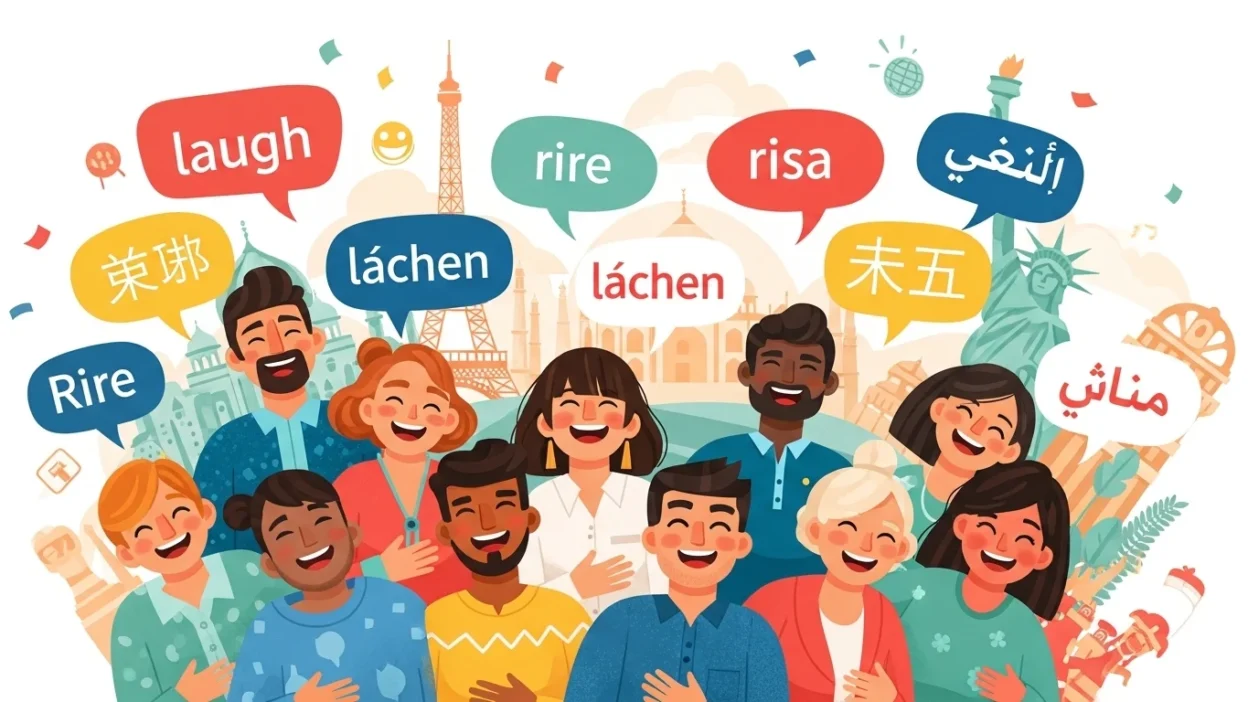
Laughter is universal but the way we express it in words is beautifully different across cultures. If you’re curious about laughing in different languages, this guide will help you explore how people around the world describe and express laughter in everyday speech.
From casual conversations to social media expressions, learning laughing in all languages adds personality and cultural depth to your communication.
Laughing in All Languages 70 Expressions Table
| Language | Phrase / Example Sentence | Meaning |
|---|---|---|
| English | Laugh (laf) – I am laughing | I am laughing |
| Spanish | Reír (reh-eer) – Estoy riendo | I am laughing |
| French | Rire (reer) – Je ris | I laugh |
| Italian | Ridere (ree-deh-reh) – Sto ridendo | I am laughing |
| Portuguese | Rir (heer) – Estou rindo | I am laughing |
| German | Lachen (lah-khen) – Ich lache | I laugh |
| Dutch | Lachen (lah-khen) – Ik lach | I laugh |
| Swedish | Skratta (skrat-ta) – Jag skrattar | I laugh |
| Danish | Grine (gree-neh) – Jeg griner | I laugh |
| Norwegian | Le (leh) – Jeg ler | I laugh |
| Finnish | Nauraa (now-rah) – Minä nauran | I laugh |
| Icelandic | Hlæja (hlai-ya) – Ég hlæ | I laugh |
| Russian | Смеяться (smee-yat-sa) – Я смеюсь | I am laughing |
| Ukrainian | Сміятися (smee-ya-ty-sya) – Я сміюся | I am laughing |
| Polish | Śmiać się (shmyach shyeh) – Śmieję się | I am laughing |
| Czech | Smát se (smaat seh) – Směji se | I am laughing |
| Slovak | Smiať sa (smee-yat sa) – Smejem sa | I am laughing |
| Hungarian | Nevetni (neh-vet-nee) – Nevetek | I laugh |
| Romanian | A râde (uh ruh-deh) – Eu râd | I laugh |
| Greek | Γελάω (yeh-la-o) – Γελάω πολύ | I laugh a lot |
| Turkish | Gülmek (gool-mek) – Gülüyorum | I am laughing |
| Arabic | يضحك (yadhak) – أنا أضحك | I am laughing |
| Hebrew | לצחוק (litz-khok) – אני צוחק | I am laughing |
| Persian | خندیدن (khan-dee-dan) – من میخندم | I laugh |
| Hindi | हँसना (hans-na) – मैं हँस रहा हूँ | I am laughing |
| Urdu | ہنسنا (hans-na) – میں ہنس رہا ہوں | I am laughing |
| Punjabi | ਹੱਸਣਾ (hass-na) – ਮੈਂ ਹੱਸ ਰਿਹਾ ਹਾਂ | I am laughing |
| Bengali | হাসা (ha-sha) – আমি হাসছি | I am laughing |
| Gujarati | હસવું (has-vu) – હું હસી રહ્યો છું | I am laughing |
| Marathi | हसणे (has-ne) – मी हसत आहे | I am laughing |
| Tamil | சிரிக்க (si-rik-ka) – நான் சிரிக்கிறேன் | I am laughing |
| Telugu | నవ్వు (nav-vu) – నేను నవ్వుతున్నాను | I am laughing |
| Kannada | ನಗು (na-gu) – ನಾನು ನಗುತ್ತೇನೆ | I laugh |
| Malayalam | ചിരിക്കുക (chi-ri-ku-ka) – ഞാൻ ചിരിക്കുന്നു | I am laughing |
| Sinhala | සිනාසෙන්න (si-na-sen-na) – මම සිනාසෙමි | I laugh |
| Thai | หัวเราะ (hua-roh) – ฉันหัวเราะ | I laugh |
| Vietnamese | Cười (coo-ee) – Tôi cười | I laugh |
| Indonesian | Tertawa (ter-ta-wa) – Saya tertawa | I laugh |
| Malay | Ketawa (keh-ta-wa) – Saya ketawa | I laugh |
| Filipino | Tumawa (too-ma-wa) – Tumatawa ako | I am laughing |
| Chinese (Mandarin) | 笑 (shyao) – 我笑了 | I laughed |
| Japanese | 笑う (wa-ra-u) – 私は笑う | I laugh |
| Korean | 웃다 (oot-da) – 나는 웃는다 | I laugh |
| Mongolian | Инээх (ee-nehkh) – Би инээж байна | I am laughing |
| Swahili | Cheka (cheh-ka) – Ninacheka | I am laughing |
| Zulu | Hleka (hleh-ka) – Ngiyahleka | I am laughing |
| Afrikaans | Lag (lakh) – Ek lag | I laugh |
| Hausa | Dariya (da-ree-ya) – Ina dariya | I am laughing |
| Yoruba | Rerin (reh-reen) – Mo n rerin | I am laughing |
| Somali | Qosol (qo-sol) – Waan qoslayaa | I am laughing |
| Amharic | መሳቅ (meh-sak) – እኔ እሳቃለሁ | I laugh |
| Malagasy | Mihomehy (mee-ho-meh) – Mihomehy aho | I laugh |
| Hawaiian | ʻAkaʻaka (ah-ka-ah-ka) – Ke akaʻaka nei au | I am laughing |
| Maori | Kata (ka-ta) – Kei te kata au | I am laughing |
| Samoan | ʻAta (ah-ta) – ʻAta ata | I am laughing |
| Tongan | Kata (ka-ta) – ʻOku ou kata | I laugh |
| Fijian | Dredre (ndreh-ndreh) – Au dredre | I laugh |
| Estonian | Naerma (nair-ma) – Ma naeran | I laugh |
| Latvian | Smieties (smee-eh-ties) – Es smejos | I am laughing |
| Lithuanian | Juoktis (yoo-ok-tis) – Aš juokiuosi | I am laughing |
| Albanian | Qesh (qesh) – Unë qesh | I laugh |
| Serbian | Смејати се (smeh-ya-ti se) – Смејем се | I am laughing |
| Croatian | Smijati se (smee-ya-ti se) – Smijem se | I am laughing |
| Slovenian | Smejati se (smeh-ya-ti se) – Smejem se | I am laughing |
| Bulgarian | Смее се (smeh-eh se) – Аз се смея | I am laughing |
| Georgian | სიცილი (si-tsi-li) – მე ვიცინი | I am laughing |
| Armenian | Ծիծաղել (tsi-tsa-ghel) – Ես ծիծաղում եմ | I am laughing |
| Basque | Barre egin (ba-rreh eh-gin) – Barre egiten dut | I laugh |
| Catalan | Riure (ree-oo-reh) – Ric molt | I laugh a lot |
| Galician | Rir (reer) – Estou rindo | I am laughing |
How to Say Laughing in Different Languages Around the World
Expressions for laughter vary widely. Some languages use verbs, while others use sounds or expressions depending on context.
For example:
- English uses “laugh”
- Japanese may use “笑う (warau)”
- Spanish uses “reír”
Learning how to say laughing in different languages helps you sound more natural and expressive.
Why Learn Laughing in All Languages
Understanding laughing in all languages is useful because:
- It improves conversational skills
- Helps express emotions clearly
- Enhances cultural understanding
- Makes communication more engaging
Laughter is a key part of human connection.
Common Expressions of Laughter Around the World
Different cultures express laughter in unique ways:
- Verbal verbs (laugh, rire, lachen)
- Sound-based expressions (like “haha”)
- Context-based expressions depending on formality
These variations make laughing translations fun and interesting to learn.
Conclusion
Exploring laughing in different languages shows how a universal human emotion is expressed in diverse and creative ways.
No matter the language, laughter connects us all.
FAQs
1. How to say laughing in different languages?
You can say reír, rire, lachen, hansna, and many more.
2. Is laughter expressed the same worldwide?
No, each language has unique words and expressions.
3. Why learn laughter words in other languages?
It helps you express emotions and connect better.
4. What is laughing in Asian languages?
Examples include warau (Japanese), hansna (Hindi), 웃다 (Korean).
5. Is laughter universal?
Yes, but the way we express it in language varies.