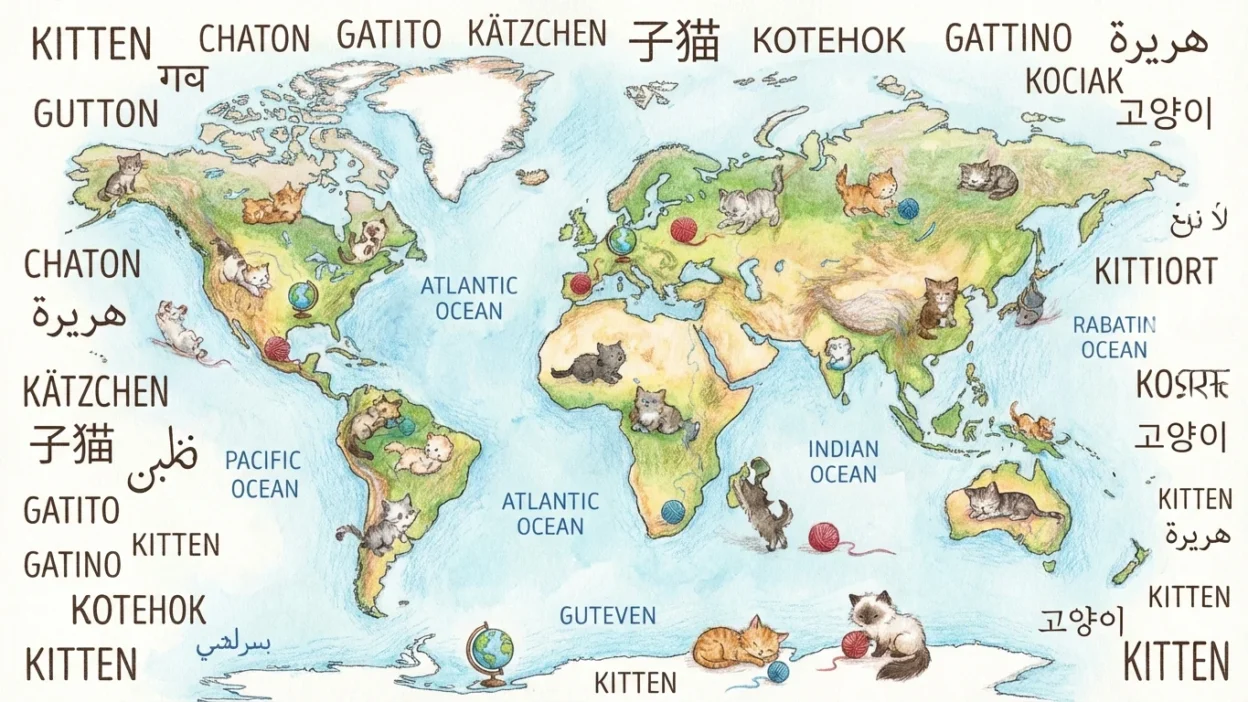
A kitten is a young cat, often associated with cuteness, playfulness, and warmth. Across the world, people adore kittens and have their own unique words to describe them. While the meaning stays the same, the pronunciation and expressions vary beautifully from one language to another.
Learning kitten in different languages is fun and useful for animal lovers, language learners, and travelers. It also helps you understand how different cultures express affection toward pets.
In this guide, you’ll discover 70 kitten translations around the world, along with pronunciation and simple example sentences.
Kitten in 70 Different Languages Around the World
| Language | Phrase & Pronunciation | Example Sentence |
|---|---|---|
| English | Kitten (KIT-n) | The kitten is sleeping. |
| Spanish | Gatito (ga-TEE-to) | El gatito está durmiendo. |
| French | Chaton (sha-TON) | Le chaton dort. |
| German | Kätzchen (KET-chen) | Das Kätzchen schläft. |
| Italian | Gattino (gat-TEE-no) | Il gattino dorme. |
| Portuguese | Gatinho (ga-TEEN-yo) | O gatinho está dormindo. |
| Dutch | Kitten (KIT-ten) | De kitten slaapt. |
| Russian | Котёнок (ka-TYO-nok) | Котёнок спит. |
| Ukrainian | Кошеня (ko-she-NYA) | Кошеня спить. |
| Polish | Kociak (KO-chak) | Kociak śpi. |
| Czech | Kotě (KO-tye) | Kotě spí. |
| Slovak | Mačiatko (ma-CHAT-ko) | Mačiatko spí. |
| Hungarian | Kiscica (kish-TSEE-tsa) | A kiscica alszik. |
| Romanian | Pisoi (pee-SOY) | Pisoiul doarme. |
| Greek | Γατάκι (ga-TA-ki) | Το γατάκι κοιμάται. |
| Turkish | Yavru kedi (yav-roo ke-di) | Yavru kedi uyuyor. |
| Arabic | قطة صغيرة (qit-ta sa-ghee-ra) | القطة الصغيرة نائمة. |
| Hebrew | חתלתול (khat-le-tool) | החתלתול ישן. |
| Persian | بچه گربه (ba-che gor-be) | بچه گربه خواب است. |
| Hindi | बिल्ली का बच्चा (bil-li ka bach-cha) | बिल्ली का बच्चा सो रहा है। |
| Urdu | بلی کا بچہ (bil-li ka bach-cha) | بلی کا بچہ سو رہا ہے۔ |
| Bengali | বিড়ালছানা (bi-ral-cha-na) | বিড়ালছানা ঘুমাচ্ছে। |
| Punjabi | ਬਿੱਲੀ ਦਾ ਬੱਚਾ (bil-li da bach-cha) | ਬਿੱਲੀ ਦਾ ਬੱਚਾ ਸੌ ਰਿਹਾ ਹੈ। |
| Gujarati | બિલાડીનું બચ્ચું (bi-la-di nu bach-chu) | બિલાડીનું બચ્ચું ઊંઘે છે. |
| Marathi | मांजराचे पिल्लू (man-ja-ra-che pil-lu) | मांजराचे पिल्लू झोपले आहे. |
| Tamil | பூனைக்குட்டி (poo-nai kut-ti) | பூனைக்குட்டி தூங்குகிறது. |
| Telugu | పిల్లి పిల్ల (pil-li pil-la) | పిల్లి పిల్ల నిద్రపోతుంది. |
| Kannada | ಬೆಕ್ಕಿನ ಮರಿ (bek-ki-na ma-ri) | ಬೆಕ್ಕಿನ ಮರಿ ಮಲಗಿದೆ. |
| Malayalam | പൂച്ചക്കുഞ്ഞ് (poo-cha kunj) | പൂച്ചക്കുഞ്ഞ് ഉറങ്ങുന്നു. |
| Sinhala | පූස් පැටියා (poos pa-ti-ya) | පූස් පැටියා නිදාගෙන. |
| Thai | ลูกแมว (look maew) | ลูกแมวนอนอยู่. |
| Vietnamese | Mèo con (meo kon) | Mèo con đang ngủ. |
| Indonesian | Anak kucing (a-nak ku-ching) | Anak kucing sedang tidur. |
| Malay | Anak kucing (a-nak ku-ching) | Anak kucing tidur. |
| Filipino | Kuting (ku-ting) | Ang kuting ay natutulog. |
| Chinese (Mandarin) | 小猫 (xiao mao) | 小猫在睡觉. |
| Japanese | 子猫 (ko-ne-ko) | 子猫は寝ています。 |
| Korean | 새끼 고양이 (saek-ki go-yang-i) | 새끼 고양이가 자고 있다. |
| Mongolian | Муурын зулзага (mu-u-rin zul-za-ga) | Муурын зулзага унтаж байна. |
| Swahili | Kitoto cha paka (ki-to-to cha pa-ka) | Kitoto cha paka kinalala. |
| Zulu | Ikati elincane (i-ka-ti e-lin-ca-ne) | Ikati elincane lilele. |
| Afrikaans | Katjie (kat-kee) | Die katjie slaap. |
| Somali | Ilmo bisad (il-mo bi-sad) | Ilmo bisad hurdaa. |
| Amharic | ድመት ጫጩት (di-met cha-chut) | ድመት ጫጩት እያንቀላፋ ነው. |
| Hausa | Kyanwa ƙarama (kyan-wa ka-ra-ma) | Kyanwa ƙarama tana barci. |
| Yoruba | Ọmọ ologbo (o-mo o-log-bo) | Ọmọ ologbo sun. |
| Igbo | Nwa pusi (nwa pu-si) | Nwa pusi na-ehi ụra. |
| Danish | Killing (kil-ling) | Killingen sover. |
| Swedish | Kattunge (kat-tung-e) | Kattungen sover. |
| Norwegian | Kattunge (kat-tung-e) | Kattungen sover. |
| Finnish | Kissanpentu (kis-san-pen-tu) | Kissanpentu nukkuu. |
| Icelandic | Kettlingur (ket-lin-gur) | Kettlingur sefur. |
| Estonian | Kassipoeg (kas-si-poeg) | Kassipoeg magab. |
| Latvian | Kaķēns (ka-chens) | Kaķēns guļ. |
| Lithuanian | Kačiukas (ka-chu-kas) | Kačiukas miega. |
| Serbian | Маче (ma-che) | Маче спава. |
| Croatian | Mače (ma-che) | Mače spava. |
| Bosnian | Mače (ma-che) | Mače spava. |
| Slovenian | Mucek (mu-tsek) | Mucek spi. |
| Albanian | Kotele (ko-te-le) | Kotele fle. |
| Macedonian | Маче (ma-che) | Маче спие. |
| Georgian | კნუტი (knu-ti) | კნუტი სძინავს. |
| Armenian | Կատվիկ (kat-vik) | Կատվիկը քնած է. |
| Kazakh | Мысық баласы (my-syk ba-la-sy) | Мысық баласы ұйықтап жатыр. |
| Uzbek | Mushukcha (mu-shuk-cha) | Mushukcha uxlayapti. |
| Tajik | Гурбачаи хурд (gur-ba-chai khurd) | Гурбачаи хурд хоб аст. |
| Nepali | बिरालोको बच्चा (bi-ra-lo ko bach-cha) | बिरालोको बच्चा सुतिरहेको छ। |
| Khmer | កូនឆ្មា (kon chma) | កូនឆ្មាកំពុងដេក. |
| Lao | ລູກແມວ (look maew) | ລູກແມວນອນ. |
The Meaning of “Kitten” in Different Languages
A kitten is a baby cat, typically less than one year old. It symbolizes innocence, playfulness, and affection in many cultures.
When exploring kitten in all languages, you will notice that many languages describe it as “baby cat” rather than having a completely separate word.
How People Use the Word Kitten in Everyday Conversations
People commonly use the word kitten when talking about:
Pets and animals
Adoption and care
Cute or affectionate expressions
Family conversations about animals
Understanding kitten translations around the world helps in conversations about pets and animals.
Why Learning Animal Names in Different Languages Is Useful
Animal vocabulary is often among the first things people learn in a new language. Knowing how to say kitten in different languages helps with everyday conversations and improves vocabulary in a fun way.
It’s especially useful for pet lovers and travelers.
Conclusion
The word kitten is simple but loved across the world. While different languages use unique expressions, the idea of a small, adorable cat remains universal.
By learning kitten in different languages, you expand your vocabulary and connect with cultures that share a love for animals.
FAQs
What is kitten in different languages?
Examples include Gatito (Spanish), Chaton (French), Kätzchen (German), 小猫 (Chinese), and 子猫 (Japanese).
How do you say kitten in 10 common languages?
English (Kitten), Spanish (Gatito), French (Chaton), German (Kätzchen), Italian (Gattino), Arabic (Small cat), Hindi (Baby cat), Chinese (Xiao Mao), Japanese (Ko-neko), and Turkish (Yavru kedi).
Why do many languages say “baby cat” for kitten?
Some languages describe animals by combining words like “baby” and “cat” instead of using a unique term.
Is kitten vocabulary useful in language learning?
Yes, animal names are commonly used and easy to remember.
Can kitten have other meanings?
Sometimes it is used as a term of affection for someone cute or lovable.