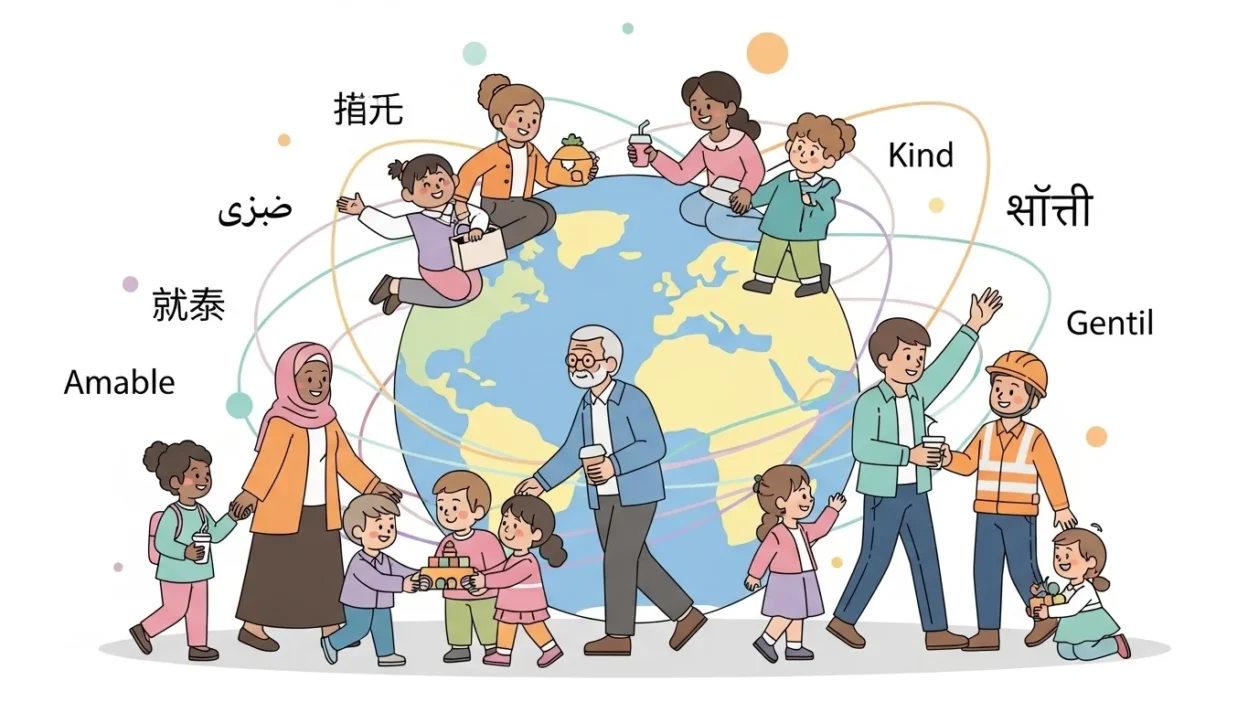
Kindness is a universal value that connects people across cultures, languages, and borders. Learning how to say kind in different languages not only improves your vocabulary but also helps you communicate warmth, empathy, and respect wherever you go.
In this guide, you’ll discover how to say kind in different languages, complete with pronunciation and real life example sentences. If you’re learning a new language or simply exploring kind translations around the world, this article is your perfect starting point.
Kind in All Languages (70 Translations Table)
Below is a simple, mobile friendly table with 70 languages, their translation of “kind,” pronunciation, and example usage.
| Language | Phrase / Pronunciation | Example Sentence |
|---|---|---|
| English | Kind (kined) | She is very kind. (She is kind) |
| Spanish | Amable (a-ma-ble) | Ella es amable. (She is kind) |
| French | Gentil (zhon-teel) | Il est gentil. (He is kind) |
| German | Freundlich (froint-likh) | Er ist freundlich. (He is kind) |
| Italian | Gentile (jen-tee-le) | Lei è gentile. (She is kind) |
| Portuguese | Gentil (zhen-cheel) | Ele é gentil. (He is kind) |
| Dutch | Vriendelijk (vreen-de-lik) | Hij is vriendelijk. (He is kind) |
| Russian | Добрый (dob-ryy) | Он добрый. (He is kind) |
| Chinese (Mandarin) | 善良 (shàn liáng) | 她很善良。(She is kind) |
| Japanese | 親切な (shin-setsu-na) | 彼は親切です。(He is kind) |
| Korean | 친절한 (chin-jeol-han) | 그는 친절해요. (He is kind) |
| Arabic | لطيف (lateef) | هو لطيف. (He is kind) |
| Hindi | दयालु (da-yaa-loo) | वह दयालु है। (He/She is kind) |
| Urdu | مہربان (mehr-baan) | وہ مہربان ہے۔ (He/She is kind) |
| Turkish | Nazik (na-zik) | O nazik. (He/She is kind) |
| Greek | Ευγενικός (ev-ye-ni-kos) | Είναι ευγενικός. (He is kind) |
| Polish | Miły (mee-wi) | On jest miły. (He is kind) |
| Swedish | Snäll (snell) | Han är snäll. (He is kind) |
| Danish | Venlig (ven-li) | Han er venlig. (He is kind) |
| Norwegian | Snill (snill) | Han er snill. (He is kind) |
| Finnish | Ystävällinen (us-ta-val-li-nen) | Hän on ystävällinen. (He/She is kind) |
| Czech | Milý (mi-lee) | On je milý. (He is kind) |
| Hungarian | Kedves (ked-vesh) | Ő kedves. (He/She is kind) |
| Romanian | Amabil (a-ma-bil) | El este amabil. (He is kind) |
| Thai | ใจดี (jai-dee) | เขาใจดี (He is kind) |
| Vietnamese | Tốt bụng (tot-boong) | Anh ấy tốt bụng. (He is kind) |
| Indonesian | Baik (ba-ik) | Dia baik. (He/She is kind) |
| Malay | Baik (ba-ik) | Dia baik. (He/She is kind) |
| Filipino | Mabait (ma-ba-it) | Siya ay mabait. (He/She is kind) |
| Hebrew | אדיב (a-deev) | הוא אדיב. (He is kind) |
| Persian | مهربان (mehr-baan) | او مهربان است. (He/She is kind) |
| Bengali | দয়ালু (do-ya-loo) | সে দয়ালু। (He/She is kind) |
| Tamil | கனிவான (ka-ni-vaan) | அவர் கனிவானவர். (He/She is kind) |
| Telugu | దయగల (da-ya-ga-la) | అతను దయగలవాడు. (He is kind) |
| Marathi | दयाळू (da-yaa-loo) | तो दयाळू आहे. (He is kind) |
| Gujarati | દયાળુ (da-yaa-loo) | તે દયાળુ છે. (He/She is kind) |
| Punjabi | ਦਿਆਲੂ (di-aa-loo) | ਉਹ ਦਿਆਲੂ ਹੈ। (He/She is kind) |
| Swahili | Mkarimu (mka-ree-mu) | Yeye ni mkarimu. (He/She is kind) |
| Zulu | Mnene (m-ne-ne) | Unomusa. (He/She is kind) |
| Afrikaans | Vriendelik (vreen-de-lik) | Hy is vriendelik. (He is kind) |
| Icelandic | Góðhjartaður (goth-hyar-ta-thur) | Hann er góður. (He is kind) |
| Irish | Cineálta (kin-yal-ta) | Tá sé cineálta. (He is kind) |
| Scottish Gaelic | Coibhneil (koy-nel) | Tha e coibhneil. (He is kind) |
| Welsh | Caredig (ka-re-dig) | Mae e’n garedig. (He is kind) |
| Albanian | I sjellshëm (i shel-shum) | Ai është i sjellshëm. (He is kind) |
| Serbian | Љубазан (lyu-ba-zan) | On je ljubazan. (He is kind) |
| Croatian | Ljubazan (lyu-ba-zan) | On je ljubazan. (He is kind) |
| Slovak | Milý (mi-lee) | On je milý. (He is kind) |
| Slovenian | Prijazen (pri-ya-zen) | On je prijazen. (He is kind) |
| Estonian | Lahke (lah-ke) | Ta on lahke. (He/She is kind) |
| Latvian | Laipns (laip-ns) | Viņš ir laipns. (He is kind) |
| Lithuanian | Malonus (ma-lo-nus) | Jis yra malonus. (He is kind) |
| Maltese | Ġentili (jen-tee-lee) | Huwa ġentili. (He is kind) |
| Basque | Atsegina (at-se-gi-na) | Atsegina da. (He/She is kind) |
| Catalan | Amable (a-ma-ble) | És amable. (He/She is kind) |
| Galician | Amable (a-ma-ble) | É amable. (He/She is kind) |
| Armenian | Բարի (ba-ri) | Նա բարի է։ (He/She is kind) |
| Georgian | კეთილი (ke-ti-li) | ის კეთილია. (He/She is kind) |
| Khmer | សប្បុរស (sa-bo-ros) | គាត់សប្បុរស។ (He/She is kind) |
| Lao | ໃຈດີ (jai-dee) | ລາວໃຈດີ. (He/She is kind) |
| Burmese | ကြင်နာ (kyin-na) | သူကြင်နာသည်။ (He/She is kind) |
| Mongolian | Сайхан сэтгэлтэй (sai-khan) | Тэр сайхан сэтгэлтэй. (He/She is kind) |
| Nepali | दयालु (da-yaa-loo) | ऊ दयालु छ। (He/She is kind) |
| Sinhala | කරුණාවන්ත (ka-ru-na-van-ta) | ඔහු කරුණාවන්තයි. (He is kind) |
| Amharic | ደግ (deg) | እሱ ደግ ነው። (He is kind) |
How to Say Kind in Different Languages
Learning kind in all languages helps you express positivity and empathy globally. While some languages use words that directly translate to “kind,” others reflect deeper meanings like generosity, compassion, or friendliness.
Kind Translations Around the World
Kindness is valued in every culture, but the expression can vary:
- In Asian languages, kindness often connects with respect and harmony
- In European languages, it may relate to politeness and friendliness
- In African languages, kindness often reflects generosity and community care
Understanding these differences makes your communication more meaningful.
Tips to Use “Kind” in Different Languages
- Practice daily with simple sentences
- Listen to native pronunciation
- Use kindness words in real conversations
- Group similar words for faster learning
Conclusion
Knowing how to say kind in different languages allows you to spread positivity wherever you go. It’s a simple word with a powerful impact, helping you connect with people across cultures and backgrounds.
FAQs
1. How do you say kind in different languages?
You can say kind as amable (Spanish), gentil (French), freundlich (German), and दयालु (Hindi).
2. What is the meaning of kind in all languages?
It generally means being nice, helpful, and caring toward others.
3. Why learn kindness words in different languages?
It improves communication and helps build positive relationships globally.
4. Is kind the same in every culture?
The meaning is similar, but cultural expression may vary.
5. What is the easiest way to remember kind translations?
Practice with examples and group similar-sounding words.