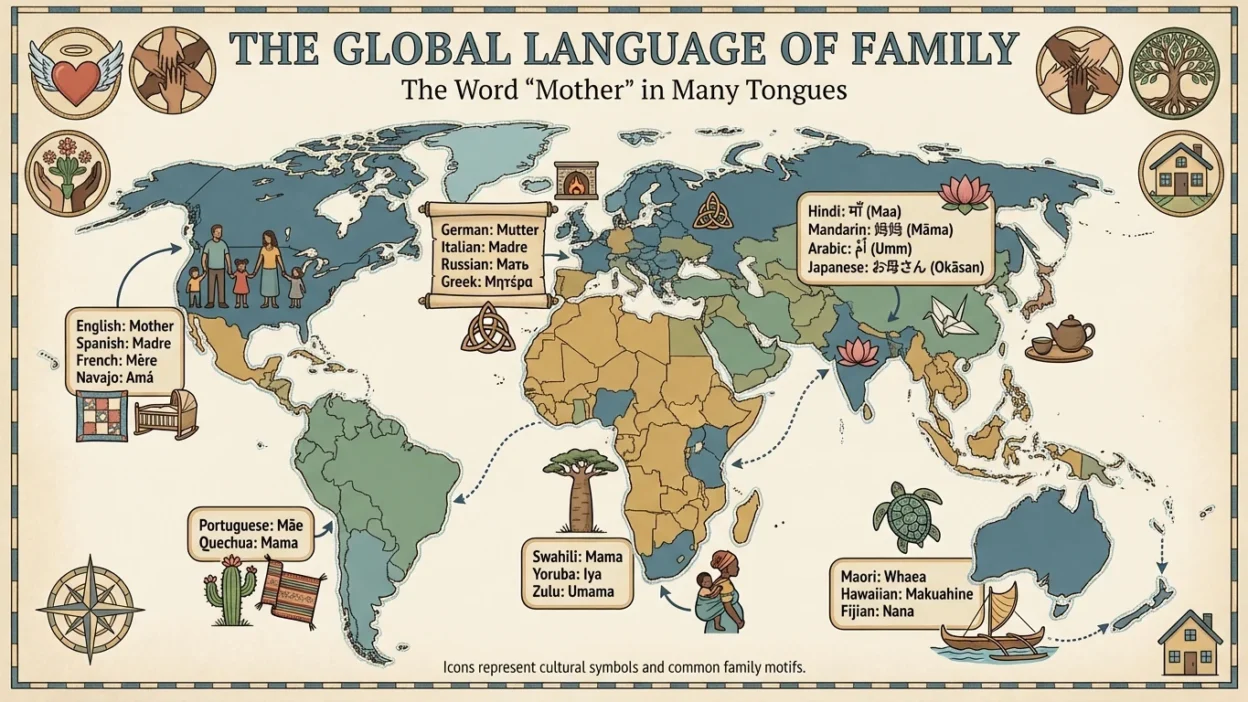
The word mother is one of the most meaningful and universal words in human language. It represents love, care, support, and family. Every culture has its own way of saying it, yet the emotion behind the word remains the same everywhere.
Learning how to say mother in different languages is interesting for language learners, travelers, and anyone curious about world cultures. It also helps people understand family vocabulary in global communication.
In this guide, you will discover mother in different languages, including pronunciation and example sentences that show how the word is used in daily conversation.
Mother in 70 Different Languages Around the World
| Language | Phrase & Pronunciation | Example Sentence |
|---|---|---|
| English | Mother (MUH-ther) | My mother is very kind. |
| Spanish | Madre (MA-dre) | Mi madre es muy amable. |
| French | Mère (mehr) | Ma mère est gentille. |
| German | Mutter (MOO-ter) | Meine Mutter ist nett. |
| Italian | Madre (MA-dre) | Mia madre è gentile. |
| Portuguese | Mãe (maing) | Minha mãe é incrível. |
| Dutch | Moeder (MOO-der) | Mijn moeder is lief. |
| Russian | Мать (mat) | Моя мать добрая. |
| Ukrainian | Мати (MA-ty) | Моя мати добра. |
| Polish | Matka (MAT-ka) | Moja matka jest dobra. |
| Czech | Matka (MAT-ka) | Moje matka je hodná. |
| Slovak | Matka (MAT-ka) | Moja matka je milá. |
| Hungarian | Anya (AN-ya) | Az én anyám kedves. |
| Romanian | Mamă (MA-ma) | Mama mea este bună. |
| Greek | Μητέρα (mi-TE-ra) | Η μητέρα μου είναι καλή. |
| Turkish | Anne (AN-ne) | Annem çok iyi. |
| Arabic | أم (umm) | أمي طيبة. |
| Hebrew | אמא (i-ma) | אמא שלי טובה. |
| Persian | مادر (ma-dar) | مادر من مهربان است. |
| Hindi | माँ (maa) | मेरी माँ बहुत अच्छी है। |
| Urdu | ماں (maa) | میری ماں بہت اچھی ہے۔ |
| Bengali | মা (ma) | আমার মা খুব ভালো। |
| Punjabi | ਮਾਂ (maa) | ਮੇਰੀ ਮਾਂ ਬਹੁਤ ਚੰਗੀ ਹੈ। |
| Gujarati | મા (maa) | મારી મા સારી છે. |
| Marathi | आई (aai) | माझी आई खूप चांगली आहे. |
| Tamil | அம்மா (am-ma) | என் அம்மா நல்லவர். |
| Telugu | అమ్మ (am-ma) | నా అమ్మ చాలా మంచిది. |
| Kannada | ಅಮ್ಮ (am-ma) | ನನ್ನ ಅಮ್ಮ ಒಳ್ಳೆಯವರು. |
| Malayalam | അമ്മ (am-ma) | എന്റെ അമ്മ നല്ലവളാണ്. |
| Sinhala | අම්මා (am-ma) | මගේ අම්මා හොඳයි. |
| Thai | แม่ (mae) | แม่ของฉันใจดี. |
| Vietnamese | Mẹ (meh) | Mẹ tôi rất tốt. |
| Indonesian | Ibu (ee-boo) | Ibu saya baik. |
| Malay | Ibu (ee-boo) | Ibu saya sangat baik. |
| Filipino | Nanay (na-nai) | Mabait ang nanay ko. |
| Chinese (Mandarin) | 妈妈 (ma-ma) | 我妈妈很好. |
| Japanese | 母 (haha) | 私の母は優しいです。 |
| Korean | 어머니 (eo-meo-ni) | 우리 어머니는 친절해요. |
| Mongolian | Ээж (eej) | Миний ээж сайн. |
| Swahili | Mama (MA-ma) | Mama yangu ni mzuri. |
| Zulu | Umama (oo-MA-ma) | Umama wami muhle. |
| Afrikaans | Ma (ma) | My ma is baie lief. |
| Somali | Hooyo (hoo-yo) | Hooyaday waa fiican. |
| Amharic | እናት (e-nat) | እናቴ ጥሩ ናት. |
| Hausa | Uwa (oo-wa) | Uwata tana da kirki. |
| Yoruba | Iya (ee-ya) | Iya mi dara. |
| Igbo | Nne (nne) | Nne m dị mma. |
| Danish | Mor (mor) | Min mor er sød. |
| Swedish | Mor (mor) | Min mor är snäll. |
| Norwegian | Mor (mor) | Moren min er snill. |
| Finnish | Äiti (ai-ti) | Äitini on hyvä. |
| Icelandic | Móðir (mo-thir) | Móðir mín er góð. |
| Estonian | Ema (e-ma) | Minu ema on hea. |
| Latvian | Māte (maa-te) | Mana māte ir laba. |
| Lithuanian | Motina (mo-ti-na) | Mano motina gera. |
| Serbian | Мајка (mai-ka) | Моја мајка је добра. |
| Croatian | Majka (mai-ka) | Moja majka je dobra. |
| Bosnian | Majka (mai-ka) | Moja majka je dobra. |
| Slovenian | Mati (ma-ti) | Moja mati je dobra. |
| Albanian | Nënë (ne-ne) | Nëna ime është e mirë. |
| Macedonian | Мајка (mai-ka) | Мојата мајка е добра. |
| Georgian | დედა (de-da) | ჩემი დედა კარგია. |
| Armenian | Մայր (mair) | Մայրիկս բարի է. |
| Kazakh | Ана (a-na) | Менің анам жақсы. |
| Uzbek | Ona (o-na) | Onam juda yaxshi. |
| Tajik | Модар (mo-dar) | Модари ман меҳрубон аст. |
| Nepali | आमा (aa-ma) | मेरी आमा राम्रो छिन्। |
| Khmer | ម្តាយ (m-dai) | ម្តាយខ្ញុំល្អណាស់. |
| Lao | ແມ່ (mae) | ແມ່ຂອງຂ້ອຍດີ. |
The Meaning of “Mother” in Different Languages
The word mother refers to a female parent and is one of the most fundamental family terms in every language. While pronunciation and spelling vary, the meaning remains consistent across cultures.
When exploring mother in all languages, you will notice that many languages use soft sounds such as ma, amma, mama, or maa, which are often among the first sounds babies learn to say.
How the Word Mother Is Used in Everyday Conversations
People use the word mother in many situations, including:
Talking about family members
Expressing love and respect
Celebrating special occasions like Mother’s Day
Introducing relatives in conversation
Learning mother translations around the world helps people understand family related vocabulary across cultures.
Why Learning Family Words in Different Languages Is Important
Family vocabulary is essential when learning any language. Knowing how to say mother in different languages helps in daily communication, cultural understanding, and building relationships with people from different backgrounds.
It is often one of the first words people learn when studying a new language.
Conclusion
The word mother carries deep emotional meaning in every culture. Although the pronunciation changes across languages, the love and respect associated with the word remain universal.
By learning mother in different languages, you gain insight into global cultures and expand your language knowledge.
FAQs
What is the word mother in different languages?
Examples include Madre (Spanish), Mère (French), Mutter (German), Maa (Hindi), and Mama (Chinese).
How do you say mother in 10 common languages?
English (Mother), Spanish (Madre), French (Mère), German (Mutter), Italian (Madre), Arabic (Umm), Hindi (Maa), Chinese (Mama), Japanese (Haha), and Turkish (Anne).
Why do many languages use sounds like “ma” for mother?
Linguists believe babies naturally produce the “ma” sound easily, which is why it appears in many languages.
Is mother the same word used in formal and informal situations?
Some languages have formal and informal variations for mother depending on context.
Why is learning family vocabulary important?
Family words are commonly used in everyday conversations and help build meaningful communication.