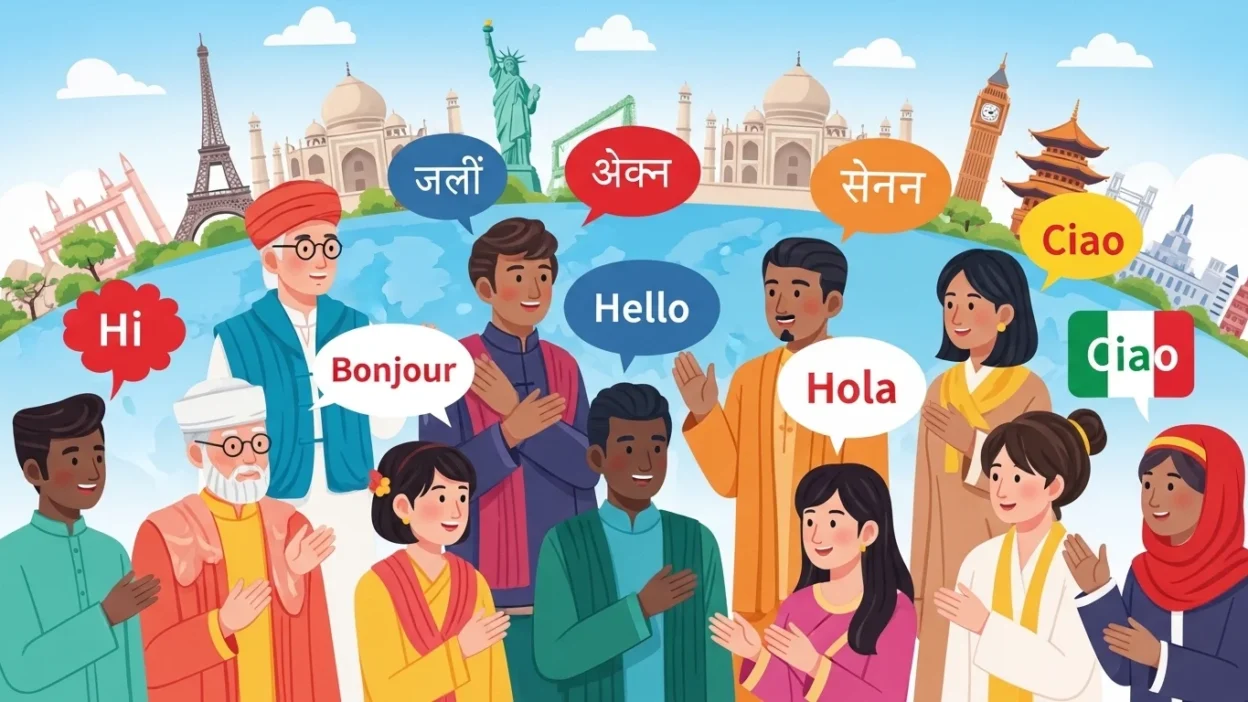
Saying “hi” is one of the simplest ways to connect with people anywhere in the world. Learning how to say hi in different languages not only improves your communication skills but also shows respect for different cultures.
In this guide, you’ll discover hi in all languages with easy pronunciation and real life examples. Whether you’re traveling, chatting online, or learning languages, these greetings will help you make a great first impression.
Hi in All Languages (70 Greetings Table)
| Language | Phrase | Example Sentence |
|---|---|---|
| English | Hi | Hi, how are you? (hai) |
| Spanish | Hola | Hola, ¿cómo estás? (oh-la) |
| French | Salut | Salut, ça va ? (sa-lu) |
| German | Hallo | Hallo, wie geht’s? (ha-lo) |
| Italian | Ciao | Ciao, come stai? (chow) |
| Portuguese | Olá | Olá, tudo bem? (o-la) |
| Dutch | Hoi | Hoi, hoe gaat het? (hoy) |
| Russian | Привет | Привет, как дела? (pri-vyet) |
| Polish | Cześć | Cześć, co słychać? (cheshch) |
| Turkish | Merhaba | Merhaba, nasılsın? (mehr-ha-ba) |
| Arabic | مرحبا | مرحبا كيف حالك؟ (mar-ha-ba) |
| Hindi | नमस्ते | नमस्ते, आप कैसे हैं? (na-mas-te) |
| Urdu | سلام | سلام، آپ کیسے ہیں؟ (salaam) |
| Bengali | হ্যালো | হ্যালো, কেমন আছো? (hello) |
| Chinese | 你好 | 你好,你好吗? (nee-hao) |
| Japanese | こんにちは | こんにちは、お元気ですか? (kon-ni-chi-wa) |
| Korean | 안녕하세요 | 안녕하세요, 잘 지내세요? (an-nyong-ha-se-yo) |
| Thai | สวัสดี | สวัสดี คุณเป็นอย่างไรบ้าง (sa-wat-dee) |
| Vietnamese | Xin chào | Xin chào, bạn khỏe không? (sin chow) |
| Indonesian | Halo | Halo, apa kabar? (ha-lo) |
| Malay | Hai | Hai, apa khabar? (hai) |
| Filipino | Kumusta | Kumusta ka? (koo-mus-ta) |
| Greek | Γεια | Γεια σου, τι κάνεις; (ya) |
| Swedish | Hej | Hej, hur mår du? (hey) |
| Norwegian | Hei | Hei, hvordan går det? (hey) |
| Danish | Hej | Hej, hvordan har du det? (hey) |
| Finnish | Hei | Hei, mitä kuuluu? (hey) |
| Czech | Ahoj | Ahoj, jak se máš? (a-hoy) |
| Slovak | Ahoj | Ahoj, ako sa máš? (a-hoy) |
| Hungarian | Szia | Szia, hogy vagy? (see-ya) |
| Romanian | Salut | Salut, ce faci? (sa-loot) |
| Bulgarian | Здравей | Здравей, как си? (zdrav-ey) |
| Serbian | Здраво | Здраво, како си? (zdravo) |
| Croatian | Bok | Bok, kako si? (bok) |
| Ukrainian | Привіт | Привіт, як справи? (pri-veet) |
| Hebrew | שלום | שלום, מה שלומך? (sha-lom) |
| Persian | سلام | سلام، حالت چطوره؟ (sa-laam) |
| Swahili | Hujambo | Hujambo, habari? (hoo-jam-bo) |
| Zulu | Sawubona | Sawubona, unjani? (sa-woo-bo-na) |
| Afrikaans | Hallo | Hallo, hoe gaan dit? (ha-lo) |
| Icelandic | Halló | Halló, hvernig hefurðu það? (ha-lo) |
| Irish | Dia dhuit | Dia dhuit, conas atá tú? (dee-a gwit) |
| Scottish Gaelic | Halò | Halò, ciamar a tha thu? (ha-lo) |
| Welsh | Helo | Helo, sut wyt ti? (he-lo) |
| Latvian | Sveiki | Sveiki, kā jums klājas? (svei-ki) |
| Lithuanian | Labas | Labas, kaip sekasi? (la-bas) |
| Estonian | Tere | Tere, kuidas läheb? (te-re) |
| Albanian | Përshëndetje | Përshëndetje, si je? (per-shen-de-tye) |
| Macedonian | Здраво | Здраво, како си? (zdravo) |
| Slovenian | Živjo | Živjo, kako si? (zheev-yo) |
| Georgian | გამარჯობა | გამარჯობა, როგორ ხარ? (ga-mar-jo-ba) |
| Armenian | Բարև | Բարև, ինչպես ես։ (ba-rev) |
| Mongolian | Сайн уу | Сайн уу, чи сайн уу? (sain uu) |
| Nepali | नमस्ते | नमस्ते, तपाईंलाई कस्तो छ? (na-mas-te) |
| Sinhala | ආයුබෝවන් | ආයුබෝවන්, කොහොමද? (aa-yu-bo-wan) |
| Khmer | សួស្តី | សួស្តី, សុខសប្បាយទេ? (suos-dey) |
| Lao | ສະບາຍດີ | ສະບາຍດີ, ເຈົ້າເປັນແນວໃດ (sa-bai-dee) |
| Burmese | မင်္ဂလာပါ | မင်္ဂလာပါ နေကောင်းလား (ming-ga-la-ba) |
| Malagasy | Salama | Salama, manao ahoana? (sa-la-ma) |
| Haitian Creole | Bonjou | Bonjou, kijan ou ye? (bon-zhoo) |
| Basque | Kaixo | Kaixo, zer moduz? (kai-sho) |
| Catalan | Hola | Hola, com estàs? (o-la) |
| Galician | Ola | Ola, como estás? (o-la) |
| Maltese | Bongu | Bongu, kif inti? (bon-goo) |
| Esperanto | Saluton | Saluton, kiel vi fartas? (sa-loo-ton) |
| Latin | Salve | Salve, quid agis? (sal-way) |
How to Say Hi in Different Languages Correctly
Pronunciation plays a big role when learning greetings. Some words like “hola” or “ciao” are widely recognized, while others like “sawubona” or “dia dhuit” may take practice.
Repeating greetings daily and using them in conversation helps build confidence quickly.
Hi Around the World: Cultural Meaning
Saying “hi” isn’t just about words it reflects culture. In some countries, greetings are formal and respectful, while in others they are casual and friendly. For example, “namaste” carries cultural respect, while “ciao” is informal and relaxed.
Understanding these differences helps you communicate more effectively.
Tips to Learn Hi in All Languages Faster
- Practice greetings daily
- Listen to native pronunciation
- Use greetings in real conversations
- Learn cultural context
These simple steps will help you master hi in different languages quickly.
Conclusion
Learning how to say hi in different languages is one of the easiest and most useful language skills.
With these 70 greetings, you can confidently connect with people from around the world and make a positive first impression.
FAQs
1. What is the most common way to say hi worldwide?
“Hello,” “hola,” and “ciao” are among the most widely recognized greetings.
2. How do you say hi formally in different languages?
Formal greetings vary, such as “namaste” in Hindi or “bonjour” in French.
3. Is hi the same in every language?
No, each language has its own unique greeting and pronunciation.
4. What is the easiest greeting to learn?
Words like “hi,” “hola,” and “hej” are simple and easy to remember.
5. Why is learning greetings important?
It helps build connections, show respect, and start conversations easily.