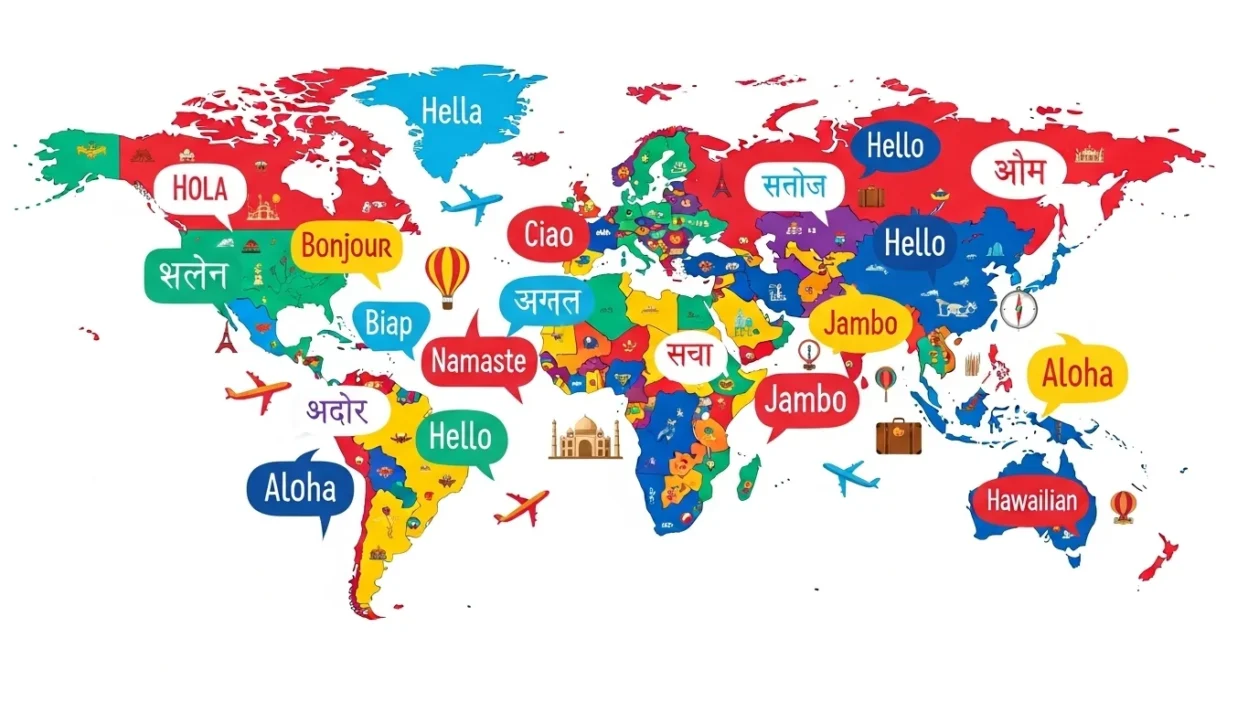
Saying hello is the first step to connection. If you’re searching for hola in different languages, you’re likely curious about how people greet each other across cultures. If you’re traveling, learning a new language, creating global content, or simply expanding your knowledge, understanding how to say hola in different languages helps you communicate with confidence.
In this complete guide, you’ll discover hola translations in all languages, along with pronunciation help and real life example sentences. Let’s explore how people say “hola” around the world.
Hola in All Languages 70 Global Greetings in One Table
Below is a clean, mobile-friendly table showing 70 languages, their native greeting, pronunciation, and a real-life example sentence with meaning.
| Language | Phrase (Pronunciation) | Example Sentence (English Meaning) |
|---|---|---|
| Spanish | Hola (OH-lah) | Hola, ¿cómo estás? (Hello, how are you?) |
| French | Bonjour (bon-ZHOOR) | Bonjour, mon ami. (Hello, my friend.) |
| German | Hallo (HAH-loh) | Hallo, wie geht’s? (Hello, how’s it going?) |
| Italian | Ciao (chow) | Ciao, come stai? (Hi, how are you?) |
| Portuguese | Olá (oh-LAH) | Olá, tudo bem? (Hello, everything good?) |
| Dutch | Hallo (HAH-loh) | Hallo, leuk je te zien. (Hello, nice to see you.) |
| Russian | Привет (pree-VYET) | Привет, как дела? (Hi, how are you?) |
| Chinese (Mandarin) | 你好 (nee how) | 你好,很高兴见到你。 (Hello, nice to meet you.) |
| Japanese | こんにちは (kon-nee-chee-wah) | こんにちは、お元気ですか? (Hello, are you well?) |
| Korean | 안녕하세요 (ahn-nyong-ha-se-yo) | 안녕하세요, 만나서 반갑습니다. (Hello, nice to meet you.) |
| Arabic | مرحبا (mar-ha-bah) | مرحبا، كيف حالك؟ (Hello, how are you?) |
| Hindi | नमस्ते (nah-mas-tay) | नमस्ते, आप कैसे हैं? (Hello, how are you?) |
| Bengali | হ্যালো (ha-lo) | হ্যালো, কেমন আছো? (Hello, how are you?) |
| Urdu | سلام (sa-laam) | سلام، آپ کیسے ہیں؟ (Hello, how are you?) |
| Turkish | Merhaba (mehr-ha-bah) | Merhaba, nasılsın? (Hello, how are you?) |
| Greek | Γεια σου (yah soo) | Γεια σου, τι κάνεις; (Hello, what are you doing?) |
| Polish | Cześć (cheshch) | Cześć, co słychać? (Hi, what’s up?) |
| Swedish | Hej (hey) | Hej, hur mår du? (Hi, how are you?) |
| Norwegian | Hei (hay) | Hei, hvordan går det? (Hi, how’s it going?) |
| Danish | Hej (hi) | Hej, hvordan har du det? (Hello, how are you?) |
| Finnish | Hei (hey) | Hei, mitä kuuluu? (Hi, what’s up?) |
| Icelandic | Halló (hat-loh) | Halló, hvernig hefurðu það? (Hello, how are you?) |
| Romanian | Salut (sah-loot) | Salut, ce faci? (Hi, what are you doing?) |
| Hungarian | Szia (see-yah) | Szia, hogy vagy? (Hi, how are you?) |
| Czech | Ahoj (ah-hoy) | Ahoj, jak se máš? (Hi, how are you?) |
| Slovak | Ahoj (ah-hoy) | Ahoj, čo robíš? (Hi, what are you doing?) |
| Ukrainian | Привіт (pree-veet) | Привіт, як справи? (Hi, how are things?) |
| Hebrew | שלום (sha-lom) | שלום, מה שלומך? (Hello, how are you?) |
| Thai | สวัสดี (sa-wat-dee) | สวัสดี, คุณเป็นอย่างไรบ้าง? (Hello, how are you?) |
| Vietnamese | Xin chào (sin chow) | Xin chào, bạn khỏe không? (Hello, are you well?) |
| Indonesian | Halo (hah-loh) | Halo, apa kabar? (Hello, how are you?) |
| Malay | Hai (hi) | Hai, apa khabar? (Hi, how are you?) |
| Filipino | Kumusta (koo-moos-tah) | Kumusta ka? (How are you?) |
| Swahili | Jambo (jam-boh) | Jambo, habari gani? (Hello, what’s the news?) |
| Zulu | Sawubona (sah-woo-boh-nah) | Sawubona, unjani? (Hello, how are you?) |
| Afrikaans | Hallo (hah-loh) | Hallo, hoe gaan dit? (Hello, how are you?) |
| Persian | سلام (sa-laam) | سلام، حال شما چطور است؟ (Hello, how are you?) |
| Punjabi | ਸਤ ਸ੍ਰੀ ਅਕਾਲ (sat sri akaal) | ਸਤ ਸ੍ਰੀ ਅਕਾਲ, ਕੀ ਹਾਲ ਹੈ? (Hello, how are you?) |
| Tamil | வணக்கம் (va-na-kam) | வணக்கம், எப்படி இருக்கிறீர்கள்? (Hello, how are you?) |
| Telugu | నమస్తే (nah-mas-tay) | నమస్తే, మీరు ఎలా ఉన్నారు? (Hello, how are you?) |
| Kannada | ನಮಸ್ಕಾರ (nah-mus-kah-ra) | ನಮಸ್ಕಾರ, ನೀವು ಹೇಗಿದ್ದೀರಿ? (Hello, how are you?) |
| Marathi | नमस्कार (nah-mus-kar) | नमस्कार, कसे आहात? (Hello, how are you?) |
| Gujarati | નમસ્તે (nah-mus-tay) | નમસ્તે, કેમ છો? (Hello, how are you?) |
| Sinhala | ආයුබෝවන් (ah-yu-bo-wan) | ආයුබෝවන්, ඔබ කොහොමද? (Hello, how are you?) |
| Nepali | नमस्ते (nah-mas-tay) | नमस्ते, तपाईंलाई कस्तो छ? (Hello, how are you?) |
| Burmese | မင်္ဂလာပါ (min-ga-la-ba) | မင်္ဂလာပါ, နေကောင်းလား? (Hello, are you well?) |
| Khmer | សួស្តី (soo-sday) | សួស្តី, សុខសប្បាយទេ? (Hello, are you fine?) |
| Lao | ສະບາຍດີ (sa-bai-dee) | ສະບາຍດີ, ເຈົ້າເປັນແນວໃດ? (Hello, how are you?) |
| Mongolian | Сайн байна уу (sain bain-oo) | Сайн байна уу, та сайн уу? (Hello, are you well?) |
| Armenian | Բարեւ (ba-rev) | Բարեւ, ինչպես ես? (Hello, how are you?) |
| Georgian | გამარჯობა (ga-mar-jo-ba) | გამარჯობა, როგორ ხარ? (Hello, how are you?) |
| Albanian | Përshëndetje (per-shen-det-ye) | Përshëndetje, si je? (Hello, how are you?) |
| Serbian | Zdravo (zdrah-voh) | Zdravo, kako si? (Hello, how are you?) |
| Croatian | Bok (bohk) | Bok, kako si? (Hi, how are you?) |
| Bulgarian | Здравей (zdravey) | Здравей, как си? (Hello, how are you?) |
| Lithuanian | Labas (lah-bahs) | Labas, kaip sekasi? (Hi, how’s it going?) |
| Latvian | Sveiki (svay-kee) | Sveiki, kā jums klājas? (Hello, how are you?) |
| Estonian | Tere (teh-reh) | Tere, kuidas läheb? (Hello, how’s it going?) |
| Basque | Kaixo (kai-sho) | Kaixo, zer moduz? (Hi, how are you?) |
| Catalan | Hola (oh-lah) | Hola, com estàs? (Hello, how are you?) |
| Galician | Ola (oh-lah) | Ola, que tal? (Hello, how are things?) |
| Maltese | Bongu (bon-goo) | Bongu, kif inti? (Hello, how are you?) |
| Haitian Creole | Bonjou (bon-joo) | Bonjou, kijan ou ye? (Hello, how are you?) |
| Somali | Salaan (sa-laan) | Salaan, sidee tahay? (Hello, how are you?) |
| Amharic | ሰላም (se-lam) | ሰላም, እንዴት ነህ? (Hello, how are you?) |
| Maori | Kia ora (kee-ah or-ah) | Kia ora, kei te pēhea koe? (Hello, how are you?) |
| Hawaiian | Aloha (ah-lo-ha) | Aloha, pehea ʻoe? (Hello, how are you?) |
How to Say Hola in Different Languages Correctly
Learning how to say hola in different languages is more than memorizing words. Focus on:
- Correct pronunciation
- Cultural context
- Formal vs informal greetings
- Body language and tone
For example, “Namaste” in Hindi is often accompanied by folded hands, while “Bonjour” in French is used mainly during the day.
Why Learning Hola Translations Matters
Understanding hola around the world helps you:
- Travel confidently
- Build international friendships
- Improve language learning
- Create culturally aware content
- Make better first impressions
A simple greeting in someone’s native language shows respect and effort.
Conclusion
Now you know 70 ways to say hola in all languages. From Europe to Asia, Africa to the Americas, every culture has its own beautiful greeting. Learning these hola translations is a small step that creates big connections.
Start using them today and make your world a little more global.
FAQs
1. What does hola mean in English?
Hola means “hello” or “hi” in English.
2. How do you say hola in different languages?
You can say Bonjour in French, Ciao in Italian, Namaste in Hindi, Jambo in Swahili, and many more listed above.
3. Is hola used in languages other than Spanish?
Yes. Catalan also uses “Hola,” and many languages have similar-sounding greetings.
4. What is the most universal way to say hello?
“Hello” in English and “Hola” in Spanish are widely understood globally.
5. Why should I learn hola translations?
Learning greetings improves communication, shows respect, and helps when traveling or doing business internationally.