
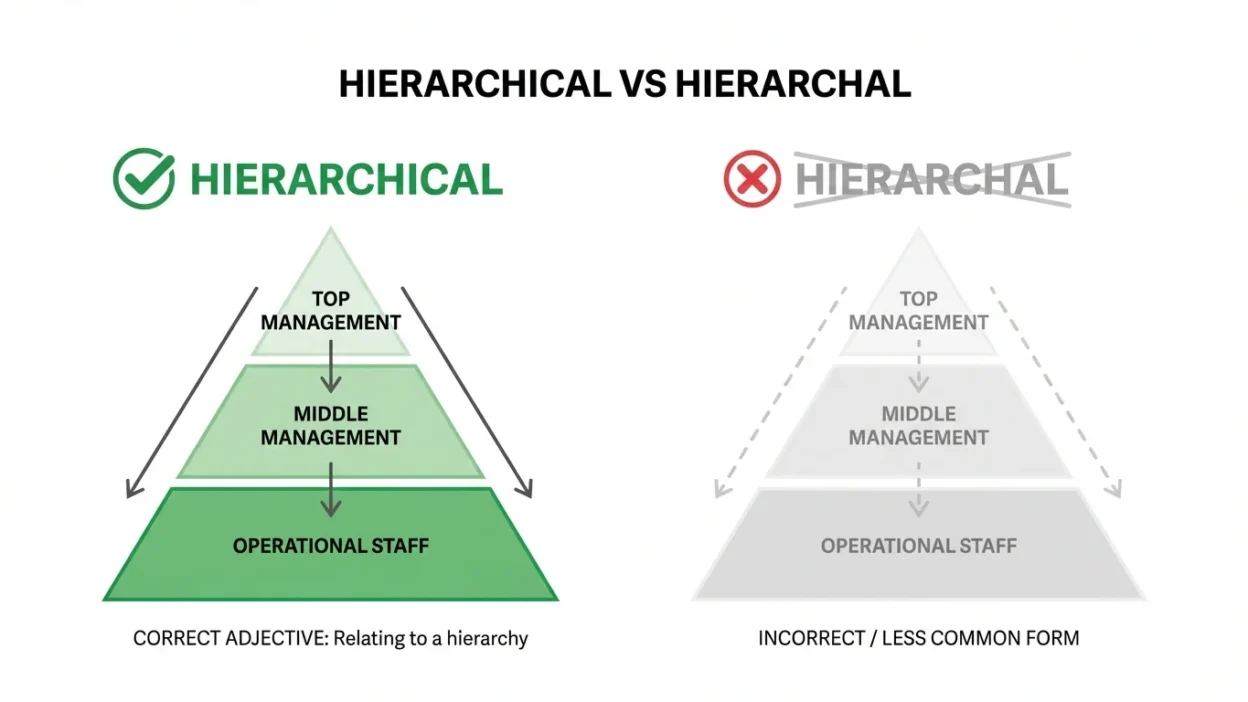
Have you ever hesitated between “hierarchical” and “hierarchal” while writing? You’re not alone. Both forms appear in writing, and because they look so similar, it’s easy to assume they’re interchangeable but one is clearly more standard.
In this guide, we’ll break down hierarchical vs hierarchal, explain the correct usage, show examples, and help you choose the best word confidently in any context.
Quick Answer
- ✅ Hierarchical is the correct and preferred spelling
- ⚠️ Hierarchal is accepted but less common
👉 Simple rule:
Always use hierarchical in formal, academic, and professional writing.
What Does “Hierarchical” Mean?
Hierarchical is an adjective that describes a system organized in levels or ranks, where some positions are above others.
Common Meanings
- Arranged by rank or authority
- Structured in levels (top to bottom)
- Organized in order of importance
Example Sentences
- The company has a hierarchical structure.
- Society was highly hierarchical in that era.
- The organization follows a hierarchical model of leadership.
👉 Tone: Formal, widely used in academic, business, and technical writing
What Does “Hierarchal” Mean?
Hierarchal has the same meaning as hierarchical, but it is a less common variant.
Example Sentences
- The system is hierarchal in nature.
- They studied the hierarchal structure of the organization.
👉 Tone: Correct but uncommon and sometimes avoided in formal writing
Hierarchical vs Hierarchal: Key Differences
The main difference is usage frequency and preference.
Comparison Table: Hierarchical vs Hierarchal
| Feature | Hierarchical | Hierarchal |
|---|---|---|
| Meaning | Organized by levels or rank | Same meaning |
| Correctness | ✔ Preferred | ✔ Acceptable |
| Usage Frequency | Very common | Less common |
| Tone | Standard, professional | Less formal/less typical |
| Recommendation | Use this | Avoid when possible |
Why “Hierarchical” Is Preferred
In modern English, hierarchical is the standard form used in:
- Academic writing
- Business and management contexts
- Technical and scientific discussions
It aligns directly with the noun hierarchy, making it feel more natural and widely accepted.
👉 Using hierarchical ensures clarity and professionalism.
When Should You Use “Hierarchical”?
Use hierarchical in almost all situations, especially when writing formally.
Best Situations
- Essays and research papers
- Workplace communication
- Reports and presentations
Examples
- “The company uses a hierarchical system.”
- “The data follows a hierarchical structure.”
👉 Think of hierarchical as the safe, standard choice.
When Can You Use “Hierarchal”?
You can use hierarchal, but it’s less common and may feel unusual to readers.
Best Situations
- Informal writing
- Personal preference (rare)
👉 However, it’s generally better to stick with hierarchical.
Common Mistakes to Avoid
1. Assuming Both Are Equally Common
While both are correct, hierarchical is far more widely used.
2. Using “Hierarchal” in Formal Writing
❌ The organization has a hierarchal system
✔ The organization has a hierarchical system
👉 Always choose the standard form in professional contexts.
3. Mixing Both Forms
❌ Using both spellings in one document
✔ Stick to hierarchical for consistency
Helpful Tip to Remember
👉 Hierarchy → Hierarchical (same root pattern)
Quick memory trick:
- If you know hierarchy, then hierarchical feels natural
- Hierarchal drops a syllable and feels incomplete
More Examples in Context
Hierarchical
- “The military follows a hierarchical chain of command.”
- “The file system is hierarchical.”
Hierarchal
- “They observed a hierarchal arrangement.” (less common)
Synonyms and Related Words
To improve your writing, consider these alternatives:
- Structured
- Ranked
- Layered
- Ordered
- Tiered
👉 These can help vary your language while keeping meaning clear.
Hierarchical vs Hierarchal in American and British English
- Both spellings are recognized in American and British English
- Hierarchical is strongly preferred in both
- No regional difference in preference
👉 Globally, hierarchical is the standard choice.
FAQs
1. Are hierarchical and hierarchal the same?
Yes, they have the same meaning, but hierarchical is more commonly used.
2. Which spelling is correct?
Both are correct, but hierarchical is the preferred standard.
3. Is “hierarchal” wrong?
No, but it is less common and may sound unusual.
4. Which should I use in academic writing?
Always use hierarchical.
5. Why is “hierarchical” more popular?
Because it aligns closely with the word hierarchy and is widely accepted.
6. Can I use “hierarchal” in professional writing?
It’s better to avoid it and use hierarchical instead.
7. Do they have different meanings?
No, their meanings are identical.
Summary
When comparing hierarchical vs hierarchal, both words technically have the same meaning describing something organized by levels or rank. However, hierarchical is the preferred and standard spelling used in modern English across professional, academic, and everyday contexts.
While hierarchal is not incorrect, it is far less common and may feel awkward to readers. Choosing hierarchical ensures your writing is clear, consistent, and professional.
Actionable Takeaway
Next time you write, remember:
👉 Hierarchy → Hierarchical (correct and standard)
👉 Hierarchal → less common, best avoided
Stick with hierarchical to keep your writing polished and accurate.