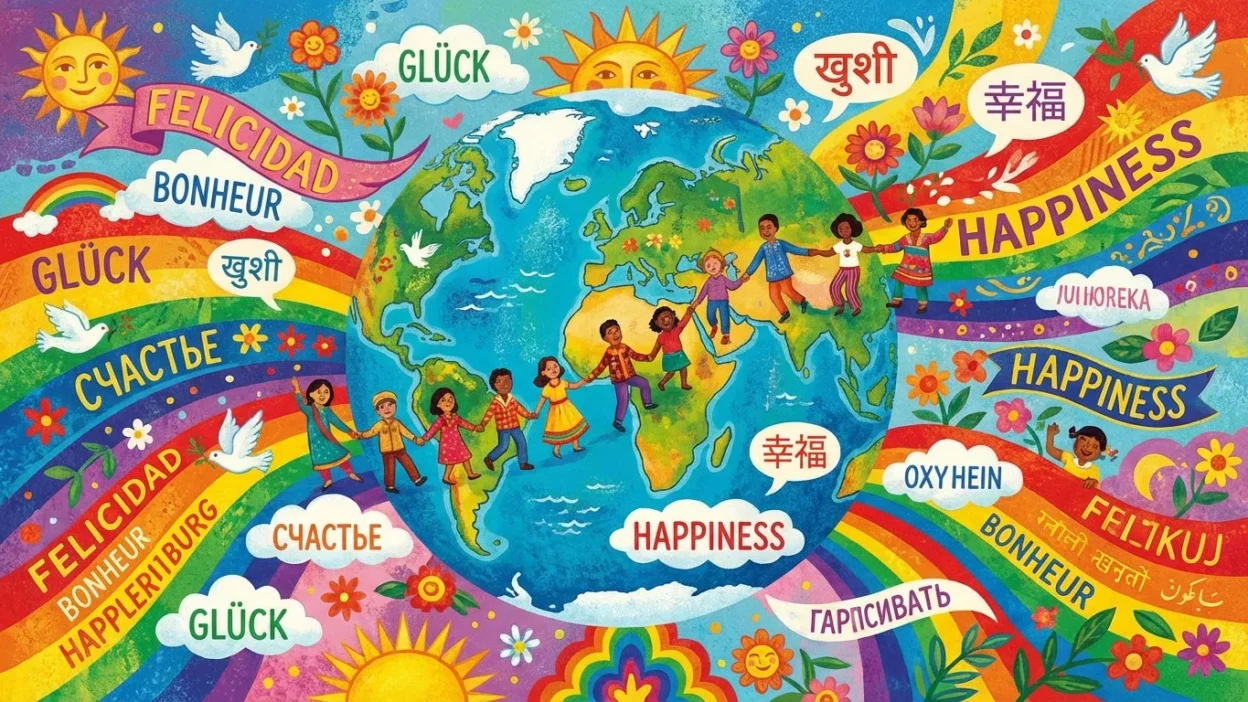
The word happiness represents joy, contentment, and emotional well-being. It’s a universal feeling that people everywhere understand, yet each language expresses it in its own unique and beautiful way.
Learning happiness in different languages helps you explore how cultures express joy and positivity. If you’re a language learner, traveler, or simply curious, this guide will show you how to say happiness in different languages, complete with pronunciation and real-life examples.
Happiness in 70 Different Languages Around the World
| Language | Phrase & Pronunciation | Example Sentence |
|---|---|---|
| English | Happiness (HAP-ee-ness) | Happiness comes from within. |
| Spanish | Felicidad (fe-lee-see-DAD) | La felicidad es importante. |
| French | Bonheur (bo-NEUR) | Le bonheur est précieux. |
| German | Glück (gluk) | Glück ist wichtig. |
| Italian | Felicità (fe-lee-chee-TA) | La felicità è importante. |
| Portuguese | Felicidade (fe-lee-see-DA-de) | A felicidade é tudo. |
| Dutch | Geluk (ghe-luk) | Geluk is belangrijk. |
| Russian | Счастье (schas-TYE) | Счастье важно. |
| Ukrainian | Щастя (shchas-TYA) | Щастя важливе. |
| Polish | Szczęście (shchen-SH-che) | Szczęście jest ważne. |
| Czech | Štěstí (shtes-TEE) | Štěstí je důležité. |
| Slovak | Šťastie (shchas-TEE-eh) | Šťastie je dôležité. |
| Hungarian | Boldogság (bol-dog-shaag) | A boldogság fontos. |
| Romanian | Fericire (fe-ree-CHE-re) | Fericirea este importantă. |
| Greek | Ευτυχία (ef-ti-HEE-a) | Η ευτυχία είναι σημαντική. |
| Turkish | Mutluluk (mut-lu-luk) | Mutluluk önemlidir. |
| Arabic | سعادة (sa-aa-da) | السعادة مهمة. |
| Hebrew | אושר (o-sher) | אושר חשוב. |
| Persian | خوشبختی (khosh-bakh-ti) | خوشبختی مهم است. |
| Hindi | खुशी (khu-shee) | खुशी महत्वपूर्ण है। |
| Urdu | خوشی (khu-shee) | خوشی اہم ہے۔ |
| Bengali | সুখ (sukh) | সুখ গুরুত্বপূর্ণ। |
| Punjabi | ਖੁਸ਼ੀ (khu-shee) | ਖੁਸ਼ੀ ਮਹੱਤਵਪੂਰਨ ਹੈ। |
| Gujarati | ખુશી (khu-shee) | ખુશી મહત્વપૂર્ણ છે. |
| Marathi | आनंद (aa-nand) | आनंद महत्त्वाचा आहे. |
| Tamil | மகிழ்ச்சி (ma-gil-chi) | மகிழ்ச்சி முக்கியம். |
| Telugu | ఆనందం (aa-nan-dam) | ఆనందం ముఖ్యమైనది. |
| Kannada | ಸಂತೋಷ (san-to-sha) | ಸಂತೋಷ ಮುಖ್ಯ. |
| Malayalam | സന്തോഷം (san-to-sham) | സന്തോഷം പ്രധാനമാണ്. |
| Sinhala | සතුට (sa-tu-ta) | සතුට වැදගත්. |
| Thai | ความสุข (khwam-suk) | ความสุขสำคัญ. |
| Vietnamese | Hạnh phúc (hanh phuk) | Hạnh phúc rất quan trọng. |
| Indonesian | Kebahagiaan (ke-ba-ha-gi-aan) | Kebahagiaan itu penting. |
| Malay | Kebahagiaan (ke-ba-ha-gi-aan) | Kebahagiaan penting. |
| Filipino | Kaligayahan (ka-li-ga-ya-han) | Ang kaligayahan ay mahalaga. |
| Chinese (Mandarin) | 幸福 (xing fu) | 幸福很重要. |
| Japanese | 幸せ (shi-a-wa-se) | 幸せは大切です。 |
| Korean | 행복 (haeng-bok) | 행복은 중요하다. |
| Mongolian | Аз жаргал (az jar-gal) | Аз жаргал чухал. |
| Swahili | Furaha (fu-ra-ha) | Furaha ni muhimu. |
| Zulu | Injabulo (in-ja-bu-lo) | Injabulo ibalulekile. |
| Afrikaans | Geluk (ghe-luk) | Geluk is belangrik. |
| Somali | Farxad (far-had) | Farxad waa muhiim. |
| Amharic | ደስታ (des-ta) | ደስታ አስፈላጊ ነው. |
| Hausa | Farin ciki (fa-rin chi-ki) | Farin ciki yana da muhimmanci. |
| Yoruba | Ayọ (a-yo) | Ayọ ṣe pataki. |
| Igbo | Obi ụtọ (o-bi u-to) | Obi ụtọ dị mkpa. |
| Danish | Lykke (lyk-ke) | Lykke er vigtigt. |
| Swedish | Lycka (lyk-ka) | Lycka är viktigt. |
| Norwegian | Lykke (lyk-ke) | Lykke er viktig. |
| Finnish | Onni (on-ni) | Onni on tärkeää. |
| Icelandic | Hamingja (ha-ming-ya) | Hamingja er mikilvæg. |
| Estonian | Õnn (onn) | Õnn on oluline. |
| Latvian | Laime (lai-me) | Laime ir svarīga. |
| Lithuanian | Laimė (lai-me) | Laimė yra svarbi. |
| Serbian | Срећа (sre-cha) | Срећа је важна. |
| Croatian | Sreća (sre-cha) | Sreća je važna. |
| Bosnian | Sreća (sre-cha) | Sreća je važna. |
| Slovenian | Sreča (sre-cha) | Sreča je pomembna. |
| Albanian | Lumturi (lum-tu-ri) | Lumturia është e rëndësishme. |
| Macedonian | Среќа (sre-kya) | Среќа е важна. |
| Georgian | ბედნიერება (bed-ni-e-re-ba) | ბედნიერება მნიშვნელოვანია. |
| Armenian | Երջանկություն (er-jan-ku-tyun) | Երջանկությունը կարևոր է. |
| Kazakh | Бақыт (ba-kyt) | Бақыт маңызды. |
| Uzbek | Baxt (bakht) | Baxt muhim. |
| Tajik | Хушбахтӣ (khush-bakh-ti) | Хушбахтӣ муҳим аст. |
| Nepali | खुशी (khu-shee) | खुशी महत्वपूर्ण छ। |
| Khmer | សុភមង្គល (so-phea-mong-kol) | សុភមង្គលសំខាន់. |
| Lao | ຄວາມສຸກ (khwam suk) | ຄວາມສຸກສຳຄັນ. |
The Meaning of “Happiness” in Different Languages
The word happiness refers to a state of joy, satisfaction, and emotional well-being. While different cultures may define it in unique ways, the feeling itself is shared by all.
When exploring happiness in all languages, you’ll notice that many words are connected to ideas like luck, peace, or inner joy.
How the Word Happiness Is Used in Everyday Life
People use the concept of happiness when talking about:
Emotions and mental well-being
Life goals and success
Relationships and family
Personal growth and positivity
Understanding happiness translations around the world helps express feelings more deeply across cultures.
Why Learning Positive Words in Different Languages Is Important
Learning how to say happiness in different languages can inspire positivity and improve communication. It allows you to express emotions clearly and connect with people on a deeper level.
Positive vocabulary is essential in both personal and social interactions.
Conclusion
The word happiness is one of the most meaningful words across all cultures. Although languages express it differently, the feeling remains universal.
By learning happiness in different languages, you gain a deeper appreciation of global cultures and emotional expression.
FAQs
What is happiness in different languages?
Examples include Felicidad (Spanish), Bonheur (French), Glück (German), Khushi (Hindi), and 幸福 (Chinese).
How do you say happiness in 10 common languages?
English (Happiness), Spanish (Felicidad), French (Bonheur), German (Glück), Italian (Felicità), Arabic (Sa’ada), Hindi (Khushi), Chinese (Xing Fu), Japanese (Shiawase), and Turkish (Mutluluk).
Do all languages have the same meaning for happiness?
Not exactly; some connect it with luck, peace, or success.
Why is happiness an important word to learn?
It helps express emotions and improves communication across cultures.
Can happiness have different cultural meanings?
Yes, different cultures may define happiness based on values, traditions, and beliefs.