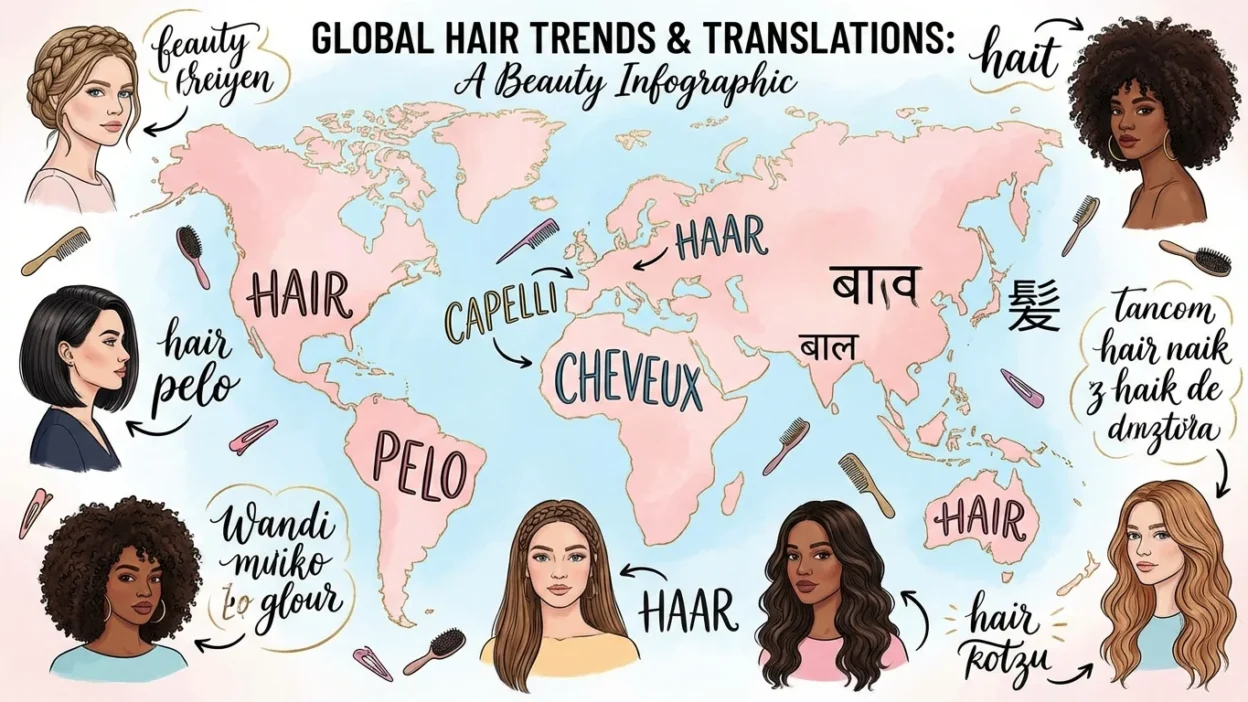
The word hair is commonly used in everyday conversation to describe the strands growing on the human head or body. It can also relate to beauty, style, culture, and identity. While the concept is universal, every language has its own unique word for it.
Learning hair in different languages is useful for travelers, language learners, and anyone interested in global cultures.
It also helps in practical situations like visiting salons, describing appearance, or shopping for beauty products. In this guide, you’ll discover 70 hair translations around the world, along with pronunciation and simple example sentences.
Hair in 70 Different Languages Around the World
| Language | Phrase & Pronunciation | Example Sentence |
|---|---|---|
| English | Hair (hair) | Her hair is very long. |
| Spanish | Cabello (ka-BE-yo) | Su cabello es largo. |
| French | Cheveux (she-VOO) | Ses cheveux sont longs. |
| German | Haare (HA-re) | Ihre Haare sind lang. |
| Italian | Capelli (ka-PEL-li) | I suoi capelli sono lunghi. |
| Portuguese | Cabelo (ka-BE-lo) | O cabelo dela é longo. |
| Dutch | Haar (haar) | Haar haar is lang. |
| Russian | Волосы (va-LO-sy) | У неё длинные волосы. |
| Ukrainian | Волосся (vo-LO-sya) | У неї довге волосся. |
| Polish | Włosy (VWO-sy) | Jej włosy są długie. |
| Czech | Vlasy (VLA-sy) | Její vlasy jsou dlouhé. |
| Slovak | Vlasy (VLA-sy) | Jej vlasy sú dlhé. |
| Hungarian | Haj (hai) | A haja hosszú. |
| Romanian | Păr (par) | Părul ei este lung. |
| Greek | Μαλλιά (ma-LYA) | Τα μαλλιά της είναι μακριά. |
| Turkish | Saç (sach) | Saçı çok uzun. |
| Arabic | شعر (sha-ar) | شعرها طويل. |
| Hebrew | שיער (se-ar) | השיער שלה ארוך. |
| Persian | مو (moo) | موی او بلند است. |
| Hindi | बाल (baal) | उसके बाल लंबे हैं। |
| Urdu | بال (baal) | اس کے بال لمبے ہیں۔ |
| Bengali | চুল (chul) | তার চুল লম্বা। |
| Punjabi | ਵਾਲ (vaal) | ਉਸਦੇ ਵਾਲ ਲੰਮੇ ਹਨ। |
| Gujarati | વાળ (vaal) | તેના વાળ લાંબા છે. |
| Marathi | केस (kes) | तिचे केस लांब आहेत. |
| Tamil | முடி (mu-di) | அவளுடைய முடி நீளமாக உள்ளது. |
| Telugu | జుట్టు (jut-tu) | ఆమె జుట్టు పొడవుగా ఉంది. |
| Kannada | ಕೂದಲು (koo-da-lu) | ಅವಳ ಕೂದಲು ಉದ್ದವಾಗಿದೆ. |
| Malayalam | മുടി (mu-di) | അവളുടെ മുടി നീളം ആണ്. |
| Sinhala | කෙස් (kes) | ඇගේ කෙස් දිගයි. |
| Thai | ผม (phom) | ผมของเธอยาว. |
| Vietnamese | Tóc (tok) | Tóc của cô ấy dài. |
| Indonesian | Rambut (ram-but) | Rambutnya panjang. |
| Malay | Rambut (ram-but) | Rambutnya panjang. |
| Filipino | Buhok (bu-hok) | Mahaba ang buhok niya. |
| Chinese (Mandarin) | 头发 (tou fa) | 她的头发很长. |
| Japanese | 髪 (ka-mi) | 彼女の髪は長いです。 |
| Korean | 머리카락 (meo-ri-ka-rak) | 그녀의 머리카락은 길다. |
| Mongolian | Үс (us) | Түүний үс урт. |
| Swahili | Nywele (ny-we-le) | Nywele zake ni ndefu. |
| Zulu | Izinwele (i-zin-we-le) | Izinwele zakhe zinde. |
| Afrikaans | Hare (ha-re) | Haar hare is lank. |
| Somali | Timo (ti-mo) | Timaha waa dheer. |
| Amharic | ጸጉር (tse-gur) | ጸጉሯ ረጅም ነው. |
| Hausa | Gashi (ga-shi) | Gashinta yana da tsawo. |
| Yoruba | Irun (ee-run) | Irun rẹ gun. |
| Igbo | Isi ntutu (i-si n-tu-tu) | Isi ntutu ya dị ogologo. |
| Danish | Hår (hor) | Hendes hår er langt. |
| Swedish | Hår (hor) | Hennes hår är långt. |
| Norwegian | Hår (hor) | Håret hennes er langt. |
| Finnish | Hiukset (hee-uk-set) | Hänen hiuksensa ovat pitkät. |
| Icelandic | Hár (haur) | Hárið hennar er langt. |
| Estonian | Juuksed (yook-sed) | Tema juuksed on pikad. |
| Latvian | Mati (ma-ti) | Viņas mati ir gari. |
| Lithuanian | Plaukai (plau-kai) | Jos plaukai ilgi. |
| Serbian | Коса (ko-sa) | Њена коса је дуга. |
| Croatian | Kosa (ko-sa) | Njezina kosa je duga. |
| Bosnian | Kosa (ko-sa) | Njena kosa je duga. |
| Slovenian | Lasje (la-sye) | Njeni lasje so dolgi. |
| Albanian | Flokë (flo-ke) | Flokët e saj janë të gjatë. |
| Macedonian | Коса (ko-sa) | Нејзината коса е долга. |
| Georgian | თმა (tma) | მისი თმა გრძელია. |
| Armenian | Մազ (maz) | Նրա մազերը երկար են. |
| Kazakh | Шаш (shash) | Оның шашы ұзын. |
| Uzbek | Soch (soch) | Uning sochi uzun. |
| Tajik | Мӯй (muy) | Мӯи ӯ дароз аст. |
| Nepali | कपाल (ka-pal) | उसको कपाल लामो छ। |
| Khmer | សក់ (sak) | សក់របស់នាងវែង. |
| Lao | ຜົມ (phom) | ຜົມຂອງນາງຍາວ. |
The Meaning of “Hair” in Different Languages
The word hair refers to the strands that grow on the human head or body. It is often associated with personal style, identity, and cultural expression.
When exploring hair in all languages, you’ll notice that some languages use different words depending on whether it refers to head hair or body hair.
How the Word Hair Is Used in Everyday Conversations
People commonly use the word hair when talking about:
Appearance and beauty
Haircuts and styling
Health and care
Fashion and trends
Understanding hair translations around the world helps in everyday conversations, especially in salons or while describing someone’s look.
Why Learning Beauty Vocabulary in Different Languages Is Useful
Beauty-related words are commonly used in daily life. Knowing how to say hair in different languages is helpful when traveling, shopping, or communicating about personal care.
It also improves vocabulary in a practical and relatable way.
Conclusion
The word hair is simple yet important in everyday communication. While each language expresses it differently, the meaning remains universal.
By learning hair in different languages, you expand your vocabulary and improve your ability to communicate about appearance and style worldwide.
FAQs
What is hair in different languages?
Examples include Cabello (Spanish), Cheveux (French), Haare (German), Saç (Turkish), and 头发 (Chinese).
How do you say hair in 10 common languages?
English (Hair), Spanish (Cabello), French (Cheveux), German (Haare), Italian (Capelli), Arabic (Sha’ar), Hindi (Baal), Chinese (Tou Fa), Japanese (Kami), and Turkish (Saç).
Do all languages use one word for hair?
No, some languages have different words for head hair and body hair.
Why is hair vocabulary important?
It is commonly used in daily conversations related to appearance and grooming.
Is hair a commonly used word in language learning?
Yes, it is part of basic vocabulary and frequently used in everyday life.